

Quick answer
An electrician’s website costs £299 flat (custom one-pager) or from £499 (full site, page per service) in 2026, same tiers as any trade. What’s different in this trade is which pages earn: the EV-charger page is currently the best growth URL in domestic electrics, EICR/landlord-certificate pages tap steady legally-driven demand, and your competent-person scheme registration (NICEIC/NAPIT) is a display-it-everywhere trust asset. Build around those three and the site earns; build a generic “electrical services” brochure and it decorates.
Route decision in two minutes
Cut through the tiers with three questions. Is one service genuinely your business? An EV-charger specialist or an EICR-focused outfit can win with a razor-sharp £299 one-pager, specialism is the exception to the multi-page rule. Do you sell three-plus distinct services people search separately? That’s the from-£499 custom build; every merged service is a ranking forfeited. Is cashflow the blocker, not conviction? The £79/month route exists for exactly that, ownership at the end included. And whichever tier: the Business Profile comes first or alongside, for “electrician near me” searches the Map Pack is the front line, and it feeds the site its warmest visitors.
What it costs to keep (running costs, honestly)
After the build: managed hosting around £20/month (updates, backups, security, non-optional for a site holding your lead flow), the domain’s £10–£20/year, and content upkeep that’s genuinely light: new job photos quarterly, prices checked when yours change, the odd new accreditation added. No retainer required at this scale, though when you’re ready to chase rankings beyond your name and town, that’s the SEO conversation, and it’s optional precisely because the foundation pages keep earning without it.
The three pages that earn (electrician edition)
EV chargers. “EV charger installation [town]” is the rare trade search that’s growing fast, converts at four-figure job values, and hasn’t yet been locked up by decade-old competitor pages. A proper page, brands you fit, typical supply-and-fit prices, real installation photos, the DNO-notification bit handled plainly, routinely becomes an installer’s top earner within months. EICRs and landlord certificates. Legally-driven, deadline-driven demand from customers who own portfolios: state your price band, turnaround, and a booking route (agents book in bulk, make it easy), and one ranking page compounds into repeat commercial relationships. Rewires and consumer units. The classic big-ticket searches, comparison-shopped over days, won by photos of tidy boards (genuinely: neat consumer-unit photos are the trade’s portfolio currency), clear process explanation, and visible certification. Each needs its own URL, the one-page format’s honest limit, which is what the £499 tier exists for.
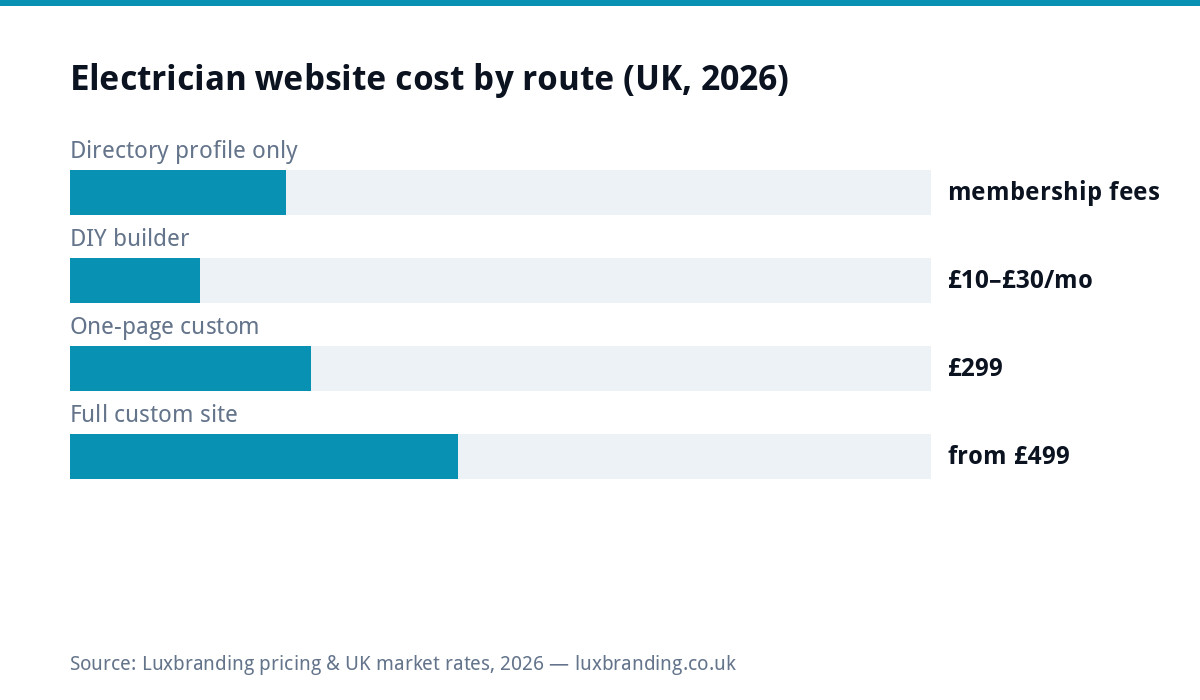
Route by route
| Route | Cost | Right when | Electrics-specific note |
|---|---|---|---|
| Directory only | Membership + fees | Filling the diary week one | EV and EICR searches increasingly bypass directories, owned pages capture them |
| DIY builder | £10–£30/mo | Placeholder stage | Certification display and service pages usually end up half-done |
| One-page custom | £299 | Focused niche (e.g. EV-only installer) | A specialist one-pager can genuinely be complete |
| Full custom | from £499 | Domestic + commercial mix, multiple earning pages | The EV/EICR/rewire trio wants separate URLs |
Certification: display it like it matters (because customers check)
Electrical work is the trade where “is this person qualified?” is a safety question, and the industry has trained customers to verify: NICEIC and NAPIT both run public find-a-contractor registers. Your site should make checking effortless, scheme logo and registration number in the header or footer of every page, a line on what Part P means for domestic work, and any specialist accreditations (EV charger schemes, fire-alarm, solar) on their service pages. Two practical notes: use the scheme’s current logo per their brand rules (they audit), and put the registration number as TEXT, not just an image, it’s what customers copy-paste into the register search. This is exactly the trust layer that separates you from the unregistered handyman quoting half your price, make the difference visible instead of hoping it’s assumed. The universal conversion kit (tappable phone, real photos, areas, reviews) applies as everywhere, see the general trades guide, but in this trade, credentials lead.
Photos that sell electrical work (yes, they exist)
Electrics seems unphotogenic until you know what customers look for. The consumer-unit glow-up, old fuse box vs your labelled, tidy replacement, is the trade’s before/after money shot; homeowners understand it instantly. Cable management on commercial jobs signals professionalism to facilities buyers the way a clean van does to homeowners. EV charger installs photograph beautifully (recognisable hardware, tidy runs, happy driveway) and populate the exact page that earns. Add one photo of you or the team with the van, and the certificate wall if you have one. What to skip: dark loft shots, wire spaghetti (even mid-job), and stock images of hard-hatted models, instantly recognised, instantly distrusted. Fifteen genuine photos from your camera roll, chosen this way, outperform any template gallery, the same rule as every trade, with the trade’s own money shots.
Payback, honestly sketched
Same hypothetical discipline as our other trade guides: £550-ish all-in for site + profile. An EV charger page that lands two installs a month at typical four-figure job values repays the build weekly, not yearly, which is why we call it the first page to build for any installer. EICR work compounds differently: rank for it, land three landlords, and their portfolios (plus renewal cycles) turn one page into a standing income line. Rewires arrive slower, comparison-shopped, bigger, rarer, but a single one covers the whole digital stack. The honest caveats: competitive cities take longer than towns, rankings need their first quarter to mature, and none of it excuses slow review-collection, which remains the cheapest ranking fuel in local trades. Shape, not promises: slow first months, then owned, compounding demand, with every price on the price list.
Content to gather before briefing (electrician’s edition)
Same rule as every trade: builds stall on materials. Assemble first: scheme registration number and logo permissions; the service split as customers search it (EV chargers / EICRs / rewires / fault-finding / commercial); from-prices where you’ll stand behind them (EICR bands by bedroom count work well); consumer-unit before/afters and charger installs from your camera roll; coverage areas; and your best reviews verbatim. An evening’s work, and it’s the difference between a five-day build and a five-week one.
Commercial work: the quiet second website audience
If you take commercial contracts, shop fits, office maintenance, landlord portfolios, remember the buyer changes: facilities managers and agents shortlist from desks, in office hours, comparing paperwork as much as price. For them your site needs: public-liability insurance level stated, commercial references or recognisable job types, response/callback commitments, and RAMS/compliance language that signals you’ve done procurement before. It’s one extra page (£0 marginal in a custom build) that qualifies you for a work stream template trade sites silently forfeit. Pair it with the Business Profile (commercial buyers check reviews too) One more electrician-specific note: date-stamp your certification page mentions, because scheme memberships lapse and a 2023 badge on a 2026 site invites exactly the wrong question from a careful customer. and the owned stack, site, profile, van-ready logo, comes in around one quiet month’s directory spend, every price public on the price list.
Get the UK Website Project Brief Template (free)
A 2-page template for briefing any UK web designer — sitemap, integrations, audience, deliverables. Cuts revision rounds in half.
No spam. Unsubscribe any time. UK GDPR compliant — your email is only used to send this resource.
Frequently asked questions
How much does an electrician's website cost in the UK? +
A custom one-page site is £299; a full site from £499 with separate pages for rewires, EV chargers, EICRs and emergency work — the structure that lets each service rank. DIY builders run £10–£30/month ongoing.
What certifications should an electrician show on their website? +
Your competent-person scheme (NICEIC, NAPIT, ELECSA) with registration number prominently displayed — customers are told to look for it and it's checkable. Add Part P compliance wording for domestic work and any EV-charger installer accreditations (OZEV-era schemes, manufacturer approvals).
Is an EV charger page worth having? +
It's currently the strongest growth page in the trade: "EV charger installation [town]" has real volume, commercial intent and less competition than rewiring terms. If you install chargers, a dedicated page with brands fitted, typical prices and photos is the first page to build.
What about landlord certificates (EICR) — do they need their own page? +
Yes. EICR/landlord-certificate searches are steady, legally-driven demand from a repeat-customer group (landlords and agents own multiple properties). A page stating turnaround, price band and booking route converts them — and one landlord relationship is worth many one-off jobs.
Do electricians get emergency search traffic like plumbers? +
Some — power cuts, tripping boards, burning smells — though less than plumbing. If you offer emergency response it deserves a page with tappable phone and honest availability; if you don't, say so and win the planned-work searches instead.


