Quick answer
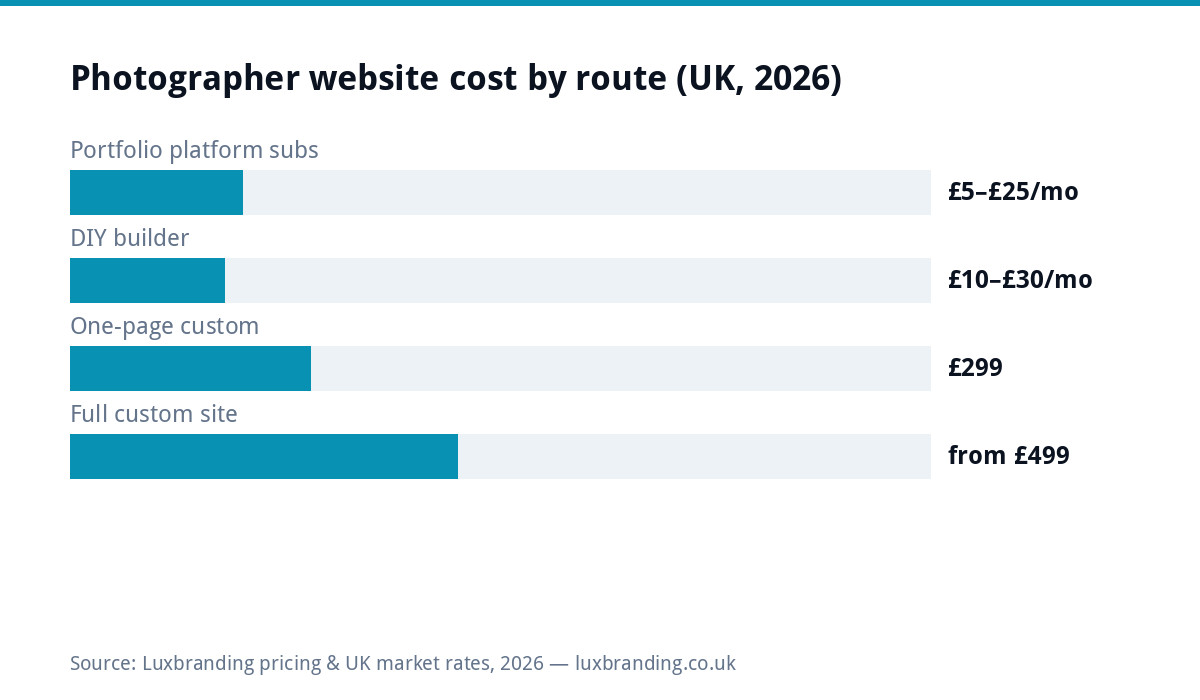
A photographer’s website costs £299 as a custom one-pager or from £499 with genre galleries and a pricing page; portfolio platforms rent similar display for £5 to £25/month without the local rankings that actually book work. The sector’s three deciders, covered below: curation beats volume, speed beats resolution, and the from-price question answers itself once you price the enquiries silence loses.
The platform question, answered honestly
Portfolio platforms (Format, Squarespace-for-photographers, and kin at their published £5 to £25/month) do display beautifully, and for photographers whose work arrives by referral and social, they are a legitimate shopfront. What they structurally cannot do is win “family photographer [town]” or “headshots [city]”: generic subdomains and template structures rank weakly, and the platform’s SEO ceiling is the same builder ceiling wearing nicer clothes. The owned site’s case is exactly those searches: local, commercial, comparison-shopped, and winnable with genre pages plus the Business Profile the platforms ignore. Many photographers sensibly run both for a season, then notice which one books strangers.
Route by route for photographers
| Route | What you pay | Right for | The catch |
|---|---|---|---|
| Portfolio platform | £5 to £25/mo published | Referral-fed photographers; second-shooter stage | Displays work, wins few strangers; fees forever |
| DIY builder | £10 to £30/mo | Testing a genre pivot cheaply | Gallery templates + huge files = the classic slow site |
| One-page custom | £299 | Single-genre specialists (headshots, newborn, events) | One ranking theme, which suits one-genre perfectly |
| Full custom | from £499 | Multi-genre working photographers | Genre pages need YOUR curation decisions first |
Curation and speed: the two levers that book work
Curation. The portfolio paradox: more images, weaker portfolio. Galleries of 8 to 15 per genre, opened by your two strongest frames, signal a photographer who knows their best work; two hundred images signal someone hoping the client will find it. Curate per genre for the CLIENT’s decision (“will my wedding look like this?”), not for peer applause, and retire images ruthlessly as better ones arrive. Speed. Photographer sites are reliably the slowest in local business, because full-resolution exports go straight to the web: 8MB frames, mobile agony, bookings lost to the back button. Export web-sized (long edge ~2000px, 200 to 400KB), let the site serve modern formats, and test on PageSpeed Insights after every gallery update; screens cannot show the resolution being sacrificed, but clients absolutely feel the load time. Web-export discipline is half of what the speed guide fixes on photographer sites.
Pricing pages, genres, and the enquiry machinery
From-prices, published. Photography’s price-silence tradition costs more than it protects: the comparison-shopping majority (which is weddings, families, headshots, almost everything) shortlists from sites that say “weddings from £950” and skips the mystery. Packages can stay for the call; the floor goes on the site, the same published-price mechanics as every vertical in this series and our own price list. Genre pages, not one blended gallery: “newborn photographer [town]” and “corporate headshots [city]” are different searches, different buyers, different pages, which is the from-£499 build’s whole argument. The enquiry form that qualifies: date, venue/location, genre, rough budget band; four fields that turn “how much?” emails into half-booked calls. Availability honesty (“booking spring 2027 weddings now”) converts urgency the vague never harvest.
Mini-sessions and the calendar page (the recurring-revenue lever)
For family, pet and portrait photographers, the highest-ROI page after the genre galleries is the dated events page: autumn mini-sessions, Christmas sets, spring bluebell weekends, each with date, location, price and a book-now route. Dated scarcity converts browsers who would otherwise “think about it” forever, the page re-earns every season with an edit rather than a rebuild, and the mailing list it feeds (past clients told first) sells out the best slots before the public sees them. It is the photographer’s version of the booking economics every service business runs, and on the from-£499 build it is one template page reused each season, which is about as close to compound interest as a portfolio site gets.
Client galleries and delivery (the part platforms actually do well)
Separating two jobs untangles most photographer-website confusion: the MARKETING site (this guide: wins strangers, ranks locally, converts enquiries) and CLIENT DELIVERY (proofing galleries, downloads, print sales), which dedicated gallery services genuinely do well and cheaply. The clean stack most working photographers land on: owned marketing site at £299 to £499 (the one-page build or full custom) doing the ranking and converting, plus a delivery platform at its published subscription doing proofing and sales, linked from a simple “client login” corner. What to avoid is the inversion: a delivery platform’s profile page doing marketing duty, which is how photographers end up invisible for every local search while paying monthly for beautiful galleries nobody finds. The marketing site is the shop window; the gallery service is the back room, and neither substitutes for the other.
Enquiry to booking: stop the leak after the click
Photographer enquiry handling leaks bookings at two known points. Speed: wedding enquiries especially go to multiple photographers in one sitting, and the first warm, specific reply (not a price list PDF cannon) frames the decision, so an acknowledgement within hours with one personal line (“Your venue is gorgeous, I shot there in May”) converts disproportionately. And deposits: a date is inventory, and unreserved dates evaporate, so the booking flow should move smoothly from enquiry to call to contract-and-deposit, stated plainly on the site (“dates secured with a signed agreement and £200 deposit”), which serious couples find reassuring rather than presumptuous. Both behaviours cost nothing; both out-earn most portfolio agonising, which is the recurring lesson of every vertical in this series.
The stack and the season
Site £299 to £499, profile £199 (reviews with genre keywords are photographer gold: ask happy couples to mention “wedding” and the venue), a brand that does not fight the work (£129 if the current one does), and blogging real shoots with venue names, the sector’s honest local-SEO cheat code, since “photos at [venue]” searches convert couples booked at that venue. Timing: weddings book 12 to 18 months ahead with enquiry surges after Christmas engagements and summer; families surge for autumn mini-sessions and Christmas. Build in YOUR off-season so the surge lands on settled rankings; the £79/month route exists when the off-season is also the thin one. Everything, as ever, on the price list.
For the whole market in one place, from DIY builders to full agency builds and the running costs after launch, see how much a website costs across the UK.
The about page that books (photographer edition)
In most sectors the about page is furniture; in photography it converts, because clients are hiring a person to be present at something intimate, and “will I like having them around” is a real criterion. The version that works: one good photo of you (by another photographer, the shoemaker’s-shoes test), a paragraph in your actual voice about how you shoot (documentary and unobtrusive, or directed and playful), and the practical reassurances woven in naturally (backup gear, insurance, how delivery works). Skip the awards paragraph unless clients’ venues would recognise them. Ten sentences that sound like you outperform any manifesto, and they finish the persuasion the galleries started.
The working summary: platforms display, owned sites get found; curate small and export light; publish the from-prices; page per genre; and let the seasonal calendar time both the build and the mini-session engine. A photographer’s site has one job, turning strangers who searched into booked calls, and every recommendation above exists only because it measurably serves that job.
Get the UK Website Project Brief Template (free)
A two-page template for briefing any UK web designer: sitemap, integrations, audience and deliverables. Cuts revision rounds in half.
No spam. UK GDPR compliant. We only use your email to send this resource, unless you tick the box to hear from us.
Frequently asked questions
How much does a photographer's website cost in the UK? +
Portfolio platforms run £5 to £25 a month at published rates; a custom one-page site is £299; a full site with genre and pricing pages from £499. The custom routes end subscriptions and rank locally, which platforms barely attempt.
Is a portfolio platform enough for a working photographer? +
For showing work to people you send there, yes. For being FOUND ("wedding photographer [county]"), rarely: platform profiles compete on the platform's terms and generic subdomains rank weakly. Working photographers earning from local searches need an owned site.
Should photographers publish prices on their websites? +
At least from-prices per genre. "Weddings from £950" filters and reassures; total price-silence loses the comparison-shopping majority and attracts only price-blind enquiries, which are rarer than photographers hope. Package detail can wait for the call.
How many photos should a photography website show? +
Fewer, better: 8 to 15 per genre gallery, ruthlessly curated, fast-loading. Two hundred images prove indecision and kill mobile load times; the goal is booked calls, not applause for volume.
Why is website speed such a problem for photographers? +
Full-resolution uploads: a gallery of 8MB files takes an age on mobile, and slow galleries lose the couples and clients they were meant to win. Web-sized exports (200 to 400KB) look identical on screens and load instantly; it is the single most common fix on photographer sites.