Quick answer
Most cafes need exactly £299 of website (the one-page build): one custom page carrying the menu as text, true hours, the map, honest photos and the practical answers (dogs, laptops, bookings). The from-£499 tier earns its keep only when there is more business to sell: events, catering, retail. This guide prices both honestly, and the one-pager’s content order matters more than any tier decision, so it is here too.
What cafe searches actually look like
Cafe demand is same-hour demand: “cafe near me”, “breakfast [town]”, “dog friendly cafe”, “cafes with wifi” typed by someone deciding where to walk in the next twenty minutes. Two surfaces answer those searches: the Map Pack (your Business Profile, arguably the single most valuable asset a cafe holds) and the website Google reads to corroborate and rank it. Instagram, whatever its follower count, is invisible to all of it; the £299 page is how the walking-distance stranger finds you, and the profile-plus-page pair is the whole discovery machine for a single-site cafe.
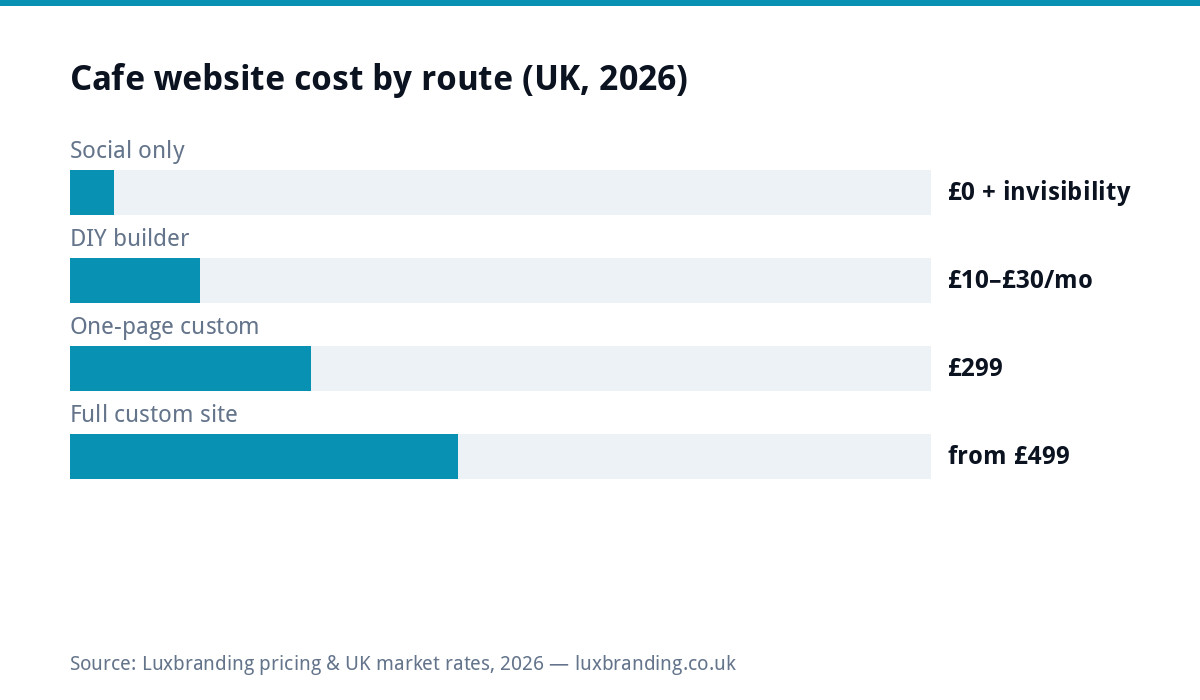
Route by route, cafe edition
| Route | What you pay | Right for | The catch |
|---|---|---|---|
| Social only | £0 | Honestly: nobody past opening month | Invisible to every “near me” search that fills Tuesdays |
| DIY builder | £10–£30/mo | Testing whether you’ll keep it updated | The subscription outlives the enthusiasm; menus rot as PDFs |
| One-page custom | £299 | Most cafes, full stop | Nothing, if the content order below is followed |
| Full custom | from £499 | Events, catering, retail, multi-site | Only buy pages you have business for |
The one-page order that works (same skeleton as restaurants, cafe-tuned)
Top to bottom: one great photo of the room or the counter with the name and area visible instantly; the menu next, as text with prices, because it is what most visitors came for; hours and location with tap-to-navigate; then the practicals cafes get asked daily, answered in one line each: dogs yes/no (an official Google profile attribute too), laptop policy, card/cash, bookings or walk-in, buggy space, gluten-free options (with the FSA allergen guidance behind whatever you claim). Photos after (six honest ones beat thirty), reviews pulled from Google, socials last. This mirrors our hospitality skeleton (the menu guide carries the print half) with the practicals promoted, because cafe choice hangs on them: “dog friendly cafe [town]” is a real search family, and the cafe whose page says the words wins it. Everything text, nothing PDF, hours sacred: the one-star review machine runs on wrong hours.
When the £499 tier earns it (sell what you actually have)
Each of these is a page and a search family the one-pager cannot chase: private hire and events (“venue hire [town]”, birthday bookings, supper clubs), the highest-margin page most cafes with a suitable room never build; catering (office lunches, event trays: “catering [town]” is steady B2B demand); retail (beans, blends, merch, with e-commerce scoped per our e-commerce guide when it grows real); the story page for roaster-cafes whose sourcing IS the brand. Buy the pages your business actually has; a cafe bolting on empty sections bought decoration. And if events or catering become the growth engine, that is when the booking-and-enquiry plumbing conversation starts paying.
Search phrases cafes win (write to them)
The winnable long-tail for a single cafe is wonderfully concrete, and the page should simply say the words: “dog friendly cafe [town]”, “breakfast [town]”, “coffee shop with wifi”, “bottomless brunch [town]” if you do it, “gluten free cakes [town]” if the counter carries them. Each true phrase on the page is a search you can appear for; each missing one is a customer walking to whoever said it. This is why the practicals section above earns its promotion, and why menu-as-text beats every design flourish: the words ARE the SEO. Pair the page with a complete profile whose categories and attributes say the same things (Google’s attribute list includes dog-friendly, wifi and outdoor seating precisely because people search them) and the two surfaces corroborate each other, which is how small cafes outrank chains for the searches that matter within walking distance.
Worked example: the Tuesday problem, solved for £299
The composite every cafe recognises: weekends heave, Tuesdays echo. The Tuesday customer is not a regular (they have habits elsewhere); they are the searcher: remote workers hunting “cafe with wifi”, dog walkers hunting “dog friendly”, locals hunting “breakfast near me” on a day off. Before the one-pager, the cafe is invisible to all three; after it (words on the page, attributes on the profile, hours true), it appears exactly when those decisions happen, and Tuesday fills one laptop and one spaniel at a time. No offer, no discounting, no social grind: just being findable for demand that already existed. That is the honest promise of the £299 tier for cafes, and why the practicals section outranks the design conversation entirely.
Delivery apps and the counter question
Cafes doing delivery face the same commission maths every hospitality venue faces on the delivery apps’ published rates: apps take their published cut of every order, worth it for discovery, ruinous as the default channel for regulars. The cafe version is lighter but real: if lunch orders through an app are a meaningful line, the “order direct” nudge (sign at the till, link on the site, £-off first direct order if margins allow) moves regulars to the commission-free channel, and even a simple order-ahead form on the £299 page beats paying acquisition rates on a loyal customer’s flat white. Volume that outgrows forms is the point where the ordering-system arithmetic starts, not before.
The running reality (and the free stuff that matters more)
After the build: hosting ~£20/month, domain £10–£20/year, and the upkeep habits that outweigh both: hours updated the moment they change (including bank holidays), menu edits when the kitchen changes, three fresh photos a month promoted from your socials, and the review ask at the counter, because “best cafe [town]” is decided in Google reviews long before design enters it. Photography note for the sector: daylight window shots of real plates from your own tables beat anything staged; phone cameras are enough, and the brief template covers the rest if you commission the build. All prices public on the price list; build in the January quiet and it is ranking by Easter trade.
Independent vs chain: the search fight you can actually win
Cafes assume the chains own local search; the opposite is usually true at the query level that matters. Chain pages are national templates with no idea whether the branch has outdoor seating or tolerates laptops, while your page can say every true specific thing about one room in one town, and specificity is what long-tail local queries reward. “Independent coffee [town]”, “quiet cafe to work”, “cafe with parking”: the chain cannot even enter these fights, and the £299 page wins them by simply telling the truth in words. The pattern repeats across this whole series: at local scale, the specific beats the big, provided the specific is written down where Google can read it.
Get the UK Website Project Brief Template (free)
A 2-page template for briefing any UK web designer — sitemap, integrations, audience, deliverables. Cuts revision rounds in half.
No spam. Unsubscribe any time. UK GDPR compliant — your email is only used to send this resource.
Frequently asked questions
How much does a cafe website cost in the UK? +
For most cafes, £299 buys everything needed: a custom one-page site with menu as text, hours, location, photos and social links. Cafes with event spaces, catering arms or serious coffee retail justify the from-£499 multi-page build. DIY builders run £10–£30/month ongoing.
Does a small cafe really need a website beyond Instagram? +
The searches that fill quiet weekday mornings ("cafe near me", "breakfast [town]", "dog friendly cafe") are Google and Maps searches Instagram never sees. A one-pager plus a complete Business Profile captures them; Instagram keeps doing the vibe.
What should a cafe website include? +
Menu as page text with prices, opening hours kept religiously true, location with a map link and parking note, six to ten real photos, the practical answers (dog friendly? laptops? bookings?), and social links. That is one good page, not a big site.
Should a cafe menu be a PDF on the website? +
No: PDFs punish phones and hide dishes from search. Menu as text means "best brunch [town]" and even dish-level searches can find you, and updating it is edit-and-save rather than redesign-and-reupload.
When should a cafe spend more than £299? +
When there is more business to sell: private hire and events, catering, retail beans and merch, or multiple locations. Each earns its own page and the from-£499 build. A single-room cafe serving daytime trade rarely needs it.