
Quick answer
You can benchmark any web design quote against published UK anchors: fixed-price studios charge £299 to £499 for small business sites (our own public price list sits exactly there), freelancers typically charge £500 to £1,500, and small agencies £1,500 to £4,000 for comparable brochure sites. A higher price is not automatically overcharging; custom features, content writing, photography and strategy all legitimately cost more. Overcharging is a price that cannot be explained by deliverables. This guide gives you the five fair-value tests, the red flags, and the clean exit route if the tests fail, without assuming your designer is a villain.
What UK web design actually costs in 2026
The honest market has three tiers, and the chart shows the published anchors. Fixed-price studios list prices openly and make money on volume and efficiency. Freelancers price per project with wide variation driven by experience and demand. Agencies carry teams and overheads, so the same five-page site costs more but arrives with more process around it. All three can be fair value. The full breakdown by site type lives in our guide to what a website costs in the UK; the short version is that a standard small business brochure site has no business costing five figures, and a genuinely custom platform has no business costing £300.
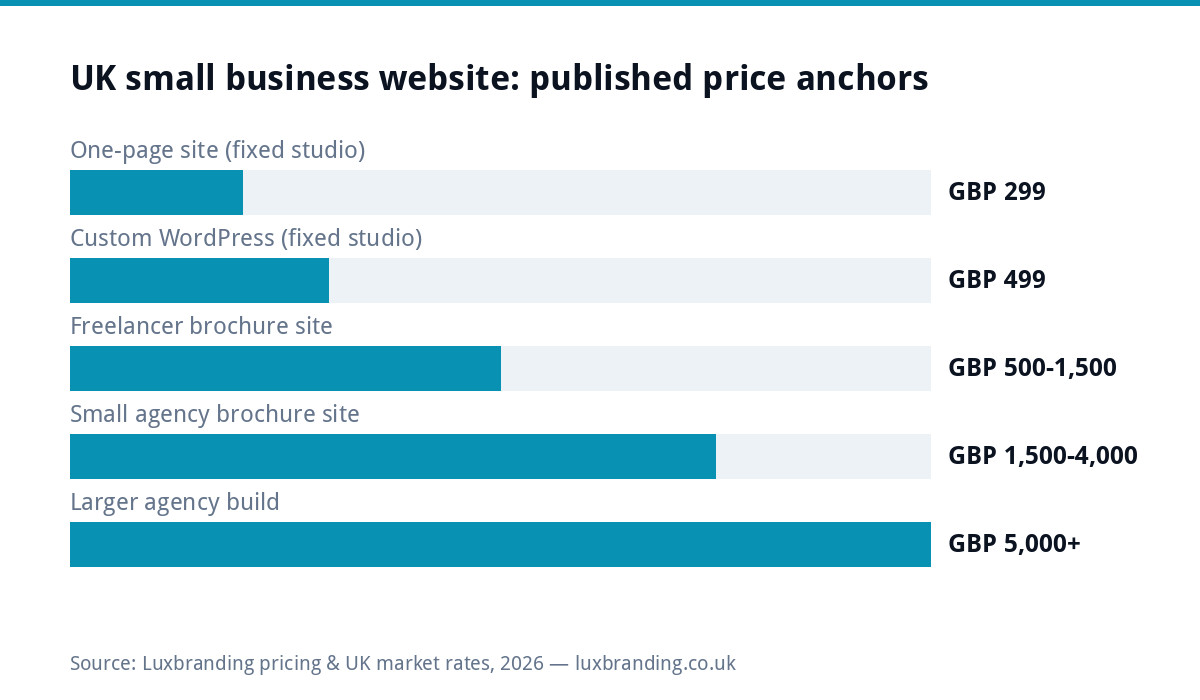
The benchmark table
| Provider type | Typical brochure-site price | Typical monthly fees | Watch for |
|---|---|---|---|
| Fixed-price studio | £299–£499 published | £20 managed care | Check what the fixed price includes |
| Freelancer | £500–£1,500 | £0–£30, varies | Ownership and handover terms |
| Small agency | £1,500–£4,000 | £30–£100 retainers | Itemisation of strategy and extras |
| Larger agency | £5,000+ | £100+ retainers | Whether you need agency process at all |
The five fair-value tests
Test 1, the deliverables list: can they itemise what you are paying for, in writing, in plain English? Vague scope is where padding hides. Test 2, the comparison quote: would two other providers quote within roughly double of this price for the same written scope? Get the quotes; it takes two emails. Test 3, the explanation test: when you ask why an item costs what it does, do you get a reason or a mood? Test 4, the ownership test: at the end, do you own the domain, the site files and the content, with admin access in your name? A low price that ends in hostage-taking is the most expensive quote on the table. Test 5, the recurring-fees test: list every ongoing charge and what each buys. Build fees are visible; the markup usually lives in the monthlies.
What legitimately costs more
Before crying foul, check whether your quote includes things the cheap anchors exclude. Copywriting is real work; professional content for ten pages can defensibly add hundreds. Photography, custom illustration and brand design are separate crafts, and our own brand identity service at £299 is priced apart from web builds for exactly that reason. Booking systems, member areas, calculators and integrations are software development, not page design, which is why our guide to booking system costs reads so differently from a brochure-site guide. And genuine strategy, research and conversion work has a market rate too. Overcharging is not a big number; it is a number bigger than its contents.
Red flags that suggest you are being overcharged
Round numbers with no itemisation. “Bespoke” used to describe a recognisable template, which you can sometimes verify by searching fragments of the demo text. Hosting at £30 to £50 a month for a small brochure site when managed care is available at £20 a month on public lists. Charges for “licences” that are free open-source software. A domain registered in the designer’s name rather than yours. Update fees per tiny text change, which signals a business model built on dependency. And hostility to the question “what exactly does this cover?”, which is the tell that the answer would embarrass the invoice.
The renewal and hosting markup problem
The most common overcharge is not the build; it is the drip. A £40 monthly “maintenance” fee that covers nothing measurable is £480 a year, £2,400 over five years, often exceeding the original build cost for a site nobody has touched since launch. Fair maintenance has a written scope: updates applied, backups running, uptime monitored, small changes included or priced. If your invoices cannot be matched to activity, ask for the activity log. Our maintenance cost guide sets out what each price band should include, so you can compare your monthlies line by line.
Worked example: the £3,000 brochure site
A trades business shows us a £3,000 invoice: five-page template site, no copywriting, stock photos, client-supplied logo, plus £45 a month hosting. Against the anchors: the comparable fixed-price build is £499, a freelancer might fairly charge £800 to £1,200 with some customisation, and the hosting is roughly double the managed-care rate. Verdict by the tests: the build fails test 2 by a factor of about three and the monthlies fail test 5. But note the counter-case: the same £3,000 with professional copywriting for ten pages, a photo half-day, and conversion-focused landing pages would pass. The number was never the issue; the contents were.
The line items every fair quote shows
The quickest way to test a price is to ask for it itemised. A fair supplier can break a quote down without hesitation, because each line maps to work they will actually do. A quote that stays as one round number after you have asked is the first real warning sign, before you compare a single figure.
| Line item | What fair looks like | Why it matters |
|---|---|---|
| Pages designed and built | A named list of pages, not “up to” a number | Stops the scope quietly shrinking |
| Words and images | Clear on who writes the copy and who supplies the photos | Copywriting is the most common hidden extra |
| Domain name | Registered in your name, on your own account | Whoever controls the domain controls your website and email |
| Hosting and renewals | A monthly or yearly price, with what it covers | Renewal markups hide here |
| Revisions | A stated number of rounds, or a clear rule | Avoids surprise change fees |
| Handover | Admin logins and files passed to you at launch | Makes leaving possible later |
None of these lines should be controversial. If a supplier resists putting the domain in your name or handing over admin access, that tells you more about the relationship than the price does. Our public price list shows every service with its fixed price and what is included, which is the standard any quote, from anyone, can reasonably be held to.
How to renegotiate without burning the bridge
If the relationship is otherwise good, do not open with an accusation. Ask for an itemised breakdown of the quote or the monthlies, in writing. Then say what the anchors say: published fixed prices exist at £299 to £499, managed hosting at £20, and ask them to help you understand the difference. A fair provider either explains value you had not seen or sharpens the price. An unfair one gets defensive, which is your answer. For ongoing fees, propose a written scope: this list of services for this monthly number, reviewed annually. Reasonable professionals accept scope conversations; dependency merchants resist them.
How to exit cleanly if the tests fail
Leaving is mostly logistics. Confirm you control the domain registrar login, or start the transfer; UK consumers also have general protections on services under the Consumer Rights Act 2015 if what was supplied fell short of what was agreed. Get a full copy of the site files and database, admin access to everything, and any licences in your name. Give notice per your agreement on monthlies, in writing. Then move hosting or rebuild: at fixed prices, a clean redesign often costs less than a year of the fees you are escaping. If the designer has vanished rather than overcharged, that is a different playbook, covered in our guide to a disappeared website developer.
When the price is actually fair
Sometimes the audit lands the other way, and it is worth saying so. If your provider itemises willingly, the comparison quotes come back similar, the monthlies map to real activity, and you own everything, then a price above the cheapest anchor is not overcharging; it is a different product. Which? offers sensible general guidance on consumer rights around services, but the best protection is simpler: transparent providers publish prices, itemise quotes and survive questions. Judge yours by whether daylight makes them comfortable.
What to do next
Run the five tests against your current quote or invoices this week; it takes an hour and two comparison emails. If the tests pass, relax and stop reading pricing guides. If they fail, renegotiate with the anchors in hand, and price the exit: our full price list is public precisely so you can benchmark without a sales call, from a £299 one-page site to a £499 custom build, fixed, owned by you from day one.
Get the UK Website Project Brief Template (free)
A two-page template for briefing any UK web designer: sitemap, integrations, audience and deliverables. Cuts revision rounds in half.
No spam. UK GDPR compliant. We only use your email to send this resource, unless you tick the box to hear from us.
Frequently asked questions
How do I know if my web designer is overcharging? +
Run five tests: a written itemised deliverables list, two comparison quotes on the same scope, clear explanations for each cost, full ownership of domain and files, and recurring fees that map to real activity. Overcharging is a price that cannot be explained by its contents.
What is a fair price for a small business website in the UK? +
Published anchors: £299 to £499 at fixed-price studios, £500 to £1,500 from freelancers, £1,500 to £4,000 at small agencies for comparable brochure sites. Custom features, copywriting and photography legitimately add more.
How much should website maintenance and hosting cost? +
Managed care is publicly available around £20 a month including hosting, updates, backups and monitoring. Monthly fees of £40 to £50 for an untouched brochure site deserve an itemised justification or a renegotiation.
Can I leave a web designer who is overcharging me? +
Yes. Secure the domain registrar login, a full copy of site files and database, and admin access, then give written notice on any monthly agreement. A fixed-price rebuild at £299 to £499 often costs less than a year of inflated fees.
When is an expensive website quote actually fair? +
When it itemises willingly and the extras are real: professional copywriting, photography, custom development such as booking systems or member areas, and strategy work. Those have genuine market rates above template-site anchors.