How much does graphic design cost in the UK?
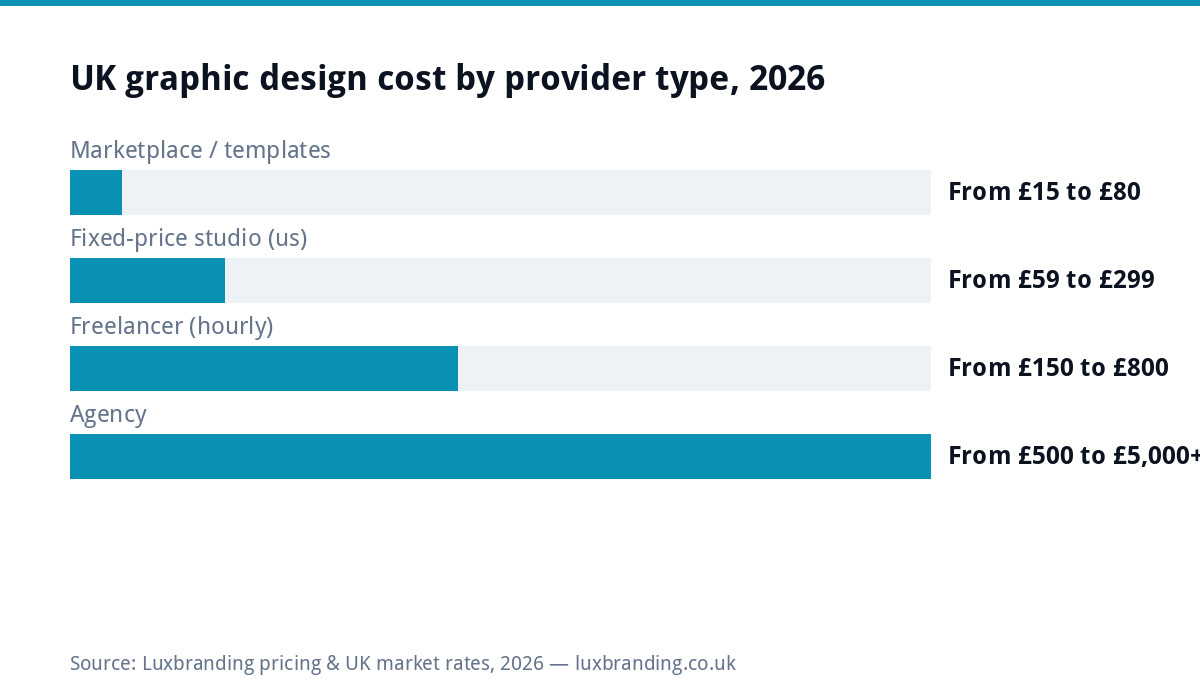
Most everyday graphic design jobs for UK small businesses cost £50 to £300 each from a fixed-price studio, £150 to £800 from a freelancer charging by the hour (commonly £25 to £60 an hour), and £500 to £5,000 or more through an agency. Our own fixed prices sit at the studio end: logo design £129, business cards £59, flyers £89, a social media template pack £79, packaging £99 and a full brand identity £299; every price is on our price list.
| Route | Typical UK price | How it is priced | Suits |
|---|---|---|---|
| Marketplace | From about £15 for a logo | Per gig | Throwaway one-off jobs |
| Freelancer | £150 to £800 a job (£25 to £60 an hour) | Hourly or day rate (£200 to £450 a day) | Long collaborations or a particular style |
| Fixed-price studio | £50 to £300 a job | A set price per deliverable | Most trading small businesses |
| Agency | £500 to £5,000+ | Project fee or retainer | Repositioning and multi-channel campaigns |
Market figures are typical UK ranges, not fixed quotes.
Every design service priced: the full table
| Design job | Typical UK market range | Our fixed price |
|---|---|---|
| Logo design | £15 marketplace to £2,500 agency | £129 |
| Full brand identity | £300 to £5,000+ | £299 |
| Business cards | £25 to £300 | £59 |
| Flyers and leaflets | £50 to £500 | £89 |
| Brochures | £150 to £800+ | Quoted in writing |
| Posters and banners | £50 to £400 | £89 |
| Menu design | £75 to £500 | £79 per side |
| Packaging and labels | £99 to £2,000+ | £99 |
| Social media graphics | £50 to £500 per pack | £79 |
Deep pricing detail lives in the dedicated guides: logo costs, flyer costs, brochure costs, poster costs, menu costs, packaging costs, social media design costs and business card costs. This page is the map; those are the streets.
The three pricing models, and what each really means
UK graphic design is sold three ways. Hourly or day rate: freelancers commonly charge £25 to £60 per hour and £200 to £450 per day, with the final bill depending on how long the job takes, which you rarely know in advance. Fixed price: studios like ours publish a set price per deliverable, and revisions are the studio’s problem rather than your meter running. Retainer or project fee: agencies price the engagement, not the artwork, which is why an agency flyer can carry a four-figure invoice. None of these models is dishonest, but they suit different buyers, and knowing which model a quote uses is the first step to comparing quotes at all.
What actually drives any design price
Five factors move nearly every quote. Originality: template assembly is cheap, drawn-from-scratch work is not. Files: print-ready CMYK PDFs, vector sources and layered working files take skill and get skipped by cheap providers. Rights: full copyright assignment is a professional default and a marketplace rarity. Revisions: unlimited rounds cost the provider real hours, so limited-revision quotes are cheaper up front and pricier the moment you disagree with round one. And strategy: when research, positioning and guidelines ride along, you are buying branding rather than a single artwork, priced accordingly in our branding cost guide.
Fixed-price studio vs freelancer vs agency: picking a lane
A fixed-price studio suits most trading small businesses: known cost, fast turnaround, complete files, no meter. A good freelancer suits work that needs one person deeply embedded, an illustration style, a long collaboration, though availability and single-person risk are real. An agency earns its premium when the problem is strategic: repositioning, multi-channel campaigns, brand architecture across companies. Paying agency prices for a flyer is how UK SMEs quietly burn marketing budgets, and paying marketplace prices for a rebrand is how they burn them loudly.
Worked example: a trades startup kits out for £356
A new electrician orders the practical set: logo at £129 with every file format included, business cards at £59, a flyer at £89 for door drops, and social templates at £79. Total £356, delivered inside a fortnight, all copyright assigned, all print-ready. The identical shopping list priced hourly at £40 with typical hours lands between £700 and £1,100, and the difference is not quality, it is pricing model. That £350 saving buys the first print run and a month of leaflet drops.
Where cheap design gets expensive later
The classic failure pattern costs more than the professional job would have: a £20 marketplace logo that arrives as a flattened JPG, cannot be embroidered or printed large, shares elements with other buyers’ marks, and fails when a signwriter asks for vector files. Rescue work is a whole service category because of it. If you are already in that hole, a £79 file rebuild is usually the way out, not a full redesign. Buying properly once remains cheaper than buying twice.
Design rates by UK region: does location still matter?
Less than it did. London agencies still command the top of every range, and northern freelancers still undercut them, but remote working has flattened the middle: a Manchester designer serves a Cornwall cafe without either noticing the distance. What replaced geography is specialism. A designer who lives inside hospitality menus or trade van livery charges more than a generalist and typically earns it back in fewer revision rounds. Published day-rate surveys from the graduate careers service Prospects put typical employed designer salaries at £20,000 to £35,000, which is the labour cost sitting underneath every freelance rate you are quoted.
Considering a design contest? Our guide to alternatives to 99designs compares five routes for UK businesses.
How the design industry prices itself: the evidence
The UK design sector is genuinely large: the Design Council’s The Design Economy 2026 report values design’s contribution to the UK economy at £136.7bn a year, supporting 2.27 million jobs. That scale is why prices range so widely: the market contains students building portfolios, template marketplaces, thousands of independent studios and global agencies, all nominally selling “a logo” or “a flyer”. Price signals quality far less reliably in design than buyers assume, which is why checking deliverables, files and rights beats checking the invoice.
By situation: what your business should budget
Pre-launch startup: £129 to £356 covers identity plus launch materials from a fixed studio; resist agency spend until revenue exists. Trading business refreshing its look: £299 full identity, plus £59 to £99 per collateral piece as needed. Hospitality venue: menu, flyer and social pack around £247 total; menus earn their redesign cost fastest. Product brand: packaging from £99 per SKU plus identity; packaging is the one category where paying more for structural expertise often pays back on shelf. Established firm repositioning: this is genuine agency territory, £2,000 to £15,000, because the deliverable is strategy with artwork attached.
Questions that expose a weak design quote
Ask what file formats are included, and walk if vector sources cost extra. Ask who owns the copyright after payment, and walk if the answer is unclear. Ask how many revision rounds are included and what round three costs. Ask to see three past jobs in your industry. Ask whether print management is included or whether artwork is thrown over the wall. Five questions, two minutes, and most bad quotes disqualify themselves before you have spent anything.
Print vs digital: why the same design prices differently
Print work carries hidden labour that digital does not: bleed and trim setup, CMYK colour conversion, resolution checks at physical size, and liaising with printers whose specifications differ. That is why a social graphic costs less than the same artwork prepared as an A5 flyer, and why “can you also make it a poster” is never quite the free favour it sounds. Digital work carries its own multipliers instead: animated variants, size sets for every platform, and accessibility contrast checks. When a quote separates design from artworking, this is the line it is drawing, and a fair quote will happily explain which side each charge sits on. Providers who print-manage as well, handling quantities, stocks and delivery, typically add ten to twenty percent and earn it in avoided reprints: the wrong-file reprint is the most expensive way to save money in the entire industry.
How briefs and revisions move the final bill
Two identical logos can cost £129 and £600, and the difference is usually process rather than pixels. A tight brief, references of what you like, clarity on where the design will live, and one decision-maker collapse the revision cycle that hourly designers bill for. Under unlimited-revision fixed pricing the studio absorbs indecision; under hourly pricing you fund it at £40 an hour. Committees are the classic multiplier: five stakeholders with veto power reliably double a project’s rounds. If your organisation needs consensus, fix it before commissioning, not during. A one-page brief that answers who the audience is, what feeling the design should carry, and what it must contain, saves more money than any negotiation on rate ever will, whichever provider tier you buy from.
The five-year view: design spend as an asset
Cheap design is bought per artwork; good design is bought per year of use. A £129 logo used across vans, cards, signage and a website for five years costs about £2 a month, while three cheap replacement logos in the same period cost more in reprints and repainted vans than the difference ever saved. The same arithmetic runs through every category: a menu that lifts average spend pays weekly, a brochure reused across three trade shows amortises to pennies, packaging that survives a product line’s life outlasts a dozen social campaigns. Budget design by the years it will serve, and the expensive option is usually the one you buy twice.
For the prices UK buyers actually see listed, from logo makers and marketplaces to UK studios, see the our index of published UK logo prices, with every source linked and a free CSV.
What to do next
Price your specific job through the linked per-service guides above, or skip straight to fixed numbers on the public price list. If the job is a logo or full identity, start with logo design at £129 or brand identity at £299; both include unlimited revisions and every file a printer, signwriter or embroiderer will ever ask you for. Print jobs run through flyer design at £89 with print-ready artwork as standard.
Get the UK Branding Budget Worksheet (free)
A printable worksheet: decide what your brand needs now and price it against fixed published prices and the IPO trademark fee.
No spam. UK GDPR compliant. We only use your email to send this resource, unless you tick the box to hear from us.
Frequently asked questions
How much does graphic design cost per hour in the UK? +
UK freelance graphic designers typically charge £25 to £60 per hour, with London and senior specialists reaching £75+. Fixed-price studios avoid the hourly question entirely: our logo is £129 flat, business cards £59, flyers £89, whatever the hours take.
What is a reasonable graphic design budget for a new UK business? +
Around £300 to £500 covers the launch essentials from a fixed-price studio: logo (£129), business cards (£59), social templates (£79) and a flyer (£89). The same set from an hourly freelancer typically runs £600 to £1,200, and from an agency £2,000+.
Why do graphic design prices vary so much? +
Because you are buying different layers: raw production at the bottom, original design plus usable files and rights in the middle, strategy and brand systems at the top. The deliverable name is the same, the depth behind it is not.
Is cheap graphic design from marketplaces worth it? +
For throwaway one-off jobs, sometimes. For anything that represents the business long term, recycled templates, missing source files and unclear rights usually cost more to fix than a proper job costs to buy. Our full teardown of cheap versus professional logo work covers the evidence.
Which design jobs should a small business prioritise first? +
Logo first, because everything else carries it. Then whatever touches customers most: business cards and social templates for service businesses, menus for hospitality, packaging for product brands. Print advertising like flyers works best once the identity is consistent.