What are the best alternatives to the GoDaddy website builder in the UK?
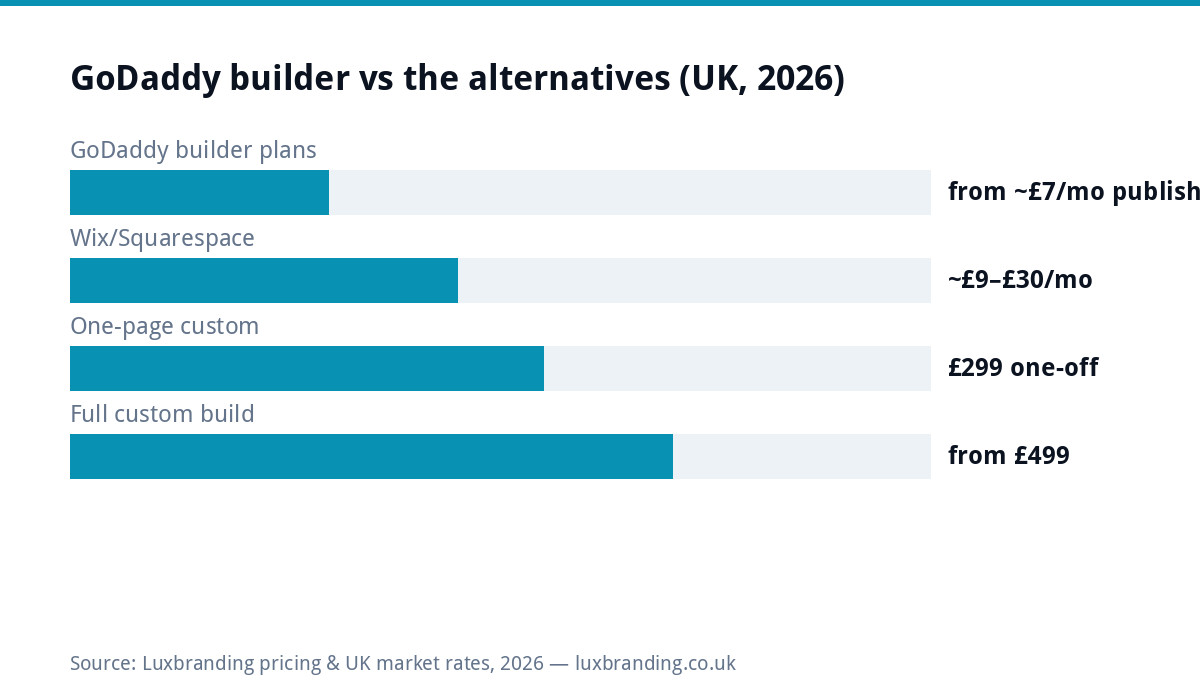
The main alternatives to the GoDaddy builder are Wix and Squarespace (richer DIY builders; Squarespace runs from £12 a month billed yearly), self-managed WordPress (free software plus hosting from about £5 a month), or a custom site you own (ours is £299 for one page or from £499 for a full site, plus £20 a month managed hosting). GoDaddy’s own builder is fine for a quick starter site, from roughly £7 a month on its published plans, but renewals and add-ons push the real bill higher, and like every builder it cannot be exported.
| Alternative | Cost | Choose it when |
|---|---|---|
| Wix or Squarespace | Squarespace £12 to £79 a month billed yearly; Wix shows prices by location | You want DIY with a richer editor and template range than GoDaddy’s; the same rent-and-ceiling structure |
| WordPress, self-managed | Hosting about £5 to £20 a month, plus your time | You want ownership and enjoy learning; the steepest start |
| One-page custom site | £299 one-off, plus hosting | The business is real and needs one page done properly: designed, owned, live in days |
| Full custom site | From £499, plus hosting | Several services that should each rank, with a page per service |
Squarespace prices checked October 2026 on Squarespace’s pricing page. GoDaddy’s UK pricing page could not be read today, so its figure is as previously published: check its current UK prices and renewal rates before buying.
The fair review: what it does well
GoDaddy’s builder wins on friction, or the lack of it: sign-up to live site in an afternoon, sections-based editing nobody needs a tutorial for, and the genuine convenience of domain, email and site under one login for the millions who bought a domain there first (which is the funnel, and it works). The AI setup drafts a workable starter, hosting and SSL are handled invisibly, and for a tradesperson who wants “a page that proves we exist” by tonight, it delivers exactly that. As with Wix, the honest frame is placeholder economics: at the experiment stage, renting simplicity is rational.
Where the ceiling bites (the review’s second half)
Three limits show up fastest. Design range: the template system is simpler than Wix’s or Squarespace’s, which speeds launch and caps distinctiveness; sites tend to look like what they are, and a business competing on premium quality feels it first. The upsell ecosystem: the builder sits inside GoDaddy’s wider catalogue, and the dashboard’s standing suggestions (SEO add-ons, marketing suites, security products, email upgrades) steadily grow the £7 plan toward £30+ for buyers who say yes by default; the discipline is buying only what you can name a use for, and pricing renewals rather than first-term promotions, since the gap between them is the industry’s oldest trick. The shared builder walls: no meaningful export, platform-bound SEO ceiling, and the five-year rent maths every builder carries, all covered structurally in our builders-vs-custom guide.
Your domain renewal matters as much as the builder. If you are dealing with a domain that has expired and taken the website with it, here is how to get it back.
The one thing to do regardless: separate the domain
Whatever you decide about the builder, the domain decision matters more, because the domain is the asset every future website points at. If GoDaddy is your registrar, that is fine (it is one of the world’s largest); the rule is that the domain lives in YOUR account, renewals on YOUR card, auto-renew on, contact email current, and never bundled so deeply into a builder plan that cancelling one threatens the other. Domain hygiene is what makes every later migration boring, and its absence is how businesses end up in our recovery guides. Check yours today: two minutes, and the whole decision tree above becomes reversible instead of scary.
Worked example: the £7 plan, three years on
The composite we meet monthly: a cleaning business took the £7 builder plan in 2023 with a domain and a burst of optimism. Three years later the real bill runs £22/month (commerce tier for the booking add-on, an email upgrade, renewal pricing), the site looks like its template, “end of tenancy cleaning [town]” rankings never came, and the total paid approaches £700 with nothing owned. The £299 one-pager built instead in 2023 would have cost less over the period, ranked for the one search family that matters, and been theirs. Nobody did anything wrong at the start (the £7 was rational then); the miss was never scheduling the graduation, which is the entire argument of our outgrowing guide: placeholders are fine, undated placeholders are expensive.
If you moved away from a builder and now cannot update your own website, there are four ways out.
The email tangle (untangle it before anything else)
GoDaddy customers often hold a second knot: business email bought as a bundle add-on, sometimes on promotional pricing that renews high, sometimes Microsoft 365 resold through the same dashboard. Before any website decision, map what you actually have (which product, renewing when, at what real price) and know that email, like the domain, is portable: the address survives any provider change because you own the domain, and mailbox contents migrate with standard tools. The full options and the authentication records that keep business email out of spam are in our business email guide; the point here is narrower: never let a website builder decision feel bigger than it is because email and domain are tangled into the same invoice. Untangled, each piece moves freely, which is exactly how supplier relationships should feel.
Review verdict, scored honestly
Speed and simplicity: strong, arguably the segment’s best onboarding for domain-first customers. Design range: adequate, below Wix and Squarespace. Value: good at headline price, eroded by renewal pricing and the upsell current, so the real bill needs watching. Ownership and portability: the standard builder walls, no better, no worse. Overall: a legitimate placeholder for a domain-first buyer who wants existence today, with the same graduation economics as every builder, and a dashboard that will test your discipline about buying only what you need. If that reads as three stars with an asterisk, it is, and the asterisk points at the alternatives table above.
Before you commit to any builder, compare it with what a website costs in the UK, from DIY plans to a fixed-price custom site.
The routing, condensed
Testing an idea this week: GoDaddy or Wix, domain kept separate, graduation date pencilled. Real business, one clear offer: the £299 one-pager, owned from day one. Multiple services, local rankings wanted: the from-£499 custom build with a page per service. Cashflow-shaped: £79/month custom, a subscription with a buy-out by agreement. And already on the GoDaddy builder with a proven business: copy your content out, run the migration order from the graduation guide, and keep the domain calm and central throughout. Prices for every owned route are public on the price list, which is itself the difference in philosophy this whole comparison keeps circling.
Final framing: GoDaddy’s builder is a reasonable answer to “I need to exist online this week” and a poor answer to “I need to compete online this year”. Both questions are legitimate; most businesses just ask them in that order, and the review’s whole job is making sure you know which one you are currently answering, and that the second question has flat-priced answers waiting when it arrives. The dashboard will keep suggesting extras either way; your job is knowing which question they answer, if any. Renewal month is the natural annual checkpoint: read the real invoice, re-ask the two questions, and either renew in peace or graduate on purpose, with the domain calmly yours either way. That yearly ten minutes is the entire maintenance cost of having chosen a placeholder deliberately.
Get the UK Website Project Brief Template (free)
A two-page template for briefing any UK web designer: sitemap, integrations, audience and deliverables. Cuts revision rounds in half.
No spam. UK GDPR compliant. We only use your email to send this resource, unless you tick the box to hear from us.
Frequently asked questions
Is the GoDaddy website builder any good? +
For speed and simplicity, genuinely decent: published plans from roughly £7/month, same-day launch, domain and email integration in one dashboard. The trade-offs are a thinner template ceiling than Wix or Squarespace, a persistent upsell ecosystem, and the export wall every builder shares.
What does the GoDaddy website builder cost in the UK? +
Published plans start around £7/month and climb with commerce and marketing tiers; renewal prices typically run higher than first-term promotions, which is the pricing pattern to check before committing. Their current UK pricing page has the live numbers.
What are the best alternatives to the GoDaddy builder? +
Depending on stage: Wix or Squarespace for a richer DIY editor at similar money, WordPress for owned flexibility with more learning curve, a £299 custom one-pager for a designed owned site, or from £499 for a full custom build. The right one follows your stage, not the ads.
Can I keep my GoDaddy domain if I move my website? +
Yes: the domain is separate from the builder and yours to point anywhere or transfer to another registrar. That separation is exactly why the domain matters more than the builder; whatever you do with the site, keep the domain in your own account.
Why does GoDaddy keep offering me extras? +
Upsells are the model: the builder sits inside an ecosystem of add-ons (email tiers, SEO tools, security products, marketing suites) that turn a £7 plan into a £30+ monthly stack. Buy only what you can name a use for; most small sites need the plan, the domain and little else.