Quick answer
A barbershop website costs £299 flat as a custom one-pager, which honestly covers most shops, or from £499 with booking built in for shops ready to own their diary. The trade’s two structural quirks decide which you need: the walk-in versus booking split (each wants different things said on the page) and the chair-renter model (one site can fill four chairs). Both are covered properly below, along with the price-list rule that outperforms every design decision in the sector.
Where new customers actually come from in barbering
Barbering runs on habit: once a customer trusts a chair, they return monthly for years. That makes the NEW-customer moment disproportionately valuable, and it happens in predictable places: a move to a new area (“barber near me” on day two in a new flat), a bad experience elsewhere, a search for something specific (“skin fade [town]”, “barbers open Sunday”), or a recommendation that still gets Googled before the visit. Instagram feeds the craft-following audience and keeps regulars engaged, and the booking apps run logistics, but every one of those new-customer searches happens on Google and Maps, where a shop without a website is relying on its profile alone against shops running both. The £299 page exists for exactly that moment, and because customer lifetime value in barbering is measured in years of monthly cuts, one converted searcher typically pays for the entire site.
Route by route: what each costs a shop
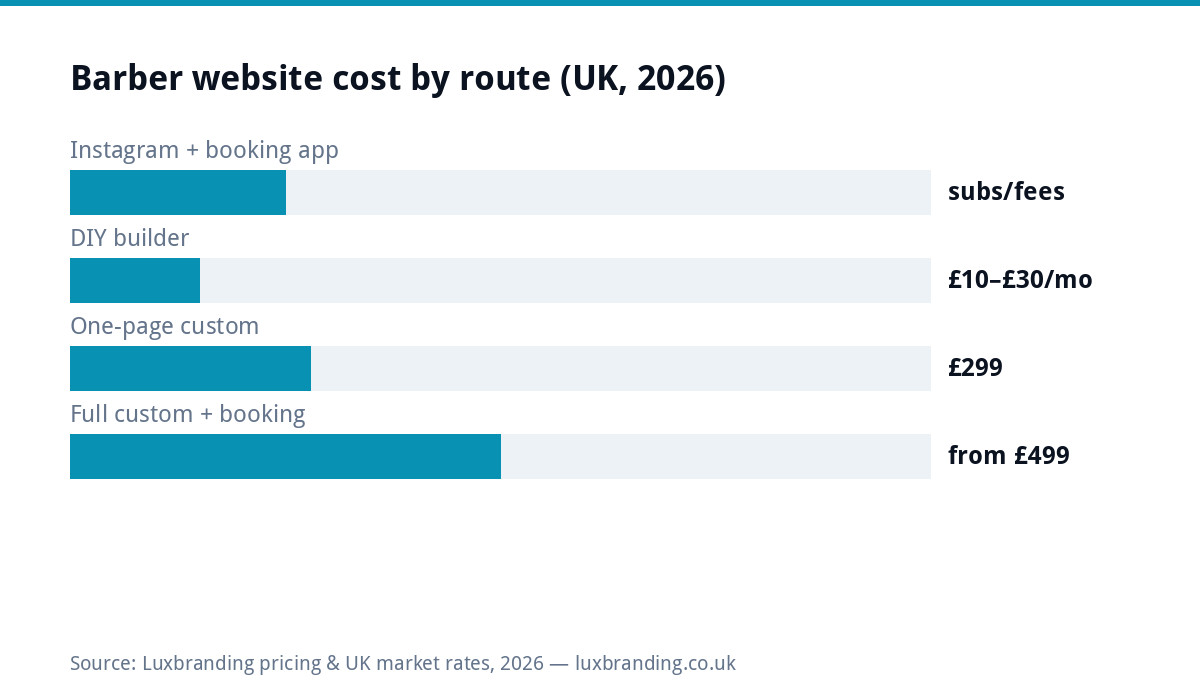
| Route | What you pay | Right for | The catch |
|---|---|---|---|
| Instagram + booking app only | App subscriptions/fees | Established shops with full chairs | Invisible to every “near me” search; prices live in DMs |
| DIY builder | £10–£30/mo forever | Testing whether you’ll maintain it | The subscription outlives the enthusiasm by years |
| One-page custom | £299 one-off | Most shops: walk-in, booked, or mixed | One ranking theme, which suits a shop perfectly |
| Full custom + booking | from £499 | Multi-chair shops ready to own the diary | Booking flow scoped to your deposit and no-show rules |
Walk-in or booked: say which, loudly
The sector splits into two cultures, and the website’s single most useful job is declaring yours, because the customer’s biggest pre-visit anxiety is getting it wrong. Booking shops: the book-now route goes everywhere, with the app’s widget or link doing the work (Booksy and Fresha both embed cleanly, at their published pricing). Walk-in shops: the page that converts says so with pride and adds the intelligence that makes walking in feel safe: “Walk-ins only. Busiest 4–6pm and Saturday mornings; quietest weekday mornings. Average wait 20 minutes, grab a coffee next door and we’ll text you.” That paragraph costs nothing, answers the exact question every new customer has, and no booking app can say it for you. Mixed shops state the split (“bookings for fades and restyles, walk-ins for trims”) and stop losing both audiences to ambiguity.
The chair-renter page: one site, four filled chairs
Most UK shops run partly or wholly on chair renters, and the website handles this better than any other channel: a chairs section listing each barber by name, their specialities (fades, afro hair, beards, kids), their Instagram, and their own booking link if they run one. Three things happen. The shop looks fuller and more skilled (specialities across four barbers beat one generic list). Each renter gains a professional presence they could never justify buying alone, which makes your chairs easier to rent and your renters likelier to stay. And searches for any barber working in your shop now land on YOUR site, which is the quiet ownership play: renters come and go, the shop’s search presence compounds. Update it when chairs change (a two-minute edit) and the page stays the shop’s live roster.
Publish the price list (the sector’s biggest free win)
Barbering’s pricing is simple, which makes hiding it inexplicable, yet shop after shop leaves prices in the window and off the internet. The searcher comparing three shops books the one whose page says “skin fade £22, scissor cut £18, beard trim £10, kids £12, OAP £10”: certainty converts, and price-checking is the number-one pre-visit behaviour in every appearance trade. List every service with its price as page text (searchable, screen-readable, updatable in minutes), state card and cash, and let the list double as your search bait, because “cheap barber [town]” and “kids barber near me” are real query families that land on the words. The same publish-the-prices mechanics run through our salon and gym guides, and through our own price list, on principle.
Photos: the craft sector’s conversion layer
Barbering is photographed constantly (the sector’s Instagram habit is a genuine asset), so the website’s photo problem is curation, not supply: pull the eight to twelve best cuts from the shop’s and renters’ feeds, add two of the room (chairs, atmosphere, the wait area) and one of the team, and refresh monthly from the same feeds. What converts is specificity: the searcher wanting a skin fade books the shop whose photos show skin fades. What repels is the stock-photo barber pole and the model with a haircut nobody in the shop performed. Since the photos already exist on Instagram, the site’s gallery costs ten minutes a month, and it puts the craft where Google and Maps can rank it, which the app feeds never do. The image sizing rules apply as everywhere: export web-sized, compressed once.
The booking question: when £499 beats the app fees
By situation, honestly. Solo barber or new shop: stay on the app; its fees buy discovery and the diary, and the £299 page in front of it completes the stack. Established multi-chair shop: run the quarterly arithmetic from our booking system guide: total app costs against how many bookings were regulars who would book direct if direct were as easy. Regulars rebooking monthly through a fee-charging channel is pure rent, and barbering has the highest regular-rebooking share of any appearance trade, which is exactly the profile where an owned booking flow (from £499 with the site) pays back fastest. Walk-in shops: skip the question entirely and spend the difference on the photos and the profile. Whichever route, deposits for long appointments (restyles, colour work where offered) collapse no-shows, and your own system enforces your rules rather than the app’s defaults.
The local pack: where the shop fight is actually won
For “barber near me”, the Map Pack decides more visits than any website, which makes the Google Business Profile the site’s essential twin: complete categories, real photos, hours sacred (a locked door at 5.45pm earns the one-star that haunts you), and reviews flowing weekly via the counter-QR habit, because in a trade this local, review count and recency ARE the ranking. The site and profile corroborate each other: same prices, same hours, same photos, same walk-in policy. Shops that keep both true routinely outrank flashier competitors who treat the profile as a set-and-forget, and the whole apparatus costs the £199 setup (or a careful DIY afternoon) plus habits.
Worked example: the new-to-town customer
Follow one customer through the machinery: moves to town, searches “barber near me”, gets the Map Pack. Shop A has 240 reviews, this week’s photos, and a website whose page says skin fade £22, walk-ins welcome, quiet before noon. Shop B has 31 reviews, a three-year-old photo, no site. He walks into A on Tuesday at 11, waits ten minutes as promised, and returns monthly for the four years he lives there: call it £1,000+ of cuts from one search, against a digital stack that cost A roughly £500 once. Multiply by every new-to-town, bad-experience and specific-style searcher in a year and the economics of this guide stop being abstract: barbering’s repeat model means the website’s converted strangers compound harder than in almost any other trade.
The full shop stack, priced
Site £299 (or from £499 with owned booking), profile setup £199 or DIY, logo that works on the window and the fade chart from £129 if the current one is a phone-number-in-Impact situation, and hosting at £20/month with someone to call. All one-off or owned, totalling less than a quiet month’s chair takings, with every price public on the price list. Build it in the January lull, photograph the shop while it’s quiet, and it’s ranking by the pre-summer trim rush; the £299 one-page build goes live in about five days from a decent brief.
Get the UK Website Project Brief Template (free)
A 2-page template for briefing any UK web designer — sitemap, integrations, audience, deliverables. Cuts revision rounds in half.
No spam. Unsubscribe any time. UK GDPR compliant — your email is only used to send this resource.
Frequently asked questions
How much does a barbershop website cost in the UK? +
A custom one-page site (prices, hours, location, chairs, booking link) is £299 flat and genuinely covers most shops; a full build with booking woven in runs from £499. DIY builders cost £10–£30/month ongoing, and booking apps charge their own subscriptions on top.
Do barbers need a website if they run everything through Booksy? +
The app runs your diary; it does not win "barber near me" or "barbers open Sunday [town]" searches, where new customers actually start. A one-pager plus a complete Google Business Profile captures those searches and hands them to whatever booking system you already use.
Should a walk-in barbershop bother with a website? +
Walk-in shops arguably need one more: the searcher deciding between three local shops checks prices, hours, the vibe and the queue culture before walking anywhere. A page that says "walk-ins welcome, busiest 4–6pm, quietest before noon" converts exactly those people.
What should a barber website include? +
The price list in full, true opening hours, location with parking notes, the chairs (who cuts, their styles, their Instagram), booking route or walk-in policy stated plainly, and real photos of cuts and the shop. One good page carries all of it.
How do chair renters fit on a barbershop website? +
List every renter with their name, specialities, Instagram and their own booking link. It costs nothing, makes the shop look fuller and busier, helps each renter fill their chair, and quietly makes your shop the search result for every barber working in it.