Quick answer
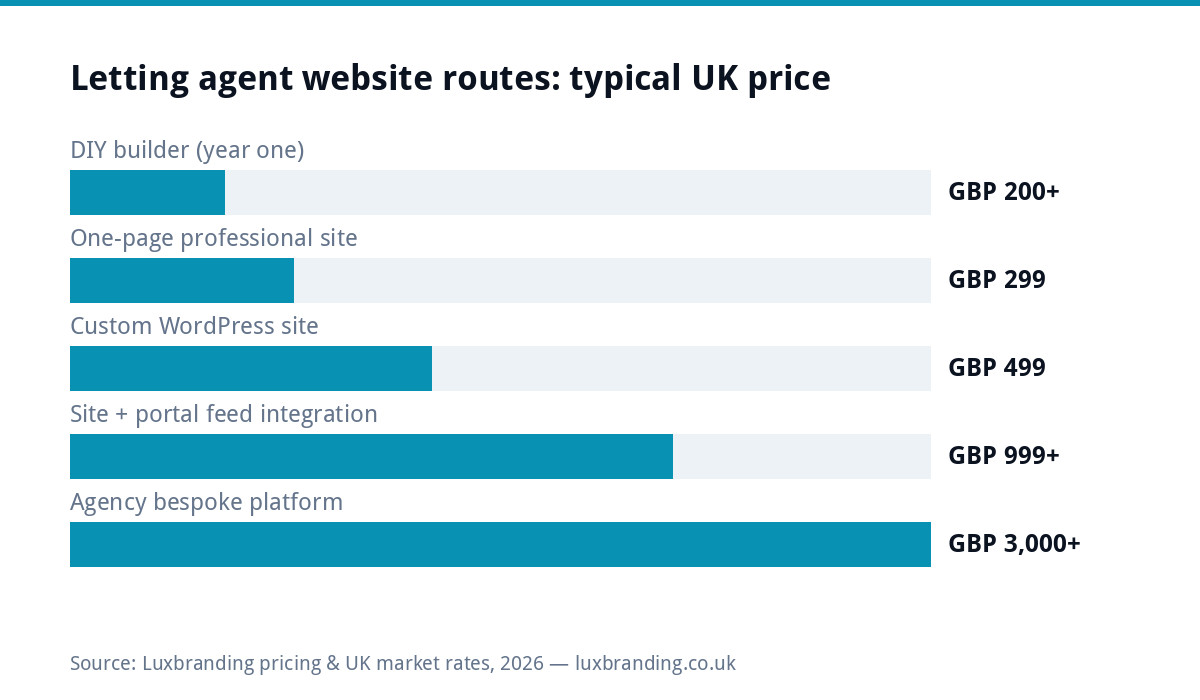
A professional letting agent website costs £299 to £499 in the UK in 2026 for a fixed-price build: £299 for a one-page site, £499 for a full custom WordPress site, both on our public price list. Add property-feed integration with the portals and quotes rise to £999 and beyond; bespoke agency platforms run into the thousands. The strategic point most letting agents miss is that the website’s real job is not advertising properties, the portals already do that. It is winning landlords, the audience the portals will never hand you. That reframing changes what you should pay for.
One website, two completely different audiences
Tenants and landlords come to the same domain wanting opposite things. Tenants want listings, application steps and honest fee information. Landlords, the audience that actually pays your management fees, want evidence you will protect their asset: your management service tiers, compliance record, rent-collection process and what switching from their current agent involves. Most letting agent websites are built entirely for tenants and then wonder why the site never wins a landlord. The professional fix is simple structure: a landlords section that sells, a tenants section that informs, and a homepage that routes each visitor in one click.
Letting agent website price bands for 2026
| Route | Typical price | What you get | Best for |
|---|---|---|---|
| DIY builder | £200+ per year, ongoing | Template site, manual property entries | Brand-new agents pre-revenue |
| One-page professional site | £299 fixed | Credible single page: services, fees, contact, reviews | Small agents winning landlords by referral |
| Custom WordPress site | £499 fixed | Multi-page site: landlord section, tenant info, valuation form | Most independent letting agents |
| Site with portal feed | £999+ | Listings sync automatically from your CRM to the site | Agents with 50+ managed properties |
| Bespoke platform | £3,000+ | Applicant portals, maintenance reporting, owner logins | Multi-branch agencies |
The portal-dependence problem
Listing on Rightmove and Zoopla is close to mandatory for tenant demand, and agents pay substantial monthly membership for the privilege. That is rented visibility: the moment you stop paying, your presence vanishes, and the portals own every applicant relationship. Your own website is the only channel where a landlord searching “letting agents in your town” can find you, read your case for switching, and submit a valuation request that costs you nothing per lead. The portals fill properties; the website fills your rent roll. Confusing those two jobs is the most expensive mistake in letting agent marketing.
What landlords check before they switch agents
Switching agents feels risky to a landlord, so your site has to de-risk it. The pages that do the work: a management fees page with actual numbers rather than “contact us”, a switching page that explains the handover process and that you handle the notice logistics, proof of client money protection and redress scheme membership, and named humans with photographs. A free rental valuation form is the conversion point; every field you add reduces completions, so ask for postcode, property type and contact details, nothing more. This is the same switching-page pattern that works for accountants (see the accountant section of our website cost guide), because the psychology is identical: the prospect already has a provider, and inertia is your real competitor.
The compliance content tenants and regulators expect
Since the Tenant Fees Act 2019, what agents can charge tenants is tightly restricted, and enforcement activity around published material information on listings has kept growing. Your website should carry your permitted-fees statement, redress scheme membership and client money protection details prominently, not because a web designer says so but because their absence is now a credibility and compliance signal that landlords, tenants and trading standards all read. A professional build puts these in the footer and a dedicated fees page so they are answered before anyone has to ask.
The £299 route versus the £499 route
At £299, a one-page site earns its keep for a small agent whose landlords come by referral: services, fees, protections, reviews and a valuation form on one fast page. At £499, the multi-page build adds what search traffic needs: a landlords section that can rank for management-fee and switching searches in your area, separate tenant information, and room to grow content. If you hold more than a handful of managed properties, the £499 route is the sensible default; the extra £200 is less than one month’s management fee on a single property.
Cost by situation
New agent, first ten properties: £299 one-page site plus Google Business Profile; spend your energy on landlord outreach. Independent with 20 to 100 managed properties: £499 custom site with a proper landlords section and valuation form. Agent with a lettings CRM: £999+ for feed integration so listings publish once and appear everywhere. Multi-branch agency: bespoke platform territory; insist on itemised fixed quotes.
Worked example: what one switched landlord is worth
Take a £1,100 monthly rent under full management at 10 percent. That single landlord is worth about £110 a month, £1,320 a year, and multi-year relationships are normal. If a £499 website wins two switching landlords in its first year, it has returned roughly five times its price, before counting the tenants those listings attract or the compounding effect of ranking for local landlord searches. No portal membership fee can deliver that, because portals do not market your agency to landlords at all.
Running costs and what to budget ongoing
An owned WordPress site needs hosting and maintenance at around £20 per month and a domain renewal near £12 a year. There is no per-listing charge and no platform subscription. Keep portal memberships for tenant demand and treat the site as the fixed-cost asset that wins the higher-margin side of the business. If the site later needs a refresh rather than a rebuild, our website redesign guide covers what that should cost.
Mistakes letting agents make online
Building the whole site for tenants and burying the landlord proposition. Publishing “fees on request”, which landlords read as “expensive”. Letting the site show properties that let months ago, which signals a sleepy agency. No valuation form, so the site cannot convert even when it persuades. And treating compliance details as small print instead of trust signals. Each is a structural decision made at build time, which is why the brief matters more than the design.
Questions to ask any web designer before you sign
Whoever builds it, put these in an email and keep the answers. Is the price fixed, and what exactly does it include? Who owns the domain, the files and the content at the end, and is that written down? Can the site take a valuation form submission and send it to two inboxes reliably? How are the fees page and compliance details structured so we can update them ourselves when legislation moves? What does the monthly care plan cover, itemised, and what costs extra? A provider who answers these quickly and in writing is safe at any of the price bands above; one who hedges on ownership or itemisation is expensive at any price. The five-minute email filters better than any portfolio review, because lettings is a compliance business and your website partner needs to behave like they know it.
How to get started
Write your fee structure and switching process down first; they are the content that converts. Choose the £299 or £499 route from the bands above, and check our full price list for exactly what each includes. A build like this is live within days, and the first landlord it switches pays for it many times over.
Get the UK Website Project Brief Template (free)
A two-page template for briefing any UK web designer: sitemap, integrations, audience and deliverables. Cuts revision rounds in half.
No spam. UK GDPR compliant. We only use your email to send this resource, unless you tick the box to hear from us.
Frequently asked questions
How much does a letting agent website cost in the UK? +
A fixed-price professional build costs £299 for a one-page site or £499 for a full custom WordPress site. Adding automatic property-feed integration from a lettings CRM raises quotes to £999 and up, and bespoke multi-branch platforms start around £3,000.
Do letting agents need property listings on their own website? +
Not necessarily. Rightmove and Zoopla already serve tenant demand. The website's higher-value job is winning landlords: management fees, switching process, protections and a valuation form. Feed integration becomes worthwhile at roughly 50+ managed properties.
What should a letting agent website include for compliance? +
Your permitted-fees statement under the Tenant Fees Act 2019, redress scheme membership, and client money protection details, displayed prominently. Their absence reads as a warning sign to landlords, tenants and trading standards alike.
What makes landlords switch letting agents via a website? +
Published fees rather than "contact us", a switching page that shows you handle the handover, visible protections, named staff and reviews, plus a short valuation form. The site's job is to make leaving their current agent feel low-risk.
What is one switched landlord worth compared to the website cost? +
At £1,100 rent under 10 percent full management, one landlord is worth about £1,320 a year, ongoing. Two switched landlords in year one returns roughly five times a £499 build, before counting tenant enquiries or search rankings.