Quick answer
A professional florist website costs £299 to £499 in the UK in 2026. Our own one-page website is £299 and a full custom WordPress site is £499, both fixed prices from our public price list. Freelancers typically charge £300 to £800 for similar work, and agencies quote £1,500 upwards. The bigger question for a florist is not the build fee but the ordering model behind it: whether you keep relying on relay networks that take commission on every order, or use your own site to take direct orders where you keep the full basket. This guide covers both, with the peak-day maths that makes florists different from every other trade.
Why a florist website is not like other small business sites
Most local businesses need a site that generates enquiries. A florist needs a site that can take money at strange hours, because flower buying is impulsive and deadline-driven: the anniversary remembered at 10pm, the funeral order placed by a relative three counties away, the Valentine’s rush where a fortnight can carry a serious share of the year’s takings. A plumber can ring back tomorrow. A missed flower order is simply gone to whichever competitor had a working order button. That is why the budget conversation for florists moves toward e-commerce faster than it does for the businesses covered in our salon website cost guide or the restaurant section of our website cost guide.
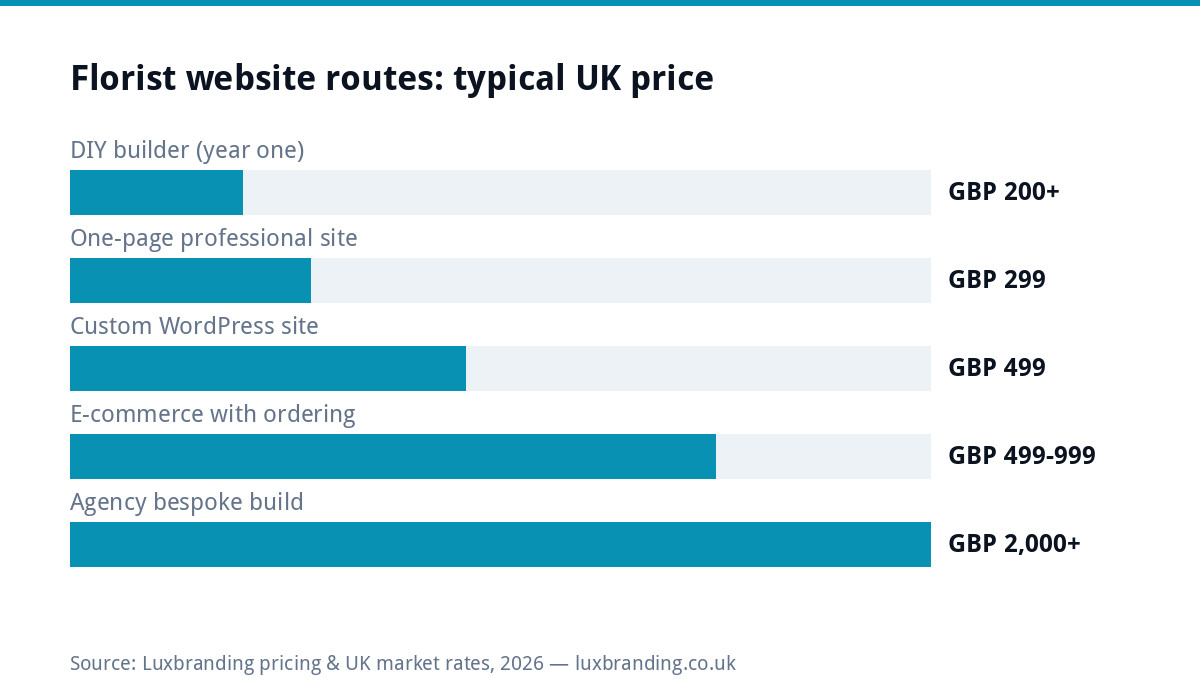
Florist website price bands for 2026
| Route | Typical price | What you get | Best for |
|---|---|---|---|
| DIY builder (Wix, Squarespace) | £200+ per year, ongoing | Template site you build yourself; commerce plans cost more | Testing the idea pre-launch |
| One-page professional site | £299 fixed | Designed single page: services, gallery, contact, click-to-call | Studios taking orders by phone |
| Custom WordPress site | £499 fixed | Multi-page site you own: occasion pages, gallery, enquiry forms | Established shops building search traffic |
| E-commerce build | £499 to £999 | Product catalogue, delivery rules, online payment | Florists ready to take direct orders |
| Bespoke agency build | £2,000+ | Custom design and features, subscriptions, wedding portals | Multi-shop and high-volume operations |
The relay commission maths every florist should run
Relay networks such as Interflora and eFlorist bring orders you did not have to win, but they charge for it: membership fees plus a commission slice on each relayed order, and the customer relationship belongs to the network, not to you. Here is a worked example. Suppose relayed orders average £40 and the combined membership and commission cost works out around 20 percent once fees are spread across the year. On 30 relay orders a month you are giving up roughly £240 monthly, £2,880 a year, to rent orders. A £499 site with ordering that redirects even a third of that volume to direct sales pays for itself inside three months, and every direct customer is one you can email next Mother’s Day for free. Relay membership can still make sense for inbound coverage; the point is to stop it being your only channel.
Peak-day economics: build for the fortnight that funds the year
Valentine’s Day and Mother’s Day are the florist’s Black Friday, and they are exactly when a weak website fails. The site has to stay up under a traffic spike, show cut-off times clearly, cap daily order volumes so the workroom is not buried, and switch messaging the moment slots sell out. A site that falls over on 13 February, as we covered in what to do when a website suddenly slows down, costs more in one weekend than a professional build costs outright. When you brief a designer, put peak-day behaviour in writing: order caps, delivery-date pickers, and a manual kill switch for same-day delivery when you are at capacity.
What the £299 one-page route buys
For a studio florist who takes orders by phone and message, a single well-built page does the essential jobs: your arrangements photographed properly, occasions you serve, delivery area, opening hours, reviews, and a phone number that dials on tap. It also gives Google a fast, legitimate page to rank for searches like “florist near me” alongside your Google Business Profile, which we show how to set up in our Google Business Profile guide. The one-page route is a fee you pay once, not a builder subscription that quietly exceeds it every year.
When the e-commerce build is worth paying for
Move up to online ordering when any of these are true: you regularly miss after-hours orders, relay commission is a four-figure annual number, you sell repeatable products such as bouquets in three sizes, or you want to grow wedding and corporate work with proper enquiry flows. An e-commerce florist build adds a product catalogue, delivery-date rules, postcode-based delivery charges, and payment. Card fees of around 1.5 to 2 percent are the only meaningful per-order charge, versus the much larger relay slice. Start with 10 to 15 best sellers photographed well rather than an 80-product catalogue you cannot maintain.
Cost by situation
New studio florist, orders by phone: £299 one-page site plus a free Google Business Profile. Established shop paying relay commission: £499 e-commerce build; run the redirection maths above. Wedding-focused florist: £499 custom site where the gallery and enquiry form do the selling; online ordering matters less than the portfolio. Multi-shop or subscription model: bespoke territory from £999; get fixed quotes in writing before committing.
Your photography is the biggest free upgrade
Flowers are the most photogenic product any local business sells, and most florist websites still use supplier stock images. Your own arrangements, shot in daylight against a plain background on a modern phone, will outperform any template imagery. Compress images before upload with a free tool like Squoosh so the gallery stays fast, and follow the sizing rules in our guide to fixing blurry website images. Photograph every peak-season best seller now; February is too late.
Running costs beyond the build
Budget for hosting and upkeep at around £20 per month managed, a domain at roughly £10 to £15 a year, and card processing fees only when you sell online. There is no compulsory monthly platform fee on an owned WordPress site, which is the structural difference from builder subscriptions and relay dependence alike: your costs stay flat while your order volume grows.
Mistakes florists make with their first website
Launching a big product catalogue nobody updates, so summer bouquets are still on sale in December. Hiding the phone number, which is still how older gift buyers order. No cut-off times listed, which creates refund conversations on the worst possible days. Using relay-network product photos, which makes your site look like every other member shop. And skipping the delivery-area statement, which invites orders you cannot fulfil. Every one of these is cheaper to prevent in the build brief than to fix after launch.
How to get started
Decide your ordering model first, relay-supported or direct, because it sets the budget band. Gather your ten best arrangement photos and your delivery rules. Then compare fixed quotes against the bands above. Ours are public: the full price list shows the £299 and £499 routes with what each includes, and first drafts arrive within days, comfortably before the next peak fortnight.
Get the UK Website Project Brief Template (free)
A two-page template for briefing any UK web designer: sitemap, integrations, audience and deliverables. Cuts revision rounds in half.
No spam. UK GDPR compliant. We only use your email to send this resource, unless you tick the box to hear from us.
Frequently asked questions
How much does a florist website cost in the UK? +
A professional florist website costs £299 to £499 fixed: £299 for a one-page site, £499 for a full custom WordPress build. E-commerce with online ordering runs £499 to £999, and bespoke agency builds start around £2,000.
Do florists really need online ordering? +
If you regularly miss after-hours orders or pay meaningful relay commission, yes. Flower buying is deadline-driven and impulsive, so an order button working at 10pm captures sales a phone line cannot. Studio florists trading on referrals can start with a £299 one-page site.
Is a website cheaper than relay network commission? +
Usually, quickly. If relay membership and commission cost you around 20 percent of each £40 order, 30 relay orders a month is roughly £2,880 a year. A £499 site that redirects a third of that volume to direct orders pays for itself within months.
What ongoing costs does a florist website have? +
Around £20 a month for managed hosting and maintenance, £10 to £15 a year for the domain, and card processing fees of roughly 1.5 to 2 percent only on orders you take online. There is no compulsory platform subscription on an owned site.
How should a florist website handle Valentine's and Mother's Day? +
Brief it into the build: clear cut-off times, delivery-date pickers, daily order caps so the workroom is not overwhelmed, and a quick way to switch off same-day delivery when slots sell out. Peak fortnights are when weak websites cost the most.