
Quick answer
A cleaning business website costs £299 as a custom one-pager, which covers most domestic rounds, or from £499 when commercial contracts deserve their own page, and in cleaning they do, because the domestic customer and the facilities manager are different buyers running different searches. The sector’s conversion currency is trust (insurance, DBS, real faces, key handling), and the recurring-revenue economics mean one converted enquiry is worth a year of weekly cleans, which is the arithmetic that makes this the cheapest customer-acquisition purchase available to a cleaning firm.
The recurring-revenue arithmetic (why cleaners underprice their own leads)
Most trades win a job; cleaners win a standing order. A converted domestic enquiry at £18/hour for three hours a week is roughly £2,800 a year, renewing by default, and a modest commercial contract multiplies that. Set against a £299 one-off site, the maths barely needs finishing: a single converted stranger repays the build several times over, and every one after is margin. This is why paying directories and agencies per-lead or per-hour commission forever sits so oddly in this sector: the lifetime value that makes cleaning attractive to agencies is exactly the value an owned site captures commission-free. The website is not a brochure here; it is the pipe that fills rounds, and rounds are annuities.
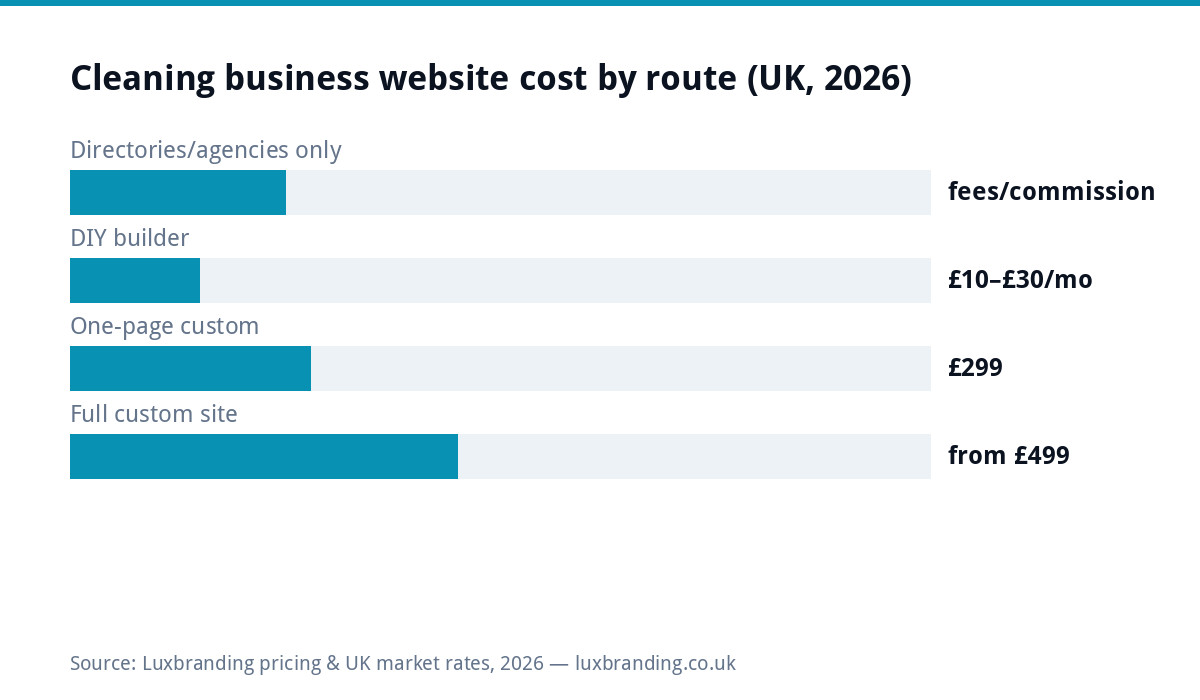
Route by route for cleaning firms
| Route | What you pay | Right for | The catch |
|---|---|---|---|
| Directories/agency platforms | Lead fees or commission | Filling this month’s gaps | Renting annuity customers at acquisition prices, forever |
| DIY builder | £10–£30/mo | Solo cleaner testing demand | Trust signals usually half-built, which is fatal in this sector |
| One-page custom | £299 | Domestic rounds, one clear area | Domestic and commercial should not share one page |
| Full custom | from £499 | Domestic + commercial + specialist services | Needs your proof assets gathered (photos, reviews, insurance) |
Trust: the sector’s entire conversion battle
A cleaner enters homes and offices unsupervised, so every enquiry is preceded by an unspoken vetting, and the website’s job is passing it in writing. The checklist clients actually run: insurance, stated plainly with the cover level (“insured to £2m public liability, the level commercial clients typically expect and platforms like Checkatrade verify for their members”), because “fully insured” with no number reads as wallpaper; DBS status for anyone working in homes, with the honest wording (basic checks are requestable by anyone via gov.uk, and saying “all staff hold basic DBS checks, renewed annually” is both checkable and reassuring); real humans: names and faces of who actually turns up, since the anonymous rotating stranger is the sector’s core anxiety; key handling, one paragraph on how keys are coded, stored and never labelled with addresses, which almost no competitor writes down and every client wonders about; and reviews with first names and areas. A page carrying all five converts vetting into booking; a page of sparkle clip-art converts nothing.
Domestic and commercial: two businesses, two pages
The from-£499 build earns its fee in this sector on one structural fact: domestic and commercial cleaning are different products bought by different people through different searches. The domestic page speaks to homeowners (“regular weekly cleaning from £18/hour, same cleaner every visit, products included”) and chases “cleaner [town]” and “domestic cleaning near me”. The commercial page speaks fluent facilities: contract cleaning, out-of-hours access, RAMS available, insurance levels, invoicing terms, references on request, and chases “office cleaning [town]” and “commercial cleaning contracts”. Blending them weakens both: the homeowner is spooked by RAMS talk, the FM discounts a page full of sparkle emojis. Specialist lines (end-of-tenancy, carpets, ovens, builders’ cleans) each justify their own page as volume proves out, because each is its own search family with its own price expectations, and end-of-tenancy in particular is a landlord-and-agent channel worth courting separately.
Pricing on the page: from-rates convert
Cleaning quotes vary by property, but the page can still anchor: “regular domestic from £18/hour (2-hour minimum)”, “end of tenancy from £120 for a 1-bed”, “offices quoted per site, typically within 48 hours”. From-rates filter the budget-mismatched before they cost a viewing, reassure the comparison shopper that you are in market, and give the page the £-signals that price-intent searches reward. The same publish-your-prices case runs through every vertical in this series, and cleaning adds one sector twist: stating the minimum visit and what is included (products, equipment) pre-answers the negotiation that otherwise eats the first phone call. Firms nervous of undercutting should note who hides prices: the agencies, whose margin depends on opacity.
By situation: solo, team, or contracts-first
Solo cleaner building a round: the £299 one-pager with the trust checklist complete, a service area drawn honestly (fuel time is unpaid time), and the Business Profile worked hard, because “cleaner near me” is a Map Pack search first. Small team, mixed work: the from-£499 build with the domestic/commercial split above, plus the specialist pages volume justifies; this is the classic shape of the sector’s £100k-turnover firms. Commercial-first firm: the site leads with contracts and compliance, domestic becomes the secondary page or drops entirely, and the enquiry flow gathers site size, frequency and access, so quotes go out same-day, the quote discipline applying to contracts doubly. In all three, the recurring model means churn management matters: a cancellations paragraph (notice period, pause options) set out plainly keeps rounds stable and disputes rare.
Photos in a sector that thinks it has none
Cleaning firms default to stock sparkles because the work seems unphotogenic; the opposite is true. What converts: honest before/afters (the oven, the end-of-tenancy carpet, the limescaled shower restored), the team in branded workwear with real faces, the van, and the small professional tells (labelled caddies, colour-coded cloths) that quietly signal system over chaos. Before/afters need the before, so the habit is photographing on arrival, which also documents condition, a dispute-prevention bonus landlords appreciate. Ten genuine photos assembled over a fortnight of normal work beat any stock library, and they feed the site, the profile and social from one camera roll, the standard one-shoot-many-surfaces economy of this series.
The enquiry form that books viewings (not conversations)
Cleaning enquiries convert best when the form gathers what a quote needs in one pass: property size (bedrooms/bathrooms as dropdowns), frequency wanted, area, and anything unusual (pets, post-build dust, end-of-tenancy deadline). Four fields turn “how much do you charge?” emails into half-quoted viewings, and the response-speed rule from every service trade applies doubly here, because the searcher filling your form filled two competitors’ forms in the same sitting: same-day replies win rounds, and a templated reply with your from-rates and two viewing slots attached wins them faster still.
The full cleaning stack, priced
Site £299–£499 · profile setup £199 or DIY, with the review habit via the scripts aimed at the end of each first month (when the relief of a reliably clean house peaks) · a logo that works on workwear and the van from £129 · hosting £20/month. The whole owned stack lands near one month of a single weekly client’s annual value, and every price is public on the price list. Build whenever; unlike the seasonal trades, cleaning demand is year-round, though January (new-year resets) and late summer (pre-tenancy churn) spike, so a site live by December catches both. The from-£499 build ships in days once the trust assets are gathered.
Get the UK Website Project Brief Template (free)
A 2-page template for briefing any UK web designer — sitemap, integrations, audience, deliverables. Cuts revision rounds in half.
No spam. Unsubscribe any time. UK GDPR compliant — your email is only used to send this resource.
Frequently asked questions
How much does a cleaning business website cost in the UK? +
A custom one-page site is £299 and suits most domestic cleaning rounds; a full site from £499 earns its keep when domestic and commercial work need separate pages, since they are different searches with different buyers. DIY builders run £10–£30/month ongoing.
Do cleaners need a website when work comes by word of mouth? +
Word of mouth still gets Googled: recommended cleaners are checked online before the first message, and a page with insurance, DBS position and real reviews converts that check. It also captures the searchers with no recommendation at all, which is how rounds grow past referral range.
What trust signals should a cleaning website show? +
The three clients quietly check: insurance (public liability, stated with cover level), DBS status for anyone entering homes, and identifiable humans (names and faces, not a stock mop). Add how keys are handled and reviews with first names, and the trust question is answered before the enquiry.
Should cleaning prices be on the website? +
At least from-rates: "domestic cleaning from £18/hour" or "end of tenancy from £120" converts comparison shoppers and filters budget mismatches before they cost a viewing. Commercial work quotes per site, and the page should say that plainly too.
What is different about marketing commercial cleaning? +
The buyer: offices, landlords and agents shortlist from desks, compare paperwork (insurance levels, RAMS, references) and buy contracts, not visits. A commercial page speaking that language, separate from the domestic one, is why multi-audience cleaning firms need the from-£499 build.