
What are Shopify’s fees in the UK?
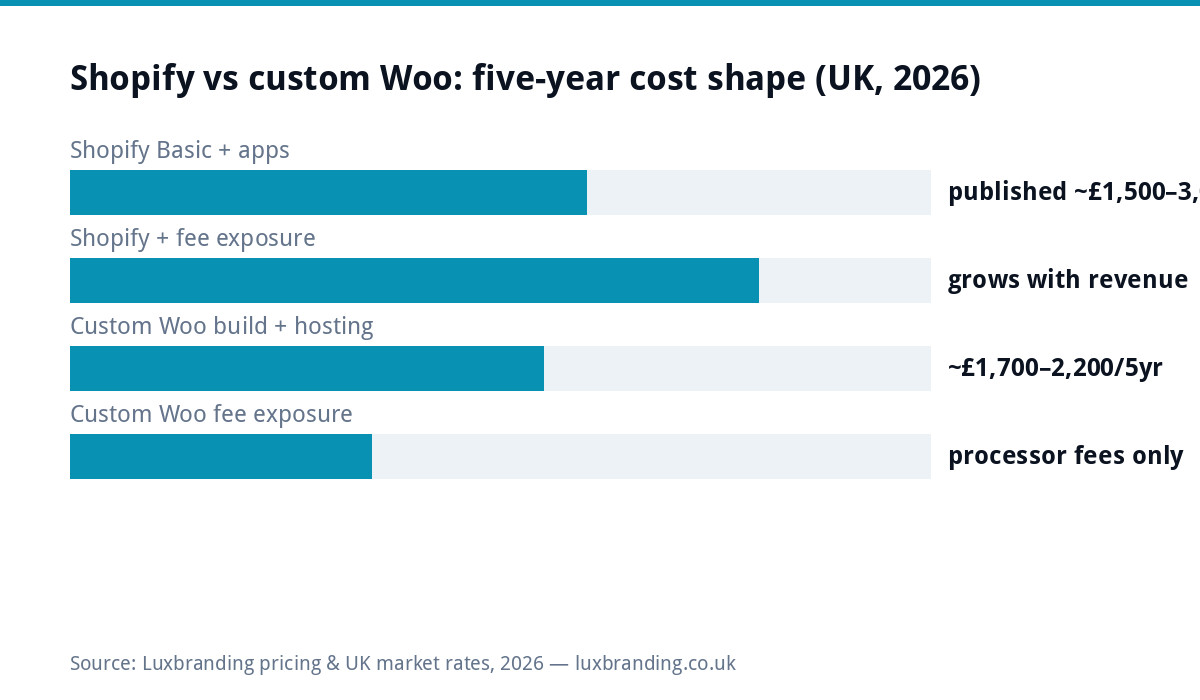
Shopify charges three kinds of fee in the UK: a monthly plan (Basic is £19 a month billed yearly or £25 billed monthly), a card rate on each online sale through Shopify Payments (2% + 25p on Basic), and an extra transaction fee of 2% on Basic if you use another payment provider instead. Apps add £5 to £30 a month each, so real stores commonly run £30 to £100 or more a month before card fees. A custom WooCommerce store has no plan or platform fee: you pay for the build (ours is from £499), hosting of about £20 a month and your card processor’s rate.
| Shopify plan | Billed yearly | Billed monthly | Online card rate, Shopify Payments | Extra fee with another payment provider |
|---|---|---|---|---|
| Basic | £19 a month | £25 a month | 2% + 25p | 2% |
| Grow | £49 a month | £65 a month | 1.7% + 25p | 1% |
| Advanced | £259 a month | £344 a month | 1.5% + 25p | 0.6% |
| Custom WooCommerce (for comparison) | No plan fee: a one-off build (ours from £499) plus hosting, about £20 a month | Your card processor’s rate | None | |
Prices checked October 2026 on Shopify’s UK pricing page (standard online UK card rates; Amex and international cards cost more). Shopify Plus starts at £1,800 a month. App costs are typical ranges.
Credit where due: what Shopify does brilliantly
Shopify earned its position: checkout polish that converts out of the box, hosting/security/PCI worries fully absorbed, an app for everything within minutes, themes that look professional immediately, and genuine same-week launches for straightforward catalogues. For a first store validating whether anyone will buy, that bundle at £19 to £25/month (annual or monthly billing) is rational, the same placeholder economics as every rent-vs-own comparison in this series. The costs arrive with success, which is the polite way of saying the model is designed so they do: apps at £5 to £30/month each, tier upgrades, and the fee exposure that grows with every sale.
Side by side
| Shopify (published tiers + apps) | Custom Woo (from £499 + £20/mo) | |
|---|---|---|
| Launch speed | Days | 2 to 4 weeks |
| Monthly shape | Plan + app stack, creeping with needs | Hosting flat; extensions mostly one-off |
| Per-sale fees | Card fees + platform fee unless Shopify Payments | Card processor’s published rate only |
| Customisation | Theme + app boundaries; Liquid beyond | Anything: it’s your code |
| Content/SEO engine | Adequate blog; app-assisted | WordPress: the strongest content stack there is |
| Ownership | Rented platform; data exports well | Owned outright, portable hosts |
| Best at | Launch, validation, straightforward catalogues | Volume, particular requirements, content-led growth |
For how we approach branding and websites for e-commerce and retail businesses, see our sector page.
The two fee conversations that decide it
The app stack. Shopify’s base tiers are honest; the stack is where budgets drift: reviews app, subscriptions app, bundle app, back-in-stock app, each £5 to £30/month, each reasonable alone, jointly a second rent. Woo’s equivalent functionality is mostly one-off extensions or free, which is why the five-year lines converge and cross despite custom’s bigger day one. The transaction fee. Card processing costs the same everywhere (processors’ published ~1.5 to 3%); Shopify’s EXTRA platform fee applies only when bypassing Shopify Payments, so stores happy with their processor barely notice, while stores needing a specific gateway (or in categories Shopify Payments restricts) pay a percentage of everything, forever, that Woo simply doesn’t charge. Model both against YOUR expected volume before choosing: at small volume the fees are noise, at scale they are a salary.
The content angle UK stores under-rate
A structural difference hiding behind the fee talk: WooCommerce lives inside WordPress, which means a custom store shares its engine with the strongest content/SEO machine available, the same one this entire blog you’re reading runs on. Stores that grow through search (guides, comparisons, the product-page craft that converts it) get that lane natively on Woo, while Shopify’s blog is serviceable but visibly second-class. For a store whose plan is ads-and-social, this matters little; for one intending to rank its way to customers, in the exact click-first way our e-commerce cost guide recommends, the platform choice is quietly a marketing-strategy choice.
By situation: honest routing
Validating a product this month: Shopify, sincerely, on the entry tier with minimal apps, and revisit at real volume. Established store bleeding app fees and platform tolls: run the five-year numbers with your actual statements; the from-£499 custom rebuild routinely pays back inside eighteen months at modest scale, and migration (products, customers, orders) is a routine project rather than the builder-style rebuild-from-zero. Particular requirements (B2B pricing tiers, unusual shipping logic, configurators): custom from the start, because fighting a platform’s assumptions is the most expensive hobby in e-commerce, as our e-commerce service scopes daily. Content-led growth plan: Woo’s WordPress engine tips it. The adjacent platform wars (Woo vs Shopify feature-by-feature) live in our dedicated comparison; this page’s question was the deeper one, rent vs own, and the ownership column’s prices are public on the price list.
Selling abroad? Our guide to multilingual websites covers the costs and the setup on each platform.
Worked example: the candle store at two stages
Stage one, 2024: a maker validating candles online. Shopify Basic, free theme, two apps, live in a weekend: unambiguously the right call, and the monthly ~£30 all-in was cheap tuition. Stage two, 2026: the store does steady volume, the app stack has crept to five (£60/month with the plan), a third-party gateway restriction adds platform fees to every sale, and the growth plan is search content the platform’s blog handles grudgingly. The rebuild maths: the from-£499 custom Woo store plus migration lands under one year of the current stack’s costs, ends the platform fees, and opens the WordPress content lane the growth plan needs. Verdict at stage one: Shopify, without hesitation. Verdict at stage two: the crossover arrived and brought receipts. Most stores meet both stages; the skill is noticing the second one on time rather than three app-subscriptions later.
Migration notes (smaller than the builder exodus)
Unlike site-builder exits, Shopify-to-Woo is a genuine migration rather than a demolition: products, customers and order history export and import with standard tooling, URL redirects preserve search equity, and the rebuild effort concentrates on theme and replacing app functions with Woo equivalents (mostly one-off). Plan payment continuity (the new processor live before the old checkout closes), keep Shopify read-only for a month as archive, and stage the switch in your quiet season like every replatform. It is routine project work, priced flat in scoping like everything on the price list, and its very routineness is worth weighing at stage one: choosing Shopify first is rarely a trap, because the door out actually opens.
Whichever you choose: the three store constants
Platform wars distract from the constants that decide store success on either side: product pages built to the trust checklist (photos, answers, reviews, visible delivery costs), checkout friction removed (guest checkout, wallets on: both platforms support it, both need it switched on), and an email capture running from day one, because first-visit conversion is a minority sport everywhere. Get those right and either platform performs; get them wrong and the fee debate is rearranging deckchairs. That, honestly, is the biggest finding from every store audit we run: the platform matters, and it matters third.
The last calibration: this comparison matters most at the margins, small validating stores and growing particular ones, and least in the middle, where a well-run store on either platform out-earns a badly-run store on the “right” one by miles. Fee shapes reward attention, not allegiance. Run the constants, watch the statements yearly, and let the crossover announce itself in your own numbers rather than in anyone’s comparison post, including this one. When it does announce itself, the scoping call is where the crossover becomes a plan with a flat price attached, and until then the constants above are worth more than the debate. Fee statements read quarterly keep the whole question honest for the price of ten minutes.
And a closing inventory worth writing down today: your products, your photography, your customer list and your domain are the store; everything else on either platform is furniture. Keep those four exportable and current, and no platform decision, this one included, can ever hold the business hostage.
Get the UK Website Project Brief Template (free)
A two-page template for briefing any UK web designer: sitemap, integrations, audience and deliverables. Cuts revision rounds in half.
No spam. UK GDPR compliant. We only use your email to send this resource, unless you tick the box to hear from us.
Frequently asked questions
Is Shopify or a custom website better for a UK online store? +
Shopify wins on speed-to-launch and polish out of the box; a custom WooCommerce build (from £499) wins on ownership, flat running costs and freedom from per-month app tolls. The crossover follows volume and customisation needs: the bigger and more particular the store, the stronger the custom case.
What does Shopify really cost per month in the UK? +
Basic is £19/month billed annually or £25 billed monthly, Grow £49 or £65 and Advanced £259 or £344 (prices checked October 2026), before apps: real stores commonly run £30 to £100+/month once review, subscription, bundle and marketing apps stack. Transaction fees apply on top unless you use Shopify Payments. Their UK pricing page has current numbers.
What are Shopify transaction fees? +
Card processing applies on every platform. On top of that, Shopify charges an extra transaction fee when you use a third-party payment provider instead of Shopify Payments: 2% on Basic, 1% on Grow and 0.6% on Advanced. With Shopify Payments there is no extra fee, and the online UK card rate is 2% + 25p on Basic, 1.7% + 25p on Grow and 1.5% + 25p on Advanced. Prices checked October 2026 on Shopify's UK pricing page.
How much does a custom WooCommerce store cost? +
From £499 as a launch-grade build plus around £20/month managed hosting. There are no platform fees or per-app monthly tolls: extensions are mostly one-off or free, and card processing is just your processor's published rate.
Can I move from Shopify to WooCommerce later? +
Yes, and unlike site builders the products/customers/orders export usably. The rebuild is the theme and apps' functionality; migrations are routine projects. Moving the other way works too, which makes this choice less permanent than the builder decisions, though still worth getting right first.