
What are the best Mailchimp alternatives in the UK?
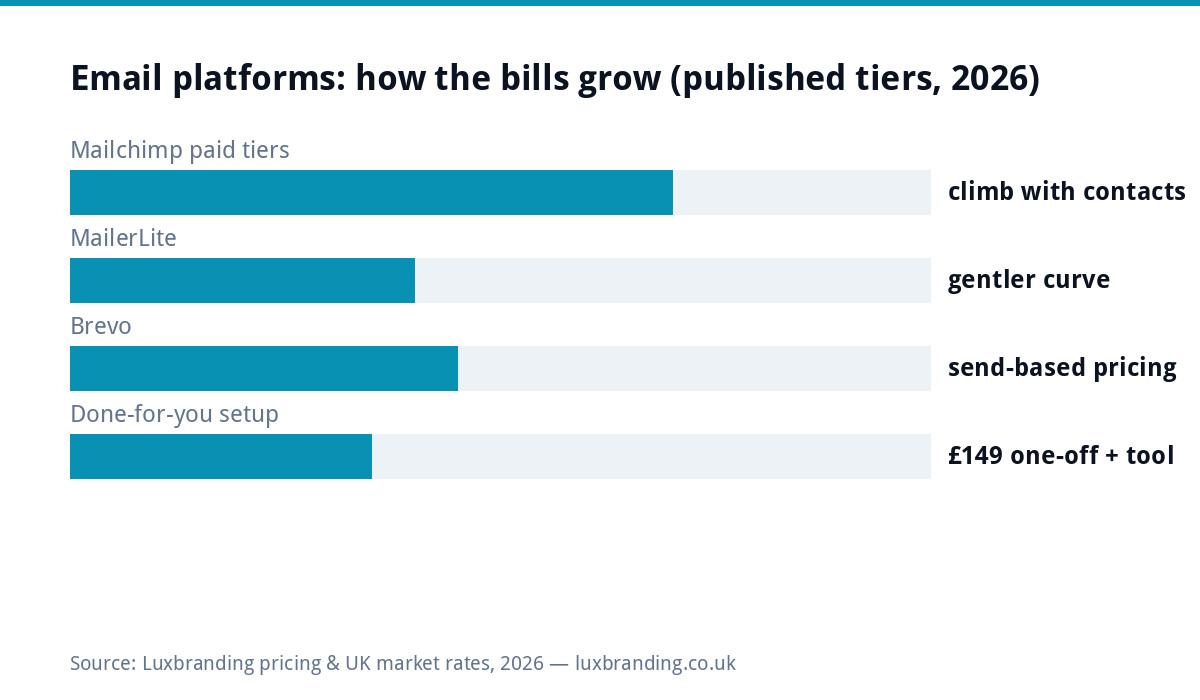
The five sensible Mailchimp alternatives for a UK small business are MailerLite (free for up to 250 subscribers, then gentle subscriber-based pricing), Brevo (priced mainly by emails sent rather than list size), Kit (free for up to 10,000 subscribers, built for creators), Moosend (low-cost contact-based tiers, with a 30-day free trial) and a done-for-you setup on whichever tool fits (ours is £149, one-off). Mailchimp’s own free plan stops at 250 contacts and its paid tiers climb with list size, which is why small senders with growing lists look elsewhere.
| Option | Free plan or trial | Pricing shape | Best for | The catch |
|---|---|---|---|---|
| MailerLite | Free up to 250 subscribers and 2,500 emails a month | By subscribers, gentle curve | The default small-business switch: newsletters and simple automation | Fewer deep integrations than the giant it replaces |
| Brevo | Free plan with a daily sending cap | By emails sent | Big quiet lists, occasional senders, transactional and marketing email in one | A busier interface; per-send thinking takes adjustment |
| Kit (formerly ConvertKit) | Free up to 10,000 subscribers | By subscribers, creator tiers | Creators, coaches and audience-first businesses selling digital things | Priced above the value line for a plain business newsletter |
| Moosend | 30-day free trial | By contacts, low tiers | Budget-first senders wanting the basics done | Smaller ecosystem; check the deliverability setup carefully |
| Done-for-you setup | Not applicable | £149 setup plus the tool’s own plan | Owners who want the machine built right once, then just write | You still write the emails, and that part should stay yours |
Free-plan limits checked October 2026 on the Mailchimp, MailerLite, Kit and Moosend pricing pages. Paid prices vary by list size and currency, so check each pricing page for your list.
Why the bills diverge (the pricing shapes, not the logos)
Email platforms price on one of two axes, and picking yours is the entire decision. Contact-based pricing (Mailchimp’s model, and most rivals’ paid tiers) bills for list size whether you send weekly or quarterly, so hoarding a large, quiet list is expensive, and the famous Mailchimp gripe (paying for unsubscribed and archived contacts on certain tiers) sharpened it. Send-based pricing (Brevo’s model) bills for volume sent, so a big list mailed monthly is cheap and a small list mailed daily is not. Map your reality: list size, honest sending frequency, and growth, against the two shapes, and the platform choice mostly makes itself; the published pricing pages then just confirm which tier the shape lands on.
The switch itself (an afternoon, in this order)
Migrations scare senders more than they should; the order that keeps it boring: export contacts from Mailchimp (CSV, including consent-relevant fields and tags); import to the new platform with the tags mapped; set up authentication for the new sender (SPF and DKIM records for the sending domain: the step casual switchers skip, and the reason their first sends land in spam; the same records our business email guide explains); rebuild your one or two templates and any automations (welcome series usually, which is also the moment to prune the automations nobody remembers writing); send a small warm-up campaign to your most engaged segment before blasting the full list; and keep the Mailchimp account read-only for a month as the archive. Consent travels with the contacts, but only if your records genuinely show it, which is the UK marketing-consent layer every platform sits under regardless of logo.
Who should stay on Mailchimp (fairness clause)
Switching has real if modest costs (the afternoon, template rebuilding, deliverability re-warming, team relearning), so the stay-put cases deserve naming: e-commerce stores whose platform sync and abandoned-cart flows run deep (rebuilding those exceeds a year of price difference), teams fluent in the tool with bills under roughly £15/month of pain, and anyone whose “Mailchimp problem” is actually a list-hygiene problem: pruning dead contacts and archiving properly sometimes drops a tier and dissolves the grievance for free. Platform-hopping as a hobby costs more than any subscription; move for a pricing shape that fits, not for novelty.
The part no platform fixes
A truth from the sending trenches: the tool is rarely why email under-performs. Lists grown without permission, subject lines nobody would open, sending rhythms that lurch from silence to blast, and newsletters with nothing to say convert identically badly on every platform at every price. The channel’s real economics (what a well-run list earns against its modest costs) live in our email marketing cost guide, and the starter discipline (what to send, how often, to whom) in the small-business email guide. The £149 setup service builds the machine (platform chosen for your shape, authentication done, templates and welcome automation live) precisely so the only remaining variable is the one that always mattered: whether the emails are worth opening. Tool prices are the platforms’ own; ours are on the price list.
Worked example: the 2,400-contact newsletter
The commonest switching case, with the maths visible: a business sends one monthly newsletter to 2,400 contacts (grown from years of the capture habits the no-sales guide teaches). On contact-based paid tiers that list size lands in the £25 to £50/month band at published rates across the majors, £300 to £600 a year for twelve sends. On send-based pricing the same twelve sends of 2,400 (under 30k emails annually) sits comfortably inside modest tiers, routinely halving the bill. The same business sending WEEKLY would flip the answer back toward contact-based tiers, which is the whole lesson: the platforms aren’t cheap or dear in the abstract, they’re priced for shapes, and an hour mapping your shape against two pricing pages is worth more than every listicle ranking the logos, this one included.
Decision in three questions
List over ~1,000 with monthly-or-less sending? Send-based pricing (Brevo-shaped) probably halves your bill. Under ~1,000 contacts and just starting the habit? MailerLite’s free tier and graduate when the curve says so. Bill fine but nobody ever built the automations, the authentication, the welcome series? The problem is setup, not platform: £149 once fixes the machine you already pay for. And in every case: the list you own (contacts, consent, history) is the asset; platforms are rented rooms it lives in, which is why the export habit and the consent records matter more than any logo on this page.
The switch checklist (print before you move)
The afternoon, itemised so nothing gets dropped: export contacts with tags and consent fields; export campaign history for the archive; import and map tags on the new platform; set SPF and DKIM for the new sender and verify them; rebuild the main template and the welcome automation; send the warm-up campaign to your engaged segment; update the signup forms on your website and profile so new consent lands in the new tool; keep the old account read-only for a month; and diarise a deliverability check at week two (are opens normal, is anything landing in spam?). Ten lines, one afternoon, and the platform change becomes a footnote rather than a saga, which is exactly what a well-shaped tool switch should be. File the checklist with your passwords note, because the next switch, if one ever comes, starts from the same ten lines, and platform leverage belongs permanently to the sender who knows leaving is an afternoon. That knowledge, more than any tier price, is what this page is really for: senders who can leave calmly negotiate every renewal from strength, and mostly never need to.
One habit to adopt whichever logo wins: a quarterly five-minute export of your list to your own storage. It costs nothing, it makes every platform decision reversible, and it is the difference between owning your audience and borrowing access to it.
Get the UK SEO DIY Audit Checklist (free)
A 32-point checklist UK SMEs can run against their own website in an afternoon. Surfaces the quick wins before paying for a paid audit.
No spam. UK GDPR compliant. We only use your email to send this resource, unless you tick the box to hear from us.
Frequently asked questions
Why do small businesses leave Mailchimp? +
Mostly pricing shape: published tiers climb with contact count (including unsubscribed contacts on some tiers, a famous gripe), features moved upmarket, and businesses sending one monthly newsletter found themselves on £20 to £60+ tiers. The product remains capable; the bill stopped matching light usage.
What is the best free Mailchimp alternative? +
For a plain business newsletter, MailerLite's free plan (up to 250 subscribers and 2,500 emails a month) is the usual starting point, with paid tiers that climb gently. Kit's free plan goes up to 10,000 subscribers and suits creators. Brevo's free plan suits send-based thinking, with a daily sending cap. Mailchimp's own free plan stops at 250 contacts. Limits checked October 2026 on each pricing page.
Which Mailchimp alternative is easiest to switch to? +
They all import Mailchimp exports (contacts as CSV, plus your templates rebuilt): the switch is an afternoon for a simple list. The real work is authentication records (SPF/DKIM for the new sender) and rebuilding any automations, which is where the done-for-you £149 setup earns its fee.
When should a business just stay on Mailchimp? +
When the bill is genuinely small for the value, deep integrations are working (e-commerce syncs especially), or the team knows it cold. Platform-hopping costs an afternoon plus deliverability re-warming; below roughly £15/month of pain, staying is usually the rational call.
Do I need any of these if I barely send email? +
If you send genuinely rarely, a platform subscription is overhead: collect addresses properly (consent recorded), and start sending when there is a rhythm to support. The email-marketing cost guide covers when the channel earns its keep at all.