
Quick answer
Some are, but only a handful. Your Google Business Profile matters far more than any directory, followed by Apple’s and Bing’s map listings and Facebook. Then add the few directories that matter in your trade, such as a trade body or TrustMark, with identical details everywhere. Paid directory packages rarely pay back; judge them as advertising, not SEO.
Ten years ago, a local business would list itself in dozens of online directories to help it rank. Some of that advice still circulates, along with offers to submit you to a hundred sites for a fee. This guide sorts the listings that still help a UK small business from the ones that waste an afternoon, and shows how to audit what you already have.
Why directories mattered, and what changed
Directory listings used to help in two ways: they were links back to your website, and they confirmed your name, address and phone number to search engines. Agencies called these mentions “citations”, and building them was a standard part of local SEO.
Two things changed. Google’s own Business Profile became the main source of local information, shown directly in the map results. And most directory links stopped carrying much weight on their own. What still matters is that your details are correct and consistent on the places people and search engines actually look.
How Google decides local rankings
Google’s help page on improving your local ranking says local results are mainly based on relevance, distance and prominence. Prominence is how well known a business is, and Google says it draws on information such as how many websites link to your business and how many reviews you have.
That tells you where directories fit. A listing on a respected site that genuinely links to you can add a little to prominence. A listing nobody visits, on a site nobody trusts, adds almost nothing. Your profile, your reviews and your website do the heavy lifting. Our guide to Google Business Profile optimisation covers that side in detail.
The listings worth having, in order
| Tier | Examples | Worth it? | Why |
|---|---|---|---|
| 1. Map platforms | Google Business Profile, Apple Maps, Bing Places | Essential | They power the maps people use on their phones and in cars |
| 2. Social profiles | Facebook page, Instagram business profile | Yes | People check them before calling; they show your details and reviews |
| 3. Trade and industry | Trade associations, competent person schemes, TrustMark | Yes, if you qualify | Trusted by customers and relevant to your work |
| 4. General UK directories | Yell and similar | A free basic entry, if offered | Some value for consistency; little ranking effect |
| 5. Lead and review platforms | Paid trade lead sites | Only as advertising | Judge on cost per job, not SEO |
| 6. Bulk submission sites | “100 directories for £50” offers | No | Low-quality links and a mess of old details to clean up later |
Tiers 1 and 2: map platforms and social profiles
Start with Google, because most local searches in the UK happen there. Then claim the same business on Apple’s platform: Apple Business is where you put your business on Apple Maps, which iPhone users see when they search from the Maps app or ask Siri. Bing Places does the same for Bing, which also feeds some other services.
Each takes under an hour to set up. Use exactly the same business name, address, phone number, opening hours and website on all three.
Social profiles count as listings too
Many customers check a business’s Facebook page or Instagram profile before they ring, even if they found you on Google. Treat these profiles as listings: fill in the category, service area, phone number, website and opening hours, and keep them current. A page that still shows last year’s hours or a disconnected number does more harm than having no page at all.
You do not need to post every day for a profile to do this job. A complete profile, a handful of recent photos of real work and replies to messages are enough to reassure someone who is about to call.
If you work from home or at customers’ premises
Many trades run from a home address and travel to customers. In that case, set up your Google profile as a business that serves customers at their location, with a service area rather than a public address, and do the same on other platforms that allow it. Never invent an office address or use a virtual office to look local; it risks your profile and confuses customers who turn up at the door. Keep the hidden address consistent behind the scenes, and let the service area do the work.
Tier 3: trade and industry listings
For trades, these are the directories that earn their place. Customers trust them, and being listed often depends on qualifications or checks, which is exactly why they carry weight.
- Your trade association’s member directory, if you belong to one.
- Competent person schemes that list registered installers in your field.
- TrustMark, the scheme for work in and around the home, which lets homeowners find a registered tradesperson.
- Local chamber of commerce or business network listings, if you are a member anyway.
Make sure each one links to your website and shows the same details as your Google profile.
Is Yell still worth it?
Yell is the directory most UK business owners remember, and these days it also sells managed marketing such as websites, listings management and advertising. The two are separate decisions.
If you can get a basic Yell entry without a paid package, take it and keep it accurate: it is one more consistent mention of your business. Any paid package should be judged like any other advert, on how many enquiries it brings and what each one costs. A listing is not a reason to sign a long contract.
Paid lead and review platforms
Platforms that sell trade leads or charge a monthly membership fee for reviews can work for some businesses, but they are advertising, not SEO. Track the jobs each one brings and the cost per job, and compare that with your other channels. The listing itself will not lift your own website’s rankings much.
Keep your own reviews on Google as the priority. If reviews have vanished from your profile, our guide to Google reviews disappearing explains the usual causes.
Consistency matters more than quantity
Ten accurate listings beat fifty with three different phone numbers. Old details on directories confuse customers, and they make it harder for search engines to be sure which information is right. Moves, new phone numbers and rebrands are when this goes wrong.
| Detail | What to check | Common mistake |
|---|---|---|
| Business name | Same form everywhere, no added keywords | “Smith Plumbing” on one site, “Smith Plumbing & Heating Ltd” on another |
| Address | Same format, or hidden if you serve customers at their homes | An old address from before you moved |
| Phone number | One main number | An old mobile number still listed |
| Website | Your current domain, with https | A dead link to a previous website |
| Opening hours | Match your Google profile, including holidays | Hours never updated after a change |
| Category | The closest match to your main service | A vague category such as “business services” |
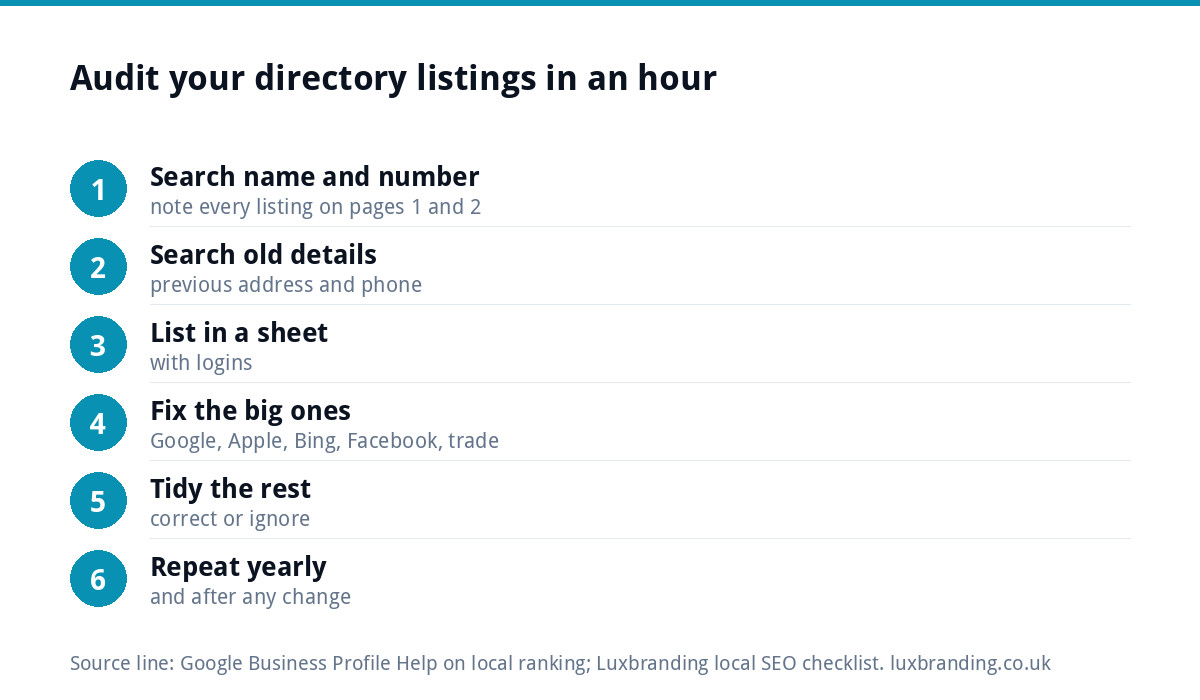
Audit your listings in an hour
- Search your business name and phone number in Google and note every directory that appears on the first two pages.
- Search your old phone number and old address if you have moved or changed numbers.
- List each listing in a spreadsheet with its login, if you have one.
- Fix the important ones first: Google, Apple, Bing, Facebook and trade listings.
- Claim or correct general directories that show wrong details, and ignore the ones nobody visits.
- Repeat once a year, and every time a detail changes.
Directory offers to avoid
- Bulk submission to “hundreds of directories” for a small fee.
- Directories that exist only to sell links, with no real visitors.
- Long contracts that bundle a listing with services you do not need.
- Anyone promising first-page rankings from listings alone.
If your business is not appearing on Google at all, directories will not fix it. Our guide to a website not showing on Google covers the usual causes first.
Getting it done for you
Our Google Business Profile Setup & Optimisation is £199 one-off and covers categories, keywords, photos, a review strategy and tracking. For ongoing work, our SEO service is £249 a month and covers rankings, content, technical health, link building and reports. Prefer to start yourself? Our free Google Business Profile checklist walks through the profile step by step. Every fixed price is on our pricing page.
Get the UK SEO DIY Audit Checklist (free)
A 32-point checklist UK SMEs can run against their own website in an afternoon. Surfaces the quick wins before paying for a paid audit.
No spam. UK GDPR compliant. We only use your email to send this resource, unless you tick the box to hear from us.
Frequently asked questions
Do online directories still help local SEO? +
A few do, mostly by keeping your business details accurate and consistent. Google says local results are based on relevance, distance and prominence, and prominence draws on things like links to your business and reviews. Your Google Business Profile, reviews and website matter far more. Claim the main map platforms and trade listings, and skip bulk directory submissions.
Is a Yell listing worth paying for? +
Judge any paid package as advertising, on the enquiries it brings and what each one costs, not as SEO. If you can get a basic Yell entry without paying, take it and keep the details accurate, because it is one more consistent mention of your business. Avoid long contracts that bundle a listing with services you do not need.
Which directories should a UK tradesperson be listed in? +
Start with Google Business Profile, Apple Maps and Bing Places, plus your Facebook page. Then add trade listings you qualify for, such as your trade association's member directory, competent person schemes and TrustMark for work in and around the home. Use identical name, address, phone number and website details on every one.
What is NAP consistency? +
NAP stands for name, address and phone number. Consistency means those details appear in exactly the same form on your website, Google profile, map listings, social profiles and directories. Mismatches, such as an old phone number or address left on a directory, confuse customers and make it harder for search engines to trust which details are correct.
Can you set up and tidy our listings? +
Our Google Business Profile Setup and Optimisation is £199 one-off, covering categories, keywords, photos, a review strategy and tracking. For ongoing work, our SEO service is £249 a month and covers rankings, content, technical health, link building and reports. Our free Google Business Profile checklist is there if you would rather start yourself.