Quick answer
Most small businesses should start a new Search campaign on Maximise clicks with a sensible cap, or Maximise conversions if conversion tracking already works. Once the campaign has steady conversions over a month or so, move to Target CPA, set close to the cost per lead you are already getting. Shops tracking sale values can later use Target ROAS.
The bid strategy is the setting that tells Google what you want from your budget: clicks, conversions, a set cost per lead or a return on spend. Pick the wrong one and Google will happily deliver it, which is how campaigns end up with plenty of cheap clicks and no phone calls. This guide explains each option in plain English and when it makes sense.
What a bid strategy actually does
Every time someone searches, Google runs an auction among the advertisers who want to appear. Your bid is the most you are prepared to pay for a click. A bid strategy decides how that bid is set, either by you, by hand, or automatically by Google based on the goal you choose.
Automated strategies look at signals you cannot see, such as the device, location and time of each search, and raise or lower the bid for that auction. Google’s overview of automated bidding describes the full set. The catch is that an automated strategy is only as good as the goal and the data you give it. If Google cannot see which clicks became enquiries, it cannot bid for more of them.
The six main strategies at a glance
| Strategy | What Google aims for | Needs conversion tracking? | Suits |
|---|---|---|---|
| Manual CPC | Whatever bid you set for each keyword | No | Tight control, very small budgets, experienced users |
| Maximise clicks | As many clicks as possible within budget | No | Brand-new campaigns gathering first data |
| Maximise conversions | As many conversions as possible within budget | Yes | Campaigns with tracking working but no history |
| Target CPA | Conversions at an average cost you set | Yes | Lead generation with steady conversion data |
| Target ROAS | Conversion value at a return you set | Yes, with values | Online shops with varied basket values |
| Target impression share | Showing in a chosen position a set share of the time | No | Protecting your own brand name searches |
Google is also renaming two of these. Its help pages note that from June 2026, “Maximise conversions with a Target CPA” is being labelled simply “Target CPA”, and “Maximise conversion value with a Target ROAS” becomes “Target ROAS”. The bidding behaviour is unchanged, so if your account shows the older names, they are the same thing.
Manual CPC: full control, more work
With manual cost-per-click bidding, you set the maximum you will pay for a click on each keyword. Nothing changes unless you change it. That makes it predictable and transparent, which is why some advertisers still like it for tiny budgets or very specific keywords.
The downside is time. Manual bidding cannot react to the difference between a search at 9am on a weekday and one at midnight on a phone, so you are bidding the same for both. For most small businesses, it is a learning tool rather than a long-term setting.
Maximise clicks: for gathering first data
Google’s page on Maximise clicks says it sets bids to get as many clicks as possible within your budget. It is useful in the first weeks of a new campaign, when there is no conversion history and you want to learn which searches bring visitors.
Two cautions. First, set a maximum cost-per-click limit so a handful of expensive clicks cannot swallow the budget. Second, clicks are not customers. Maximise clicks will find cheap clicks, and cheap clicks can come from people who were never going to buy. Treat it as a short first stage, then move on.
Maximise conversions: when tracking is ready
Maximise conversions sets bids to get the most conversions while spending your budget. Google’s page on Maximise conversions is clear that you must set up conversion tracking to use it.
A conversion should be something that matters: a contact form sent, a call from the ad or website, a quote request or a sale. Before switching, test that each one records properly. A form that sends nothing, or a thank-you page that never loads, means Google is bidding blind. If you are not sure your forms work, our guide to a website contact form not working covers the checks.
Maximise conversions spends the whole budget by design. If you want to control what each lead costs, rather than the number of leads, you need the next strategy.
Target CPA: the usual home for lead generation
With Target CPA, you tell Google the average you want to pay for each conversion, and it bids to hit that average. Some leads will cost more and some less. Google’s page on Target CPA says the recommended target is based on your average cost per conversion over the last 30 days, and advises being comfortable with spending up to twice your average daily budget on a given day, within the monthly charging limit.
The common mistake is setting the target far below what the campaign currently achieves. If leads cost £40 today and you set a £15 target, Google bids so cautiously that the campaign barely shows. Start close to your real figure, then lower it in small steps every couple of weeks while lead volume holds.
Target ROAS: for shops with sale values
Target ROAS, or return on ad spend, is for businesses that record the value of each sale. You set the return you want, and Google bids more for searches likely to bring higher-value baskets. Google’s own example is a 500% target: £5 in sales for every £1 spent.
It suits online shops where basket values vary a lot. It needs accurate values passed from the checkout, and enough sales for the system to learn from, so it is rarely the right starting point for a small new shop.
Choosing a strategy by stage
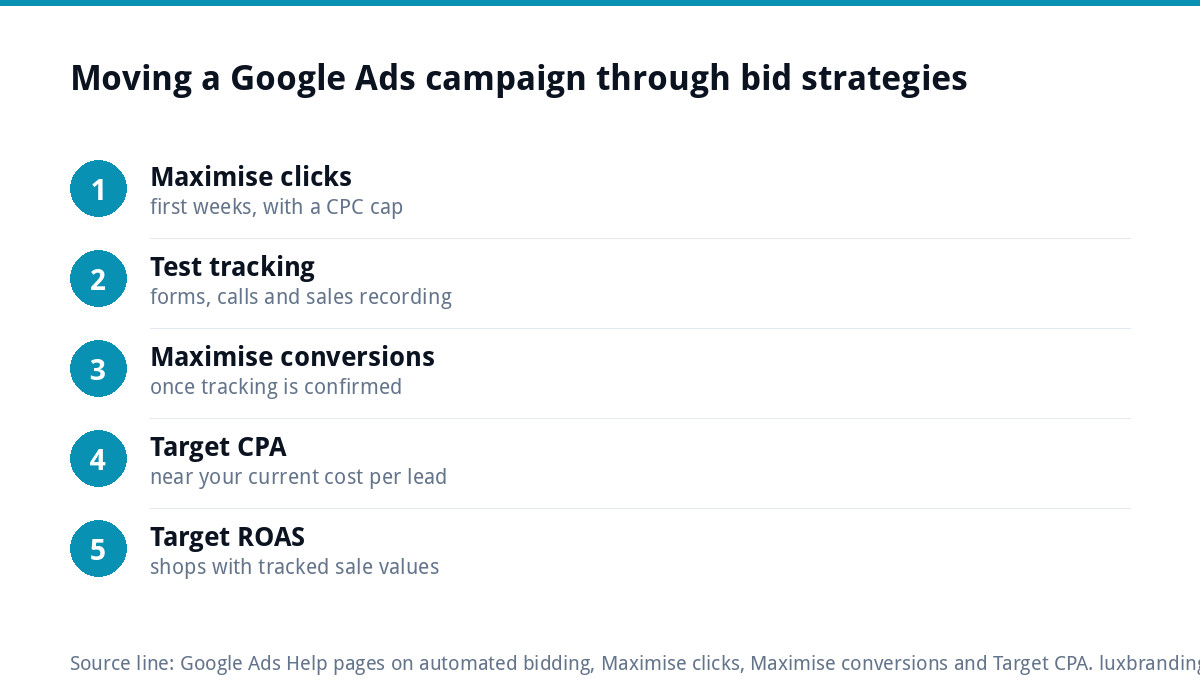
| Stage | Situation | Strategy to try |
|---|---|---|
| Week one | New campaign, tracking not yet tested | Maximise clicks with a CPC cap |
| Tracking confirmed | Forms and calls recording, little history | Maximise conversions |
| Steady data | Conversions coming in every week for a month or so | Target CPA near your current cost per lead |
| Shop with values | Sale values tracked, regular sales | Target ROAS |
| Brand protection | Competitors bidding on your name | Target impression share on a brand campaign |
Give each change time. Automated strategies need a period to adjust after a switch, and judging a new setting after three days usually leads to changing it back before it has settled.
A worked example: a roofer’s first three months
A roofer starts a Search campaign for repair work with £600 a month. For the first two weeks it runs on Maximise clicks with a £4 cap per click, while the roofer checks that calls from the ad and the quote form both record as conversions. Once they do, the campaign moves to Maximise conversions. By the end of month two it is bringing in leads every week at an average of about £35 each, so the roofer switches to Target CPA at £35, not the £20 he would like. Over month three he lowers it to £32, then £30, watching that the number of leads stays steady. These are example figures to show the method, not a forecast.
Budget and bidding work together
A bid strategy cannot make a small budget behave like a big one. If your daily budget only covers a few clicks, no strategy has enough data to learn from. On our Google Ads management page we recommend at least £500 a month of ad spend for Search, because below that there is rarely enough data to judge what is working.
The landing page matters as much as the bid. Automated bidding chases conversions, so a slow page or a vague offer means fewer conversions and higher costs. A focused landing page, £199 with us, often does more for cost per lead than any bid change. Our guide to website speed for small businesses covers the quick speed fixes.
Mistakes that waste budget
- Counting page views or button clicks as conversions, so Google optimises for the wrong thing.
- Switching strategies every week, so none of them settles.
- Setting a Target CPA far below reality, which throttles the campaign.
- Running Maximise clicks for months without moving to a conversion goal.
- Ignoring search terms, so automated bidding learns from irrelevant traffic.
Getting your bidding set up properly
Our Google Ads management is £199 a month for up to £5,000 of monthly ad spend, with no percentage taken from your budget: the spend goes straight to Google on your card. We set up conversion tracking, choose the strategy for your stage and move it on as the data builds. If you also want reach on social, our Meta ads management is priced the same way. Every fixed price is on our pricing page.
Get the UK SEO DIY Audit Checklist (free)
A 32-point checklist UK SMEs can run against their own website in an afternoon. Surfaces the quick wins before paying for a paid audit.
No spam. UK GDPR compliant. We only use your email to send this resource, unless you tick the box to hear from us.
Frequently asked questions
What is the best Google Ads bid strategy for a small business? +
It depends on the stage. A brand-new campaign can start on Maximise clicks with a cost-per-click cap, or Maximise conversions if tracking already works. Once conversions arrive steadily for a month or so, Target CPA set near your current cost per lead is usually the best fit for lead generation. Shops with tracked sale values can use Target ROAS.
Do I need conversion tracking for Smart Bidding? +
Yes, for the conversion-based strategies. Google's help pages say you must set up conversion tracking to use Maximise conversions and Target CPA, and Target ROAS also needs sale values. Track things that matter, such as form submissions, calls and sales, and test each one before switching, or Google will be bidding without the right information.
What Target CPA should I set? +
Start close to what your leads already cost. Google recommends a target based on your average cost per conversion over the last 30 days. Setting the target far below that usually makes the campaign bid so cautiously that it barely shows. Lower it in small steps every couple of weeks while lead volume holds steady.
Is Manual CPC still worth using? +
Rarely for long. Manual CPC gives you full control and predictable bids, which can help with very small budgets or while learning. But it cannot adjust for device, time or location the way automated strategies can, and it takes regular attention. Most small businesses move to a conversion-based strategy once tracking is working.
How much does it cost to have you manage Google Ads bidding? +
Our Google Ads management is £199 a month for up to £5,000 of monthly ad spend, with no percentage taken from your budget, which goes straight to Google on your card. We recommend at least £500 a month of ad spend for Search. Every fixed price is listed on our pricing page.