Quick answer
Nobody can guarantee ChatGPT will recommend your business. What you can do is make it easy for AI tools to find and trust you: let their search crawlers read your site, state your services, prices and areas plainly, keep your name, address and phone identical everywhere, and earn genuine reviews on Google and the directories in your trade.
AI assistants such as ChatGPT, Google’s AI Overviews and Copilot are increasingly where people ask “who should I use for this?”. There is no trick for getting named in the answer, and anyone selling a guaranteed placement is selling something they do not control. This guide covers the honest work that raises your chances, in the order we would do it.
How AI assistants decide which businesses to mention
When someone asks an assistant for a recommendation, it usually does one of two things. It answers from what it learned in training, which is out of date for most small businesses, or it searches the web live and summarises what it finds. For local and current questions, the live search route is what matters, and that is good news: it rewards the same things that work in ordinary search.
Google says this plainly. Its guidance on AI features and your website states there are no additional requirements to appear in AI Overviews or AI Mode beyond being indexed and eligible to show in Search with a snippet. In other words, the foundations of SEO are the foundations of AI visibility.
What the assistant is looking for, in practice:
- Clear facts it can quote: what you do, where, for whom and at what price.
- Agreement between sources: your website, Google Business Profile and directories saying the same thing.
- Independent signals: reviews, directory listings, local press and trade body memberships.
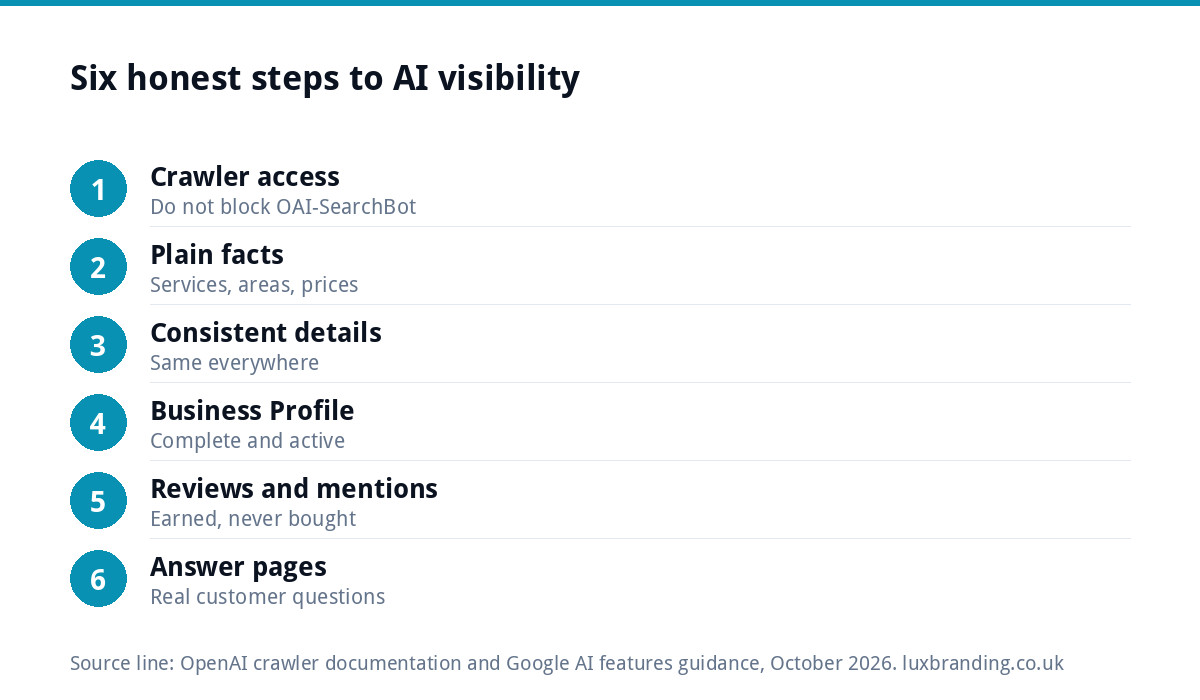
Step 1: make sure AI crawlers can read your site
Each AI company uses its own crawler, and your robots.txt file can block them, sometimes by accident. OpenAI’s documentation on its crawlers explains that OAI-SearchBot is used to surface websites in ChatGPT’s search features, and that sites which opt out of it will not be shown in ChatGPT search answers. It also explains that this is separate from GPTBot, which relates to training, so you can allow one and block the other.
Check three things:
- Visit yoursite.co.uk/robots.txt and look for any “Disallow” lines naming OAI-SearchBot or blocking all bots.
- Ask whoever manages your hosting whether a firewall or security plugin blocks unfamiliar crawlers.
- Confirm Google can index your pages; our guide to a website not showing on Google walks through that test.
Step 2: write your facts where a machine can find them
AI tools quote sentences. If your website hides the basics behind vague slogans, there is nothing to quote. Every service page should answer, in plain words near the top:
- what the service is and who it is for;
- which towns or postcodes you cover;
- a price, a starting price or what the price depends on;
- how long it takes and what the customer gets.
Short question-and-answer sections help, because they match how people phrase questions to an assistant. “Do you cover Harrogate?” with a one-line answer is more useful than a paragraph about passion and quality.
Step 3: make your details identical everywhere
Assistants cross-check. If your website says one phone number, Google another and an old directory a third, the safest thing for a machine to do is mention someone else. Google’s own guidelines for Business Profiles ask you to represent the business as it is consistently known in the real world, across signage, stationery and the website.
| Where | What to check | How often |
|---|---|---|
| Website footer and contact page | Name, address, phone, email, service area | Every change |
| Google Business Profile | Same details, categories, opening hours, services | Monthly |
| Trade directories | Same details and the same description | Twice a year |
| Social profiles | Same name, link back to the website | Twice a year |
| Companies House (if limited) | Registered name matches what you show | When anything changes |
Step 4: strengthen your Google Business Profile
For “near me” and local questions, assistants lean heavily on map and business listing data. A complete Business Profile with the right primary category, services listed, recent photos and steady reviews is one of the strongest signals a small business can control. Our guide to Google Business Profile optimisation covers each field, and if you would rather have it done, Google Business Profile Setup & Optimisation is £199 and covers categories, keywords, photos, review strategy and tracking.
Step 5: earn reviews and mentions the honest way
Reviews are one of the few independent signals an assistant can read about a small business. Ask every satisfied customer, at the moment the job is finished, with a direct link. Reply to every review, good and bad, calmly and specifically.
Beyond reviews, look for genuine mentions:
- trade body and accreditation listings with your website link;
- local business groups, chambers of commerce and supplier “find an installer” pages;
- local news coverage of real events, such as a new premises or a community project.
Do not buy reviews or write them yourself. Fake reviews break platform rules and consumer law, and they can get a profile suspended, which removes you from the very source assistants check.
Step 6: publish answers to the questions customers ask
Think about the questions people type into ChatGPT before they hire someone like you: “how much does a new consumer unit cost in Leeds”, “do I need planning permission for a porch”, “is it worth servicing a boiler every year”. A short, accurate page answering each one, written by someone who does the work, is exactly the kind of source assistants summarise and link to. Keep it factual, date your prices, and update them when they change.
A worked example: a roofer in Harrogate
Take a hypothetical two-person roofing firm. Asked “who should I use for a flat roof repair in Harrogate?”, an assistant names three competitors. A month of the steps above might look like this:
- Week one. The robots.txt file, set up years ago by a web developer, blocks every bot except Google’s. It is changed to allow search crawlers, including OAI-SearchBot.
- Week two. The flat roofing page gains a plain opening: flat roof repairs and replacements in Harrogate, Knaresborough and Ripon, typical repair prices, how long a replacement takes, and the guarantee offered.
- Week three. The firm finds two old directory listings with a former mobile number and a previous address, and corrects them so every source agrees with the website and Business Profile.
- Week four. The firm starts asking every finished customer for a Google review by text, with a direct link, and replies to each one.
None of this guarantees a mention. What it does is remove the reasons an assistant had for leaving the firm out: it could not read the site, could not find the facts, and found conflicting details. The same changes usually lift ordinary search and map visibility too, which is where most enquiries still come from.
What does not work (and what to avoid)
| Tactic | Why to skip it |
|---|---|
| Paying for “guaranteed ChatGPT placement” | No one outside the AI company controls its answers |
| Hidden text or keyword stuffing aimed at AI | Breaks search engine spam rules and can remove you entirely |
| Mass-produced pages for every town | Thin near-duplicate pages lower trust in the whole site |
| Fake or incentivised reviews | Against platform rules and UK consumer law |
| Asking ChatGPT to remember your business | Chat conversations do not change what it tells other people |
How to check whether it is working
There is no AI equivalent of a ranking report yet, so check by hand once a month. Ask ChatGPT, Copilot and Google the same three or four questions a customer would ask, with your town included, and note whether you appear, which sources are cited, and what they say about you. If a competitor is cited from a directory you are not on, that is your next listing. Alongside this, watch Google Search Console for impressions on question-style searches, which tells you whether your answer pages are being seen at all. Our free SEO audit is a quick way to spot technical problems that block both.
Where we can help
Most of the work above is free and within your control. If you would rather hand it over, our SEO service is £249 a month and covers rankings, content, technical health, link building and reports, which are the same foundations AI tools rely on. We do not promise placements in AI answers, because nobody honestly can. Prices for everything we do are on our pricing page.
Get the UK SEO DIY Audit Checklist (free)
A 32-point checklist UK SMEs can run against their own website in an afternoon. Surfaces the quick wins before paying for a paid audit.
No spam. UK GDPR compliant. We only use your email to send this resource, unless you tick the box to hear from us.
Frequently asked questions
Can I pay to be recommended by ChatGPT? +
Not in its ordinary answers. Anyone selling guaranteed placement in ChatGPT recommendations is promising something they do not control. What you can do is make your business easy to find and trust: let its search crawler read your site, publish clear facts, keep details consistent and earn genuine reviews.
Does ChatGPT use Google to find businesses? +
ChatGPT's search features use OpenAI's own crawler, OAI-SearchBot, to find web pages, and OpenAI says sites that block it will not appear in ChatGPT search answers. Separately, Google's AI Overviews draw on Google's own index. Being well indexed and clearly described helps with both.
How long does it take to appear in AI recommendations? +
There is no fixed timescale, because each assistant searches and summarises differently. Fixing crawler access and inconsistent details can help within weeks once pages are re-crawled. Building reviews, directory listings and useful answer pages takes months, in the same way that ordinary search visibility does.
Do reviews affect whether AI tools recommend my business? +
Reviews are one of the few independent signals an assistant can read about a small business, especially on Google and trade directories. Ask every satisfied customer with a direct link and reply to all reviews. Never buy or write fake reviews, which break platform rules and UK consumer law.
Can Luxbranding get my business recommended by AI? +
We do not promise AI placements, because nobody honestly can. Our SEO service at £249 a month covers rankings, content, technical health, link building and reports, which are the foundations AI tools rely on. Google Business Profile setup and optimisation is £199. Email support@luxbranding.co.uk with questions.