Quick answer
If customers find you through Google search or Maps, put Google reviews first: they cost £0 and show right where people choose a local business. Trustpilot earns its place for online shops and national brands whose buyers check it before paying. Its free plan allows 50 review invitations a month; paid plans cost hundreds a month.
Most small UK businesses do not have the time to chase reviews on two platforms properly. Spreading effort thinly gives you a handful of reviews in two places instead of a strong profile in one. Below we compare the two on cost, visibility and rules, answer five questions that settle the choice and show when it makes sense to run both.
The two platforms, side by side
| Question | Google reviews | Trustpilot |
|---|---|---|
| What it costs | £0 | Free plan; paid plans from $319 a month, billed annually |
| Where people see it | Google search, Maps and your Business Profile | Trustpilot’s site, plus widgets you add to yours |
| Who looks at it | Local customers choosing a nearby business | Shoppers checking an online seller or national brand |
| Inviting customers | Share your review link by text, email or QR code | 50 invitations a month free; more on paid plans |
| Rules on asking | No incentives, no selective asking | Its own guidelines; UK consumer law applies to both |
| Best for | Trades, salons, clinics, cafes, local services | E-commerce, subscriptions, national services |
What each actually costs
Google reviews are free. You need a Google Business Profile, which is also free, and a link customers can tap to leave a review.
Trustpilot has a free tier and paid tiers. At the time of writing (October 2026), Trustpilot’s business plans page lists a Free plan with 50 review invitations a month and one active QR code collector, a Plus plan at $319 a month and a Premium plan at $799 a month, both per domain and billed annually on a 12-month commitment, plus Enterprise on request. Prices are shown in US dollars and change, so check the page. Trustpilot says reviews stay on your profile if you stop using the paid service.
For most small businesses that gap decides it: one route is free, the other is a meaningful monthly cost that needs to earn its keep.
Do not forget the time cost either. Each platform needs someone to send requests, read new reviews and reply to them. Allow ten to fifteen minutes a week per platform once the routine is set up, and more in the first month while you build the habit and the templates.
Where each shows up
This is the bigger difference. Google reviews appear in the places local customers make decisions: the map pack, your Business Profile and the search results for your name. A plumber in Derby with strong recent Google reviews is visible at the exact moment someone searches for a plumber nearby.
Trustpilot reviews mainly appear on Trustpilot and in widgets on your own site. They matter most when a buyer is unsure whether an online seller is genuine and goes looking for reassurance before entering card details. That is a different moment, and a different kind of customer.
The rules on asking for reviews
Both platforms, and UK law, care about how reviews are collected. Google’s policy on fake engagement bans reviews posted because of an incentive, reviews based on a conflict of interest such as staff or family, and asks businesses not to discourage negative reviews or selectively ask only happy customers. It also says not to pressure customers to review while on the premises.
In the UK, the Digital Markets, Competition and Consumers Act 2024 now sits behind these rules. The CMA’s guidance on unfair commercial practices sets out the conduct the law prohibits and points to its specific guidance on fake reviews. The safe habit on any platform: ask every customer the same way, offer nothing in return and never write or buy reviews.
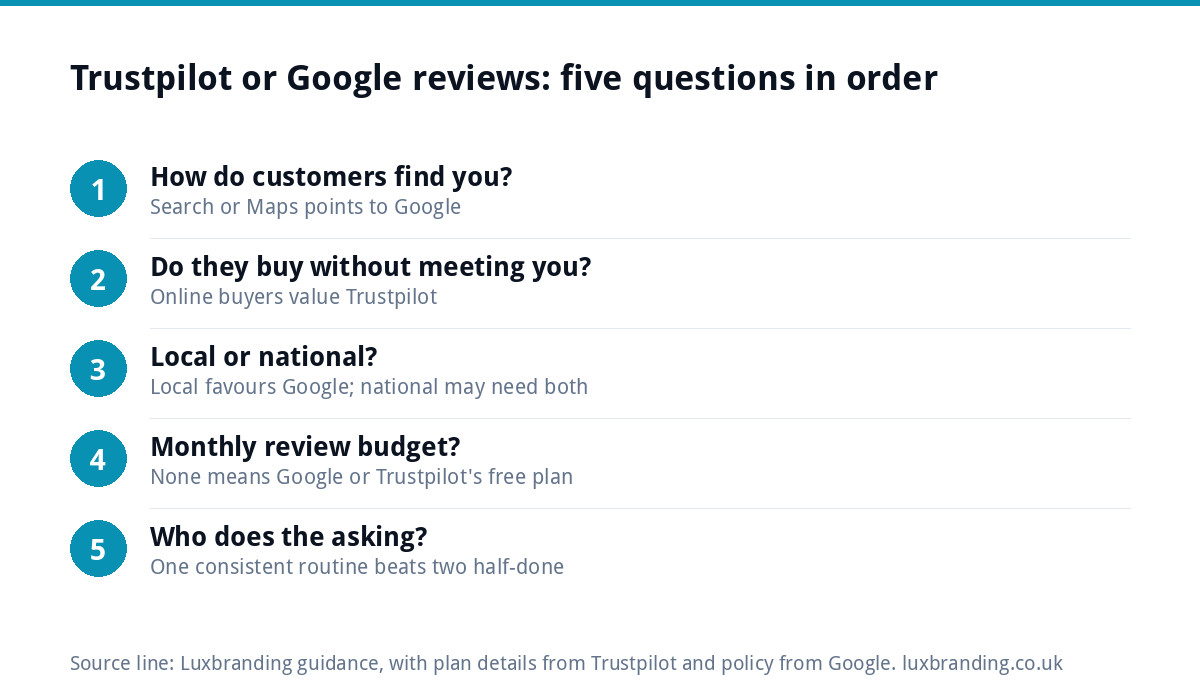
Five questions that settle it
- How do new customers find you? If the answer is Google search or Maps, Google reviews come first.
- Do customers buy without meeting you? Online shops and remote services benefit more from Trustpilot’s third-party reassurance.
- Is your market local or national? Local favours Google; national online brands often need both.
- Can you afford a monthly review budget? If not, Trustpilot’s free plan or Google alone is the sensible start.
- Who will do the asking? One person asking consistently on one platform beats a plan for two that nobody follows.
Which first, by business type
| Business | Focus | Why |
|---|---|---|
| Trades (plumber, electrician, roofer, builder) | Customers search locally and compare map listings | |
| Salon, clinic, cafe, gym | Bookings start from Maps and search | |
| Online shop, UK-wide | Trustpilot, plus Google | Buyers check an unknown seller before paying |
| Subscription or national service | Both | Search visibility and third-party trust both matter |
| B2B consultancy | Google, plus case studies | Buyers check your name in search, then want detail |
Worked example: two businesses, two answers
A roofer covering Derby and the surrounding villages. New customers search “roofer near me”, compare three or four map listings and ring the one with the most convincing recent reviews. Every job ends with a short text that thanks the customer and includes the Google review link, sent the evening the job is signed off. Photos of the finished roof go on the Business Profile the same week. Trustpilot would add cost and a second task without reaching the people who actually hire him.
An online candle shop selling across the UK. Buyers arrive from social posts and search, have never heard of the brand and hesitate at checkout. Here, an independent review site gives reassurance that a brand-new website cannot. Trustpilot’s free invitations go out after delivery, a widget sits near the basket and Google reviews are still collected for brand searches. Paid Trustpilot only makes sense once order volume outgrows the free invitations and the reviews are clearly helping sales.
Same question, opposite answers, both decided by where the customer makes up their mind.
Running both without doubling the work
If you do need both, keep it simple:
- One moment to ask. Ask straight after a job is signed off or an order arrives, the same way every time.
- One link per customer. Do not send two review requests at once. Alternate by month if you must split them, and never choose who to ask based on whether they seem happy.
- Reply to every review. Short, polite and specific on both platforms, including the critical ones.
- Use the words. With permission, good reviews make strong testimonials on your website and in quotes.
When a bad review lands
Every business gets one eventually, on either platform. Do not reply in the heat of the moment. Wait until you can be calm, then reply briefly: thank them, acknowledge the problem without arguing the detail in public, and offer to put it right offline by phone or email. Future customers read your reply more closely than the complaint. If a review breaks the platform’s rules, for example it is about a different business or contains abuse, report it through the platform’s own process rather than asking the customer to remove it.
Getting the Google side right first
Reviews work best on a Business Profile that is complete: right categories, service areas, photos of real work and accurate opening hours. Our guide to Google Business Profile optimisation covers the full setup, and the free GBP optimisation checklist lets you work through it yourself.
If reviews have vanished from your profile, our guide to Google reviews that disappeared explains the usual causes. If the whole profile is in trouble, see what to do when a Business Profile is suspended.
Where we can help
Our Google Business Profile Setup & Optimisation is £199 and covers categories, keywords, photos, a review strategy and tracking, so the profile your reviews sit on is working as hard as it can. Our guide to Google Business Profile setup costs compares doing it yourself with paying for help, and every price is on our pricing page.
The short version
Local business: Google first, and do it well before adding anything else. Online seller with customers across the UK: Trustpilot earns a place, usually alongside Google. Whatever you choose, ask every customer the same way, never pay for reviews and reply to everything. A steady flow of honest reviews on the platform your customers actually check beats a scattered handful everywhere.
Get the UK SEO DIY Audit Checklist (free)
A 32-point checklist UK SMEs can run against their own website in an afternoon. Surfaces the quick wins before paying for a paid audit.
No spam. UK GDPR compliant. We only use your email to send this resource, unless you tick the box to hear from us.
Frequently asked questions
Should a small business use Trustpilot or Google reviews? +
If customers find you through Google search or Maps, focus on Google reviews first: they are free and appear where local customers choose. Trustpilot suits online shops and national brands whose buyers check an unfamiliar seller before paying. Most small businesses do better with a strong profile on one platform than a few reviews on two.
How much does Trustpilot cost in the UK? +
At the time of writing, Trustpilot's business plans page lists a Free plan with 50 review invitations a month, a Plus plan at $319 a month and a Premium plan at $799 a month, per domain and billed annually on a 12-month commitment. Prices are shown in US dollars and change, so check the page before you commit.
Are Google reviews free? +
Yes. Collecting and showing Google reviews costs £0. You need a Google Business Profile, which is also free, and a review link you can share by text, email or QR code. Reviews then appear on your profile, in Google Maps and in search results for your business name.
Can I offer a discount for a review? +
No. Google's policy bans reviews posted because of an incentive from the business, and asks businesses not to selectively ask only happy customers. UK consumer law, now under the Digital Markets, Competition and Consumers Act 2024, also targets fake and incentivised reviews. Ask every customer the same way and offer nothing in return.
What does Luxbranding's Google Business Profile service include? +
Our Google Business Profile Setup and Optimisation is £199 and covers categories, keywords, photos, a review strategy and tracking. It makes sure the profile your reviews appear on is complete and accurate, which matters as much as the number of reviews when a customer is comparing local businesses on Maps.