Quick answer
CPA is what each lead or sale costs in ads: £300 for 10 leads is a £30 CPA. ROAS is sales per pound of ads: £1,500 from £300 is 5x, or 500%. ROI subtracts every cost, including stock, labour and fees, to show real profit. Track CPA for leads, ROAS for shops, ROI for decisions.
Ad platforms, agencies and reports throw these three abbreviations around as if everyone knows the difference. Mixing them up is how a business can look “profitable” in a dashboard while losing money in the bank. This guide explains each one in plain English, shows the maths with UK examples, and helps you choose the number that matters for your business.
The three numbers side by side
| CPA | ROAS | ROI | |
|---|---|---|---|
| Stands for | Cost per acquisition (or action) | Return on ad spend | Return on investment |
| Formula | Ad spend ÷ conversions | Revenue from ads ÷ ad spend | (Profit − total cost) ÷ total cost |
| Answers | What does each lead or sale cost me? | How much revenue does each £1 of ads bring? | Am I actually making money? |
| Includes | Ad spend only | Ad spend and revenue | Every cost: ads, fees, stock, labour, management |
| Best for | Lead generation: trades, services | Online shops with tracked sale values | Deciding whether a channel is worth keeping |
| Main trap | Ignores what the lead is worth | Ignores your margins | Needs honest cost figures |
CPA: cost per acquisition
CPA is the simplest of the three. Divide what you spent on ads by the number of conversions you got. If you spend £600 on Google Ads in a month and get 20 enquiries, your CPA is £30.
“Acquisition” can mean whatever you count as a conversion: a form, a call, a booking or a sale. That flexibility is also the trap. A £30 CPA on enquiries tells you nothing about whether those enquiries became jobs. If one in four becomes work, your real cost per job is £120.
Google’s Target CPA bid strategy uses this number directly: according to Google’s help page on Target CPA bidding, you set the average cost per conversion you want and Google bids to achieve it.
When CPA is the right number
- You sell services, so there is no sale value at the moment someone enquires.
- Most jobs are similar in value, so one lead is much like another.
- You know roughly how many enquiries turn into work.
ROAS: return on ad spend
ROAS compares the revenue your ads brought in with what they cost. If £300 of ads produces £1,500 of sales, your ROAS is 5, often written as 5x or 500%. Google’s page on Target ROAS uses the same maths, in dollars: $5 in sales for each $1 spent is a 500% target.
ROAS needs a value attached to each conversion. Google’s page on conversion values explains that you can use the same value for every conversion, or pass the real value of each transaction from your checkout, which is the most accurate.
The trap is that revenue is not profit. A 3x ROAS sounds healthy, but if your products have a 25% margin, each £1 of ads brings £3 of sales and only 75p of gross profit. You are losing money on every sale before you count anything else.
ROI: return on investment
ROI is the number your accountant cares about. It compares the profit a channel produces with everything it costs: ad spend, management fees, the cost of the goods or labour, payment fees, and your own time if you want to be strict.
The formula is: (gross profit from the channel minus total cost) divided by total cost. A positive ROI means the channel makes money. A negative one means it does not, however good the ROAS looks.
ROI is harder to measure because it needs honest cost figures, and some returns take months to arrive. A new customer who books a service every year is worth far more than the first job suggests.
A worked example: a plumber and an online shop
| Plumber | Online candle shop | |
|---|---|---|
| Monthly ad spend | £600 | £600 |
| Management fee | £199 | £199 |
| Conversions | 20 enquiries | 60 sales |
| CPA (ad spend ÷ conversions) | £30 per enquiry | £10 per sale |
| Revenue | 5 jobs at £400 = £2,000 | 60 sales at £35 = £2,100 |
| ROAS (revenue ÷ ad spend) | 3.3x | 3.5x |
| Gross profit (after parts or stock) | £1,300 | £840 |
| Total cost (ads + fee) | £799 | £799 |
| ROI | +63% | +5% |
These are example figures to show the method, not benchmarks. Both businesses have a similar ROAS. The plumber is clearly making money, because labour is the main cost and the margin is high. The shop barely breaks even, because stock eats most of each sale. Same ROAS, very different outcomes.
Break-even ROAS: the number every shop should know
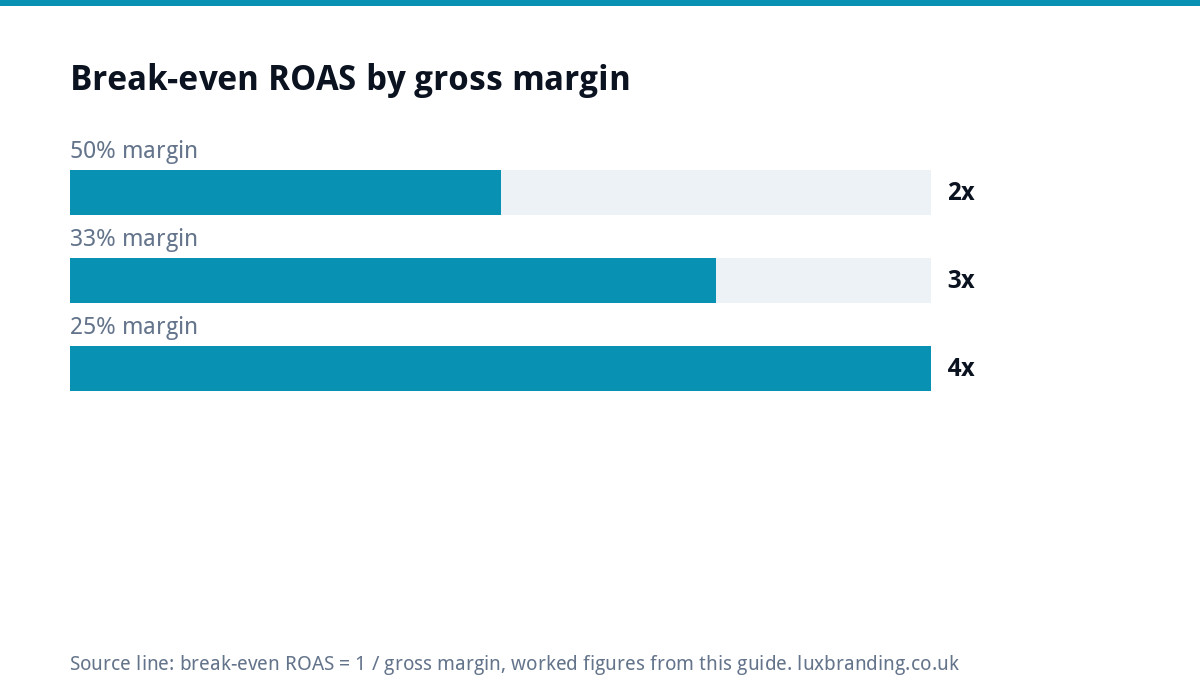
If you sell products, work out the ROAS at which your ads stop losing money. The quick version is: break-even ROAS = 1 ÷ your gross margin.
- A 50% margin means a break-even ROAS of 2x.
- A 33% margin means a break-even ROAS of 3x.
- A 25% margin means a break-even ROAS of 4x.
Anything below that line loses money on ad spend alone. Anything above it starts to pay for fees, overheads and profit. If your shop gets traffic but the numbers never add up, our guide to a store with traffic but no sales covers the usual leaks.
Which number should you track?
| Business type | Track weekly | Check monthly |
|---|---|---|
| Trade or local service | CPA per enquiry | Cost per job won, and ROI |
| Online shop | ROAS against break-even | ROI after stock and fees |
| High-value B2B service | CPA per qualified lead | ROI over several months |
| Bookings and appointments | CPA per booking | Repeat visits and ROI |
Whatever you track, it is only as good as the tracking behind it. If form submissions do not record, CPA looks worse than it is; if a purchase records twice, ROAS looks better than it is. Our guide to a website contact form not working covers the checks for lead forms.
Using all three in a monthly review
The numbers work best together, in order, once a month:
- Start with CPA for each campaign. Has the cost per enquiry or sale moved since last month, and why?
- Check quality. For leads, how many became quotes and jobs? For shops, did returns or refunds rise?
- Work out ROAS where you have sale values, and compare it with your break-even line.
- Finish with ROI, adding management fees, payment fees and the cost of the goods or labour.
- Decide one change for next month: a new ad, a better landing page, a paused keyword or a budget shift.
Write the figures in the same spreadsheet each month. After a quarter you will see trends that a single month hides.
Lifetime value changes the picture
A first job or first sale is not the whole story. A window cleaner who wins a customer on a four-weekly round, or a shop whose buyers come back every few months, earns far more from each customer than the first transaction shows. If you know roughly what a customer is worth over a year, you can afford a higher CPA, and a channel with a modest first-sale ROI may be one of your best. Be honest about it, though: use real repeat figures from your own records, not hopes.
Common mistakes with all three
- Celebrating a high ROAS on a low-margin product that loses money.
- Counting clicks or page views as conversions, which makes CPA look far better than reality.
- Leaving out management fees and your own time from ROI.
- Judging after a week, when leads from services can take weeks to turn into jobs.
- Comparing platforms on different definitions, such as one counting a call and another counting a form.
- Ignoring repeat customers, which makes channels that win loyal buyers look worse than they are.
Improving the numbers
All three numbers improve when more of the people who click go on to act. That usually comes down to the page they land on: a clear offer, a visible price or price guide, proof and a short form. A focused landing page is £199 with us, and for shops, our E-commerce Website is £499 for up to 20 products with Stripe and PayPal payments.
Getting campaigns measured properly
Our Google Ads management is £199 a month for up to £5,000 of monthly ad spend, with conversion tracking set up and no percentage taken from your budget. Our Meta ads management is priced the same way, with monthly reports covering cost per lead and ROAS by campaign. Every fixed price is on our pricing page.
Get the UK SEO DIY Audit Checklist (free)
A 32-point checklist UK SMEs can run against their own website in an afternoon. Surfaces the quick wins before paying for a paid audit.
No spam. UK GDPR compliant. We only use your email to send this resource, unless you tick the box to hear from us.
Frequently asked questions
What is the difference between ROAS and ROI? +
ROAS compares the revenue your ads produced with the ad spend alone: £1,500 of sales from £300 of ads is 5x. ROI compares profit with every cost, including stock or labour, management fees and payment fees. A business can have a healthy-looking ROAS and a negative ROI if its margins are thin.
What is a good CPA? +
One that leaves a profit once you account for how many leads become work and what a job is worth. If one in four enquiries becomes a £400 job, a £30 cost per enquiry means about £120 per job won, which may be fine. Compare CPA with your close rate and job value, not with other businesses.
What is a good ROAS for a small online shop? +
Anything comfortably above your break-even ROAS, which is 1 divided by your gross margin. With a 50% margin you break even at 2x; with a 25% margin you need 4x just to cover ad spend. Fees, overheads and profit have to come from the ROAS above that line.
Should a trade business track ROAS? +
Usually not as the main number. Trades and service businesses rarely know a sale value when someone enquires, so CPA per enquiry is the practical weekly measure. Check cost per job won and ROI monthly, once you know which enquiries became paid work and what each was worth.
Can you set up tracking so we can see these numbers? +
Yes. Our Google Ads management is £199 a month for up to £5,000 of monthly ad spend, with conversion tracking set up and no percentage taken from your budget. Our Meta ads management is priced the same way, with monthly reports covering cost per lead and ROAS by campaign. Every fixed price is on our pricing page.