Quick answer
On standard UK cards the two are close: Stripe charges 1.5% + 20p and PayPal’s Advanced card payments 1.2% + £0.30. Payments made through a customer’s PayPal account cost more, at 2.9% + £0.30. Most UK small shops do best taking cards as the main option and adding a PayPal button for buyers who want it.
Fees in this guide come from Stripe’s and PayPal’s UK pricing pages, checked at the time of writing, October 2026. Both change their fees from time to time and offer custom rates at higher volumes, so check before you decide.
What each one is
- Stripe is a card payment processor. Customers type their card details (or use Apple Pay or Google Pay) on your checkout, and Stripe processes the payment. Most customers never see the Stripe name.
- PayPal is both a payment processor and a consumer account. Many buyers have a PayPal login and like paying with it, because they do not have to share card details with a shop they do not know. PayPal also offers card processing for businesses.
So the question is rarely “which one”. It is “which one handles cards, and do I also want the PayPal button”. Both can sit on the same checkout, and most shop platforms support both, so choosing one does not rule out the other.
Fees side by side
| Payment type | Stripe (UK) | PayPal (UK) |
|---|---|---|
| Standard UK cards | 1.5% + 20p | 1.2% + £0.30 (PayPal Advanced card payments, blended pricing) |
| Premium UK cards | 2.8% + 20p | Covered by the card pricing above |
| Customer pays with a PayPal account | Not applicable | 2.9% + £0.30 (domestic PayPal checkout) |
| EEA cards or senders | 2.5% + 20p | Domestic fee plus 1.29% |
| International cards or senders | 3.15% + 20p | Domestic fee plus 1.99% |
| Currency conversion | +2% | 3% above the base exchange rate |
| American Express | Check Stripe’s page | 3.5% via PayPal Advanced |
| Monthly or setup fees | None on standard pricing | Check your account type |
Sources: Stripe UK pricing and PayPal UK business fees, both checked October 2026. Stripe’s page states “no setup fees, monthly fees, or hidden fees” for its standard pricing.
Worked example: what a £50 sale costs
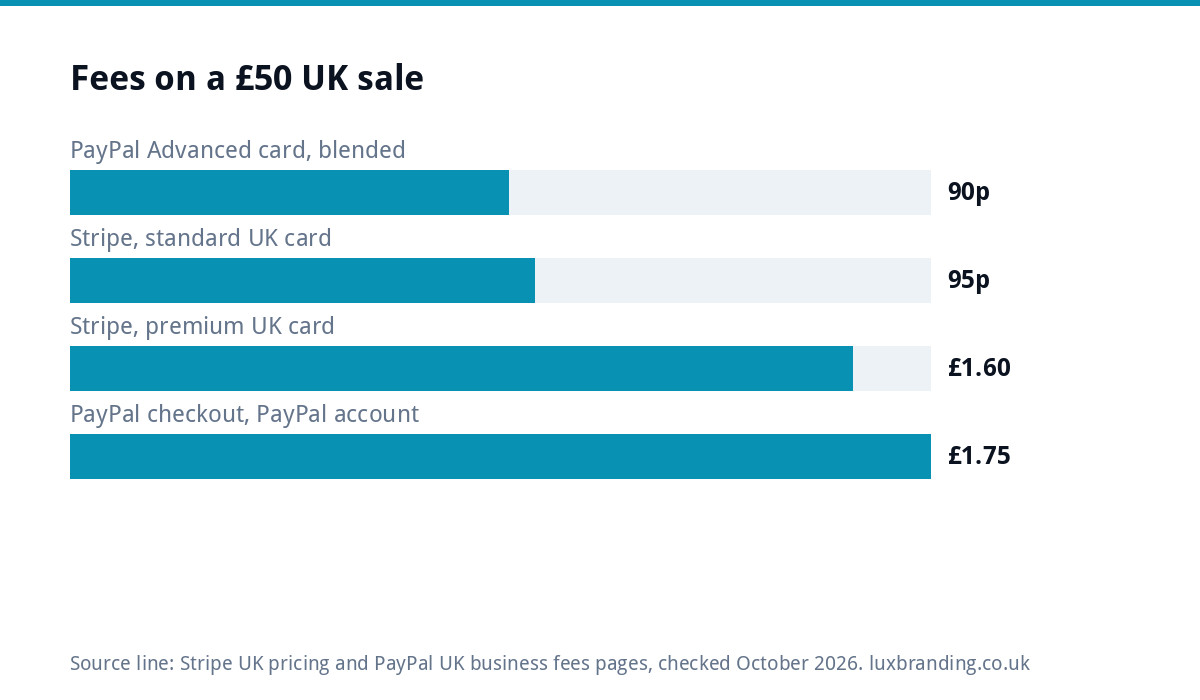
Using the published rates above for a single £50 sale from a UK customer:
- Stripe, standard UK card: 1.5% of £50 is 75p, plus 20p, so 95p.
- Stripe, premium UK card: 2.8% of £50 is £1.40, plus 20p, so £1.60.
- PayPal checkout, customer pays with their PayPal account: 2.9% of £50 is £1.45, plus 30p, so £1.75.
- PayPal Advanced card payment, blended rate: 1.2% of £50 is 60p, plus 30p, so 90p.
Over a month of 40 such sales (£2,000), standard-card fees come to £38 on Stripe and £36 on PayPal’s Advanced card pricing, while the same sales paid through PayPal accounts come to £70. The big gap is between card payments and PayPal-account payments, not between the two card processors.
Small sales favour the lower fixed fee
Stripe’s fixed fee is 20p against PayPal’s 30p, while PayPal’s Advanced card percentage is lower. On these published rates the two cost the same at about £33.33 a sale. Below that, Stripe’s standard UK card fee is lower (a £10 sale costs 35p on Stripe and 42p on PayPal Advanced). Above it, PayPal’s blended card rate is lower. If most of your sales are small, the fixed fee matters more than the percentage.
Worked example: a trade taking deposits
Say a plasterer takes a £200 deposit online before booking a job, and the customer pays by standard UK card. On Stripe that costs 1.5% of £200 (£3) plus 20p, so £3.20. On PayPal’s Advanced card pricing it costs 1.2% (£2.40) plus 30p, so £2.70. If the customer instead pays through their PayPal account, it costs 2.9% (£5.80) plus 30p, so £6.10.
On larger payments like deposits, the percentage matters more than the fixed fee, so PayPal’s card rate edges ahead, and payments through a PayPal account cost roughly twice as much as card payments. For a trade taking a few deposits a month, the difference is a few pounds either way. Choose on convenience first: which link is easiest to send, and which payment your customers are most likely to complete.
Getting paid: when the money arrives
Cash flow matters as much as fees for a small business. Stripe’s documentation on payouts says your first payout is typically scheduled within 7 to 14 days of your first live payment, depending on your industry, country and risk level. For UK accounts it lists an initial settlement time of 7 calendar days, then a default of 3 business days, with a minimum payout of £1.
With PayPal, payments arrive in your PayPal balance, and you transfer them to your bank. Check the current transfer options and any holds for new accounts in your PayPal business account before you rely on the timing.
Where Stripe wins
- A lower fixed fee (20p), which makes it cheaper on small card sales.
- A checkout that stays on your site, so the customer is not sent elsewhere to pay.
- Wallets built in, such as Apple Pay and Google Pay, which make phone checkouts quick.
- Clear, published pricing with no monthly fee on standard pricing.
Where PayPal wins
- Buyer trust. Some customers will not type card details into a site they have never used, but will happily press a PayPal button.
- Familiarity for older customers and for people buying from small or new shops.
- Useful for invoices and one-off payments, where the customer already has a PayPal account.
The trade-off is the higher fee on PayPal account payments and a higher currency conversion charge if you sell abroad.
If you sell abroad
Currency conversion is where the two differ most. Stripe adds 2% where conversion is needed; PayPal charges 3% above its base exchange rate when converting a balance or a transaction where you bear the conversion. On £100 of converted sales, that is £2 against £3, on top of the international fees in the table. If overseas customers are a large part of your sales, model a typical month on both before choosing.
Which suits your business
| Your situation | Sensible setup | Why |
|---|---|---|
| Small online shop, UK customers | Stripe for cards, plus a PayPal button | Low card fees, and an option for PayPal fans |
| Trades taking deposits online | Stripe payment links or checkout | Simple card payments with low fees |
| Selling mainly to overseas buyers | Compare both with your currency mix | Conversion and international fees differ |
| Booking-based business | Whichever your booking system supports best | The booking tool often decides |
| Brand-new shop with no reviews yet | Both | PayPal reassures first-time buyers |
If you take bookings, our guide to booking system costs covers how payments fit in.
Setting both up without slowing the checkout
Offering both should not mean a cluttered checkout. A tidy setup looks like this:
- Card payment fields, with Apple Pay and Google Pay, as the main option.
- A single PayPal button underneath, not a second checkout page.
- Both payment methods tested on a phone after every update.
- Webhooks (the messages that tell your shop a payment worked) checked in each dashboard after setup.
- Payouts to the same business bank account, so your bookkeeping stays simple.
If shoppers are dropping out before they pay, the payment method is only one possible cause. Our guide to an online store with traffic but no sales covers the others.
Things to check before you decide
- Your likely mix of standard and premium cards (premium business and reward cards cost more on Stripe).
- How many of your customers are outside the UK.
- Whether your shop platform supports both cleanly. Our Shopify vs WooCommerce comparison covers platform payment options.
- The current fees on each provider’s own page, since both change.
The simplest test is your own last three months. Take your real sales, split them by size and by how customers paid, and work out the fees on each provider using the rates above. Ten minutes with a spreadsheet beats any general rule, because your mix of sale sizes and card types is what decides it.
What we set up
Every e-commerce website we build comes with Stripe and PayPal set up. Our E-commerce Website is £499 one-off for up to 20 products, on WooCommerce or Shopify, hand-coded with no page builders, and you own the code. Our e-commerce cost guide covers bigger shops, which we quote in writing before any work starts. For upkeep, our Website Management and Hosting plan is £20 a month. Every price is on our pricing page.
Get the UK Website Project Brief Template (free)
A two-page template for briefing any UK web designer: sitemap, integrations, audience and deliverables. Cuts revision rounds in half.
No spam. UK GDPR compliant. We only use your email to send this resource, unless you tick the box to hear from us.
Frequently asked questions
Is Stripe cheaper than PayPal in the UK? +
It depends on the payment type and sale size. On standard UK cards, Stripe lists 1.5% + 20p and PayPal's Advanced card payments 1.2% + £0.30, which cost the same at about £33 a sale; Stripe is cheaper below that. Payments through a customer's PayPal account cost more, at 2.9% + £0.30.
How much does Stripe take from a £50 sale? +
On a standard UK card, 1.5% of £50 is 75p plus a 20p fixed fee, so 95p. On a premium UK card at 2.8% + 20p, it is £1.60. The same sale paid through a domestic PayPal checkout at 2.9% + £0.30 costs £1.75. These use the published rates checked in October 2026.
Should a small shop offer both Stripe and PayPal? +
Usually, yes. Stripe handles card payments with a low fixed fee and keeps the checkout on your site, while a PayPal button reassures buyers who prefer not to share card details with a new shop. Keep cards as the main option and add a single PayPal button rather than a separate checkout.
How quickly does Stripe pay out in the UK? +
Stripe says the first payout is typically scheduled within 7 to 14 days of your first live payment, depending on industry, country and risk. For UK accounts its documentation lists an initial settlement time of 7 calendar days, then 3 business days by default, with a minimum payout of £1.
Do your websites come with Stripe and PayPal? +
Yes. Every e-commerce website we build comes with Stripe and PayPal set up. Our E-commerce Website is £499 one-off for up to 20 products, on WooCommerce or Shopify, and you own the code. Larger shops are quoted in writing before any work starts.