Quick answer
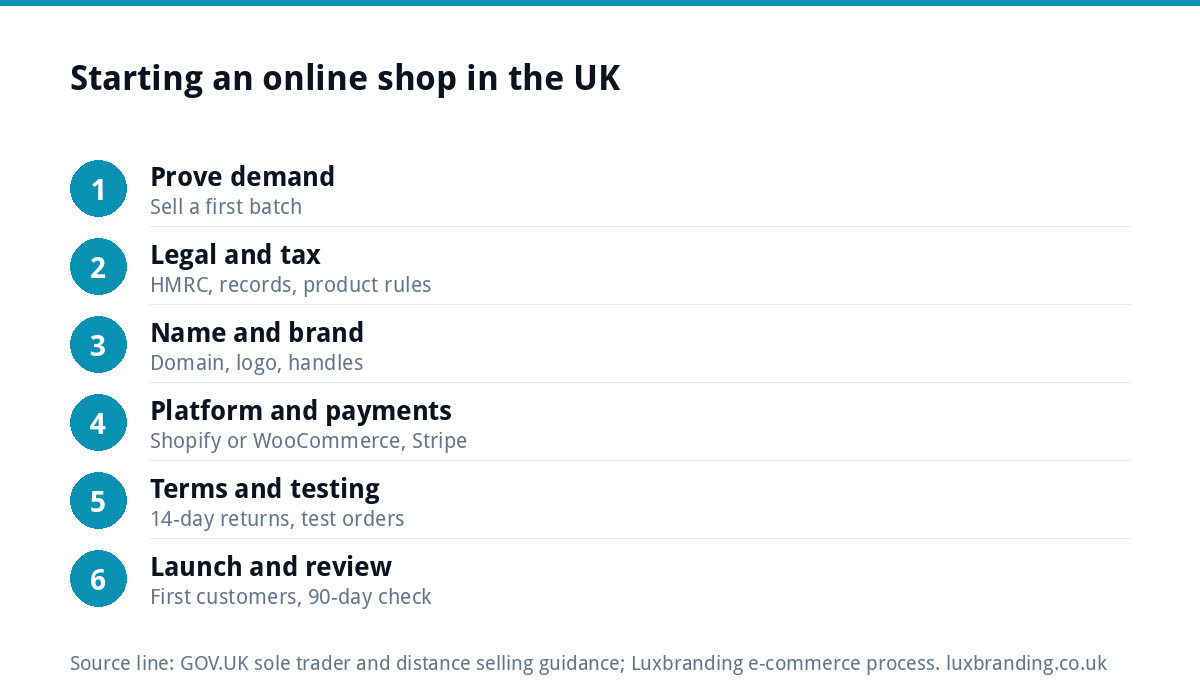
To start an online shop in the UK: test that people want your product, register with HMRC once trading income passes £1,000 a year, choose a name and domain, pick a platform such as Shopify or WooCommerce, connect card payments, write clear delivery and returns terms, photograph your products well, test every checkout path, then launch and market it.
Below is the full ten-step order we recommend, with what each step involves, what it typically costs and the mistakes that delay most first-time sellers.
Step 1: prove people will buy before you build
The most expensive online shop is one nobody visits. Before spending on a website, find out whether your product sells at a price that leaves you a profit.
- Sell a first batch to friends, at a market, through Instagram messages or on a marketplace such as Etsy or eBay.
- Work out your true unit cost: materials, packaging, postage, payment fees and your time.
- Look at what similar products sell for, and decide where you sit: cheaper, better or different.
If you already sell on a marketplace and want your own shop, our comparison of Shopify and WooCommerce will help you choose where to move.
Step 2: sort the legal and tax basics
Most new online sellers in the UK start as sole traders. GOV.UK’s guide to setting up as a sole trader says you can start trading straight away, but you must register for Self Assessment if you earn more than £1,000 in a tax year (6 April to 5 April). Some people set up a limited company instead for liability or tax reasons, which is worth a short conversation with an accountant.
You will also need to think about:
- Records: keep every receipt and sale from day one. A simple spreadsheet or bookkeeping app is enough at first.
- VAT: you must register if taxable turnover for the last 12 months goes over £90,000, according to GOV.UK’s VAT registration page. Most new shops are well under this.
- Product rules: cosmetics, toys, food, candles and electrical items each carry their own safety and labelling rules. Check yours before you list anything.
Step 3: name, domain and logo
Choose a name that is easy to spell, not already used by a competitor, and available as a domain and a social handle. Our business name checker runs the first checks for free, and the UK domain names guide explains .co.uk versus .com and where to register.
Your logo appears on the site, packaging, labels, invoices and social profiles, so get it right once. Our Logo Design is £129 with every file format and stacked, horizontal and icon-only layouts included, which covers the small spaces a shop needs, like the browser tab icon and the shipping label.
Step 4: choose your selling platform
There are three realistic routes for a small UK seller. Each suits a different stage.
| Route | Best for | What you pay | Main trade-off |
|---|---|---|---|
| Marketplace (Etsy, eBay, Amazon) | Testing demand with no website | Listing and sale fees per item | The customer belongs to the marketplace, not you |
| Shopify | Getting live quickly with little technical work | A monthly plan plus apps and payment fees | Ongoing subscription, harder to move away later |
| WooCommerce on WordPress | Owning the whole shop and its code | Hosting plus a one-off build | Needs updates and care, or someone to manage them |
At the time of writing, November 2026, Shopify’s UK pricing page lists its Basic plan at £25 a month paid monthly, or £19 a month paid yearly. Plan prices change, so check before you commit. For a fuller breakdown of build costs, see our e-commerce website cost guide.
Step 5: set up payments
Customers expect to pay by card, with Apple Pay and Google Pay on mobile, and many still look for PayPal. Stripe is the most common card processor for small UK shops. At the time of writing, November 2026, Stripe’s UK pricing lists standard UK cards at 1.5% + 20p per transaction. Build payment fees into your prices from the start rather than discovering them at the end of the month.
Before launch, open a separate business bank account so shop money never mixes with personal spending. It makes bookkeeping and your tax return far simpler.
Step 6: product photos and descriptions
Online, the photo is the product. Shoppers cannot pick anything up, so the pictures and words have to answer every question a customer would ask in a shop.
- Shoot on a plain background in daylight, plus at least one photo showing the item in use or held for scale.
- Write descriptions that cover size, materials, care, what is in the box and who it is for.
- Use the same photo style across every product so the shop looks like one brand.
- Design packaging and labels that match. Our guides to packaging for small brands and product label design cover the details.
Step 7: delivery, returns and your legal pages
UK distance selling rules apply from your first sale. GOV.UK’s distance selling guidance says you must tell customers they can cancel their order up to 14 days after it is delivered. If you do not tell them, they can cancel at any time within the next 12 months. You must also give your business name and contact details, the full price including taxes, delivery details and cancellation rights before an order is placed.
That means your shop needs, at a minimum:
- A delivery page with prices, carriers and typical times.
- A returns and cancellations page that matches the law.
- Terms and conditions of sale.
- A privacy notice explaining what you do with customer data.
A startup cost breakdown
Costs vary widely, but these are the lines most small shops pay for in the first year. Third-party prices are at the time of writing, November 2026, and change regularly.
| Item | DIY route | Done for you |
|---|---|---|
| Logo and brand basics | Your time, plus a design tool | £129 Logo Design |
| Shop build | Shopify Basic from £19 a month paid yearly | £499 E-commerce Website, up to 20 products |
| Hosting and care (WooCommerce) | Hosting plan plus your time on updates | £20 a month Website Management & Hosting |
| Card payments | Stripe at 1.5% + 20p per standard UK card | Same fees, set up for you |
| Photography | Phone, daylight and a plain backdrop | A local product photographer |
Step 8: test everything, then launch
Before you tell anyone the shop is open, place real orders yourself. Buy on a phone and a laptop, use a discount code, pay by card and by PayPal, request a refund, and check every email the shop sends. Make sure order notifications reach you and do not land in spam. Our website launch checklist covers the technical checks, from redirects to analytics.
Step 9: get your first customers
A new shop has no search traffic, so the first sales come from people you can reach directly.
- Tell existing customers, friends and followers, with a launch offer that has a closing date.
- Post regularly on the one or two social platforms your buyers actually use.
- Collect email addresses from the start, with clear consent.
- Ask every early buyer for a review and a photo.
- Add a small paid ads budget only once tracking shows which products sell.
Step 10: review after 90 days
After three months, look at which products sell, where buyers came from and where visitors drop out. Raise prices on the products that sell without effort, drop the ones that do not, and fix the pages where people leave. The shops that last are the ones that keep adjusting.
Mistakes that delay most first-time sellers
- Launching with 200 products. Start with your best sellers and add more once the first ones are photographed, described and selling.
- Free delivery with no maths behind it. Postage on a heavy, low-price item can wipe out the whole margin. Set a free delivery threshold that your numbers support.
- Endless app installs. Every extra app or plugin adds cost, slows the shop down and gives you something else to maintain. Add one only when a real problem needs it.
- Copying a competitor’s terms. Their returns policy may not match your products or the law. Write your own from the GOV.UK guidance.
- Waiting for perfect. A clear, working shop with ten good products beats a half-finished one with everything. Launch, learn, then improve.
Getting your shop built
If you would rather spend your time on products than plugins, our E-commerce Website is £499 one-off for up to 20 products on WooCommerce or Shopify, with Stripe and PayPal connected, a mobile-first build, an SEO foundation and 30 days of support. You own the site and can host it anywhere. Every price is on our pricing page.
Get the UK Website Project Brief Template (free)
A two-page template for briefing any UK web designer: sitemap, integrations, audience and deliverables. Cuts revision rounds in half.
No spam. UK GDPR compliant. We only use your email to send this resource, unless you tick the box to hear from us.
Frequently asked questions
Do I need to register a business to sell online in the UK? +
You can start trading straight away as a sole trader, but GOV.UK says you must register for Self Assessment if you earn more than £1,000 in a tax year. Keep records from your first sale. Some sellers set up a limited company instead, which is worth discussing with an accountant before you grow.
Should I start on Etsy or build my own shop? +
A marketplace such as Etsy is a low-risk way to test whether people buy your product, because it brings its own shoppers. The trade-off is fees on every sale and customers who belong to the marketplace. Once sales are steady, your own shop on Shopify or WooCommerce lets you keep the customer relationship.
What legal pages does a UK online shop need? +
At a minimum: delivery information, a returns and cancellations page, terms and conditions of sale and a privacy notice. UK distance selling rules require you to tell customers they can cancel up to 14 days after delivery, and to give your business details, full prices and delivery information before they order.
How much does it cost to start an online shop? +
A DIY start can be cheap: Shopify's Basic plan was listed at £19 a month paid yearly at the time of writing, plus Stripe's 1.5% + 20p on standard UK cards. A professionally built shop from us is £499 one-off for up to 20 products, with a £129 logo if you need one.
Can Luxbranding build my online shop? +
Yes. Our E-commerce Website is £499 one-off for up to 20 products on WooCommerce or Shopify, with Stripe and PayPal connected, a mobile-first build, an SEO foundation and 30 days of support. You own the code and can host anywhere, or use our £20 a month management and hosting.