
Quick answer
A small UK online store typically costs a few hundred to a few thousand pounds a year to run. The fixed core is hosting or a platform plan (£20 a month with us, or £25 a month for Shopify Basic billed monthly) and a domain, then card fees of about 1.5% to 2% per sale, apps, postage, marketing and bookkeeping.
The build is a one-off. Running costs come back every month, and they are what decides whether the store makes money. Below are the nine line items almost every UK store pays, a budget table, two worked examples at different sizes and the costs that creep up once you grow.
The nine running costs, line by line
These are the costs of keeping a store open and selling, not the cost of building it. For build prices, see our guide to e-commerce website costs.
| Line item | How it is charged | What to budget |
|---|---|---|
| 1. Platform or hosting | Monthly | Shopify Basic £25 billed monthly or £19 billed yearly; WooCommerce hosting £20 a month with us |
| 2. Domain name | Yearly | Usually a small yearly fee |
| 3. Card processing | Per sale | Stripe 1.5% + 20p per standard UK card |
| 4. Apps, plugins or extensions | Monthly or yearly | Only the ones you actually use |
| 5. Email marketing tool | Monthly, by list size | Free tiers exist for small lists |
| 6. Postage and packaging | Per order | Priced into delivery charges or margin |
| 7. Marketing and ads | Monthly | The most variable line; set a cap |
| 8. Bookkeeping and accounts | Monthly or yearly | Software, an accountant, or both |
| 9. Data protection fee | Yearly | Payable to the ICO unless exempt |
Platform or hosting: the fixed cost
On a hosted platform such as Shopify, the plan covers hosting, security and the checkout. At the time of writing (October 2026), Shopify’s UK pricing page lists Basic at £25 a month billed monthly or £19 billed yearly, and Grow at £65 a month or £49 billed yearly.
On WooCommerce, there is no platform subscription, but you need hosting, security and updates. Our website management and hosting is £20 a month with UK hosting, SSL, daily backups, security monitoring, automatic updates and up to 3 business email mailboxes. The wider picture is in our guide to website hosting costs.
Card fees: the cost that grows with sales
Every card payment carries a fee. Stripe’s UK pricing lists 1.5% + 20p for standard UK cards, 2.8% + 20p for premium UK cards and 3.15% + 20p for international cards. Shopify’s own online rate on Basic is 2% + 25p for a standard card, and Shopify adds a fee if you use a third-party payment provider instead of its own.
The fixed pence part matters more than people expect. On a £10 order, 20p is an extra 2% on top of the percentage. Stores with low order values should watch it closely.
Apps, plugins and the creep problem
This is the line that quietly doubles. Reviews, upsells, wishlists, shipping rules, subscriptions, translation: each is a small monthly charge that seemed worth it at the time. Twice a year, list every app or plugin, what it costs and whether anyone would notice if it went. Cancel the ones nobody would miss.
A well-built store needs fewer add-ons because the basics are already done properly. That is one reason we build without page builders: fewer moving parts to pay for and update.
Email marketing: small now, bigger later
An email list is the cheapest way to win a second order, so most stores need a sending tool. Most tools price by the number of contacts, with free tiers for small lists, which means this line grows as the store succeeds. Set up the essential automations once (welcome, abandoned basket, post-purchase thank you) and the tool earns its keep. If you would rather have someone build it for you, see our email marketing automation service.
Domain and business email
The domain is a small yearly fee, but losing it would take the store offline, so register it in your own name and keep auto-renew on. Business email at that domain looks more trustworthy on order confirmations than a free webmail address, and it is included with our hosting.
Postage, packaging and returns
Postage is usually the biggest per-order cost after the product itself. Decide early whether you charge it at cost, build it into the price or offer free delivery over a threshold, and test what that does to your margin. Packaging, labels and returns add more. Customers buying online from a UK business generally have a 14-day right to cancel, so budget for a share of goods coming back.
The three common delivery approaches each move the cost somewhere different:
- Charge at cost: honest and simple, but a high delivery charge that first appears at checkout can put buyers off.
- Build it into the price: the product looks dearer, the checkout looks cleaner.
- Free over a threshold: nudges buyers to add an item, as long as the threshold sits just above your typical basket.
Marketing: the line that decides everything
A new store gets almost no visitors on its own. Budget for one or more of: search ads, social ads, email, content and search engine optimisation. Set a monthly cap you can afford for six months, because most channels need time before you can judge them, and track which channel each order came from so you know where to put the next pound. If you have the time but not the cash, content and an email list cost effort rather than money.
Admin costs nobody mentions
- Bookkeeping: accounting software, an accountant at year end, or both.
- Data protection fee: the ICO’s data protection fee page says organisations that use personal information, including sole traders, must pay a fee unless they are exempt. An online store holding customer names and addresses should check.
- VAT: GOV.UK sets the VAT registration threshold at £90,000 of taxable turnover in the last 12 months. Crossing it changes your pricing, not just your paperwork.
- Insurance: product liability and business cover, depending on what you sell.
Worked example: two stores, one year
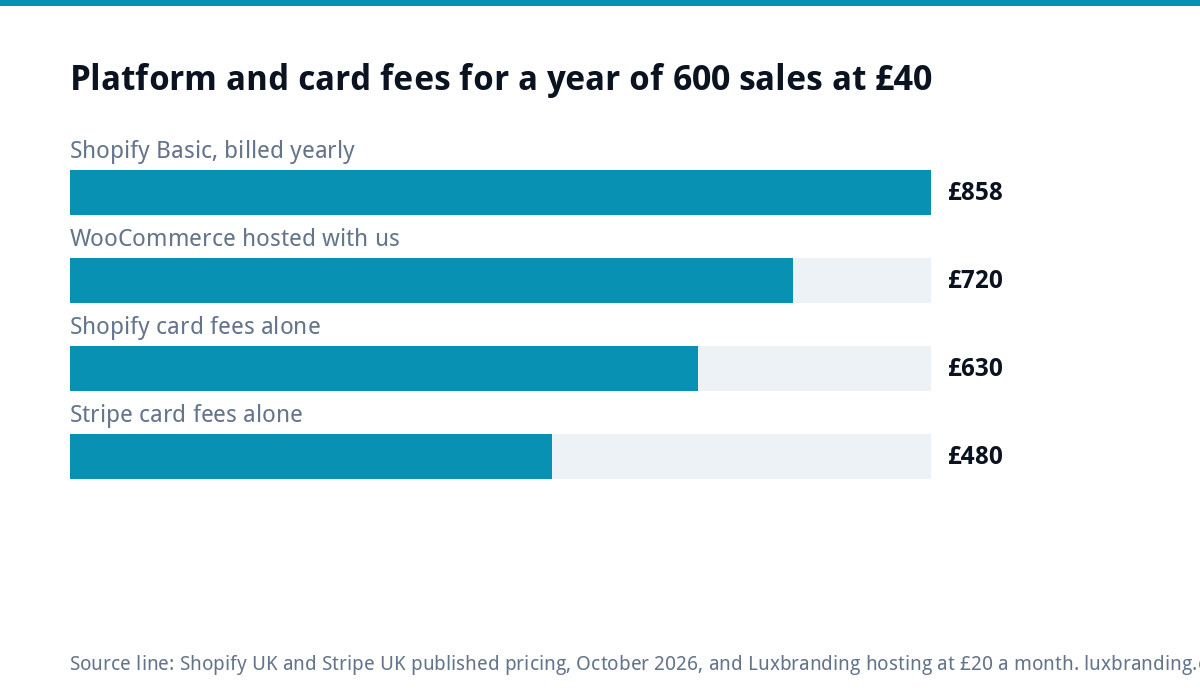
Two illustrative stores, both making 600 sales a year at £40 each (£24,000 in sales), using the published rates above. Postage, stock, apps, marketing and admin vary too much to average, so they are left as your own figures.
| Cost for the year | Shopify Basic, billed yearly | WooCommerce, hosted with us |
|---|---|---|
| Platform or hosting | £228 (£19 x 12) | £240 (£20 x 12) |
| Card fees on 600 x £40 | £630 (2% + 25p each) | £480 (Stripe 1.5% + 20p each) |
| Business email mailboxes | Not included in the plan | Up to 3 included |
| Platform updates | Handled by Shopify | Included in the £20 a month |
| Subtotal before your own costs | £858 | £720 |
Neither figure includes the domain, apps, postage, marketing or admin. For most small stores, marketing ends up bigger than everything in this table put together, which is why the platform choice is rarely the thing that makes or breaks a year. Our comparison of Shopify vs WooCommerce covers the trade-offs beyond price.
By situation: where the money goes
- Just launched, few orders: fixed costs dominate. Keep the app list short and spend on getting the first customers.
- Steady sales: card fees and postage take over. Review delivery pricing and your payment setup.
- Growing fast: marketing and admin grow. Watch the VAT threshold and consider whether a higher platform tier lowers card rates enough to pay for itself.
- Selling cheap items: the fixed pence on each card payment hurts most. Bundles and minimum order values help.
Keeping the running costs low
- Pay yearly for anything you are sure you will keep.
- Audit apps and plugins every six months.
- Price postage honestly rather than absorbing it by default.
- Put upkeep on a fixed monthly fee so it never arrives as a surprise bill. Our guide to website maintenance costs explains what that should cover.
- Own your domain in your own name, as our domain names guide explains.
Building the store in the first place
Our e-commerce website is £499 one-off for up to 20 products on WooCommerce or Shopify, with Stripe and PayPal. It is hand-coded with no page builders, you own the code and can host anywhere, and it includes an SEO foundation, Google Analytics, a written CMS walkthrough and 30 days of support. All prices are on our pricing page, and the website cost calculator gives a first figure for your setup.
Get the UK Website Project Brief Template (free)
A two-page template for briefing any UK web designer: sitemap, integrations, audience and deliverables. Cuts revision rounds in half.
No spam. UK GDPR compliant. We only use your email to send this resource, unless you tick the box to hear from us.
Frequently asked questions
How much does it cost to run an online store in the UK each year? +
For a small store, the fixed core is a few hundred pounds a year: hosting or a platform plan and a domain. Card fees then add about 1.5% to 2% plus a few pence per sale. Apps, postage, marketing and bookkeeping vary widely, and marketing is usually the biggest line once you are trying to grow.
Is Shopify or WooCommerce cheaper to run? +
On our worked example of 600 sales at £40, Shopify Basic billed yearly came to £858 for the plan and card fees, and WooCommerce hosted with us came to £720 for hosting and Stripe fees. The gap is small next to marketing and postage, so choose on how you want to run the store, not on this line alone.
What running costs do new store owners forget? +
The usual ones are app and plugin subscriptions that pile up, the fixed pence on every card payment, returns, the ICO data protection fee that most organisations handling personal information must pay unless exempt, and VAT once taxable turnover passes the £90,000 threshold. Bookkeeping and insurance are easy to leave out of a first budget too.
Do I need to pay the ICO data protection fee for an online shop? +
The ICO says organisations that use personal information, including sole traders, must pay a data protection fee unless they are exempt. An online shop handles customer names, addresses and emails, so check the ICO's guidance and its self-assessment for your business rather than assuming you are exempt.
What does Luxbranding charge to build and host an online store? +
Our e-commerce website is £499 one-off for up to 20 products on WooCommerce or Shopify, with Stripe and PayPal. Website management and hosting is £20 a month with UK hosting, SSL, daily backups, security monitoring, automatic updates and up to 3 business email mailboxes. Larger stores and custom features are quoted in writing first.