
Quick answer
A UK membership website costs little or nothing up front on a hosted platform that charges monthly or takes a share (Patreon takes 10% of income), a WordPress site from £499 plus a plugin licence and a quoted member area, or from £1,999 for a custom-built members area. Card fees, renewals, hosting and email come on top.
Below we price all three routes from the vendors’ own pricing pages, then add the running costs that most quotes leave out, your data duties as a UK organisation, four worked scenarios and a checklist for briefing a build.
What you are actually paying for
Every membership site, however it is built, needs the same five parts:
- Sign-up and login. Accounts, password resets, perhaps a free tier.
- Payments. One-off, monthly or yearly, with failed-payment retries and cancellations.
- Gated content. Pages, videos, downloads or a forum that only members can see.
- Member emails. Welcome, receipt, renewal reminder, card-expiring notice.
- Admin. A way for you to see who has paid, change a plan and answer queries.
The three routes differ in who builds those parts, who owns them, and who takes a cut of every payment.
Route 1: a hosted membership platform
Hosted platforms give you all five parts ready-made. You pay a monthly subscription, a percentage of what members pay, or both. At the time of writing (October 2026), the official pricing pages list:
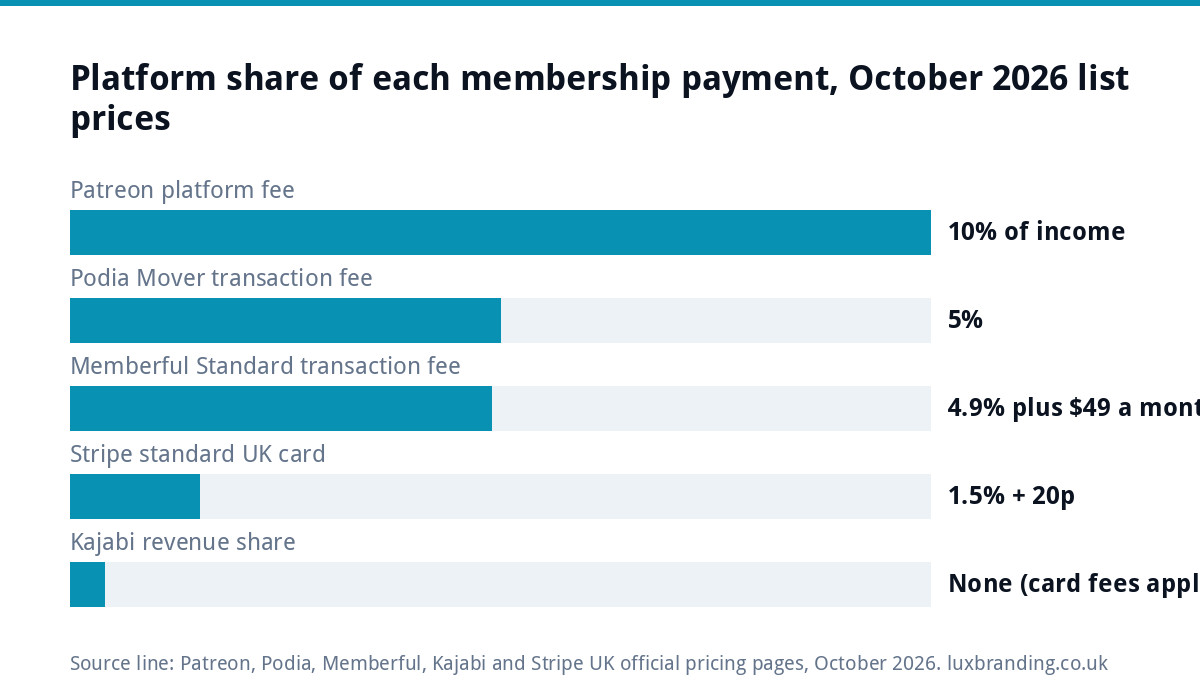
- Patreon: 10% of the income you earn on Patreon, “plus payment processing, currency conversion, and payout fees, and applicable taxes”, according to Patreon’s pricing page. Nothing to pay until you earn.
- Memberful: Standard plan $49 a month plus a 4.9% transaction fee, with Stripe’s card fees on top.
- Podia: Mover plan $42 a month billed yearly with a 5% transaction fee; Shaker at $84 a month billed yearly has no Podia transaction fee.
- Kajabi: Basic plan $143 a month billed yearly ($179 monthly), with no revenue share but card processing fees, according to Kajabi’s pricing page.
These are US-dollar list prices and they change; check each vendor before you sign up. The trade-off is simple: you get speed and no build cost, and in return you rent the platform, accept its look, and usually pay more as you grow.
Route 2: WordPress plus a membership plugin
If you already have, or want, a proper business website, a membership plugin adds the members area to it. You keep one site, one domain and one login for your customers.
- MemberPress: plans listed at $199.50, $349.50 and $499.50 a year, each marked as special introductory pricing with renewals at full price ($399, $699 and $999). The entry plan adds transaction fees. Source: MemberPress pricing.
- Paid Memberships Pro: the core plugin is free; the Standard plan with premium add-ons and support is $499 a year or $49 a month.
The plugin is the smaller part of the bill. The site still has to be designed and built, the members area styled to match, and the payment settings tested end to end. A Custom WordPress Website from us is £499 for up to 8 pages or £1,499 for the premium build up to 14 pages, hand-coded with no page builder and no platform lock-in. The member area itself is scoped and quoted in writing before any work starts, because a simple gated page and a tiered membership with a directory are very different jobs.
Route 3: a custom-built members area
When members need to do more than read content (book sessions, upload documents, manage their own listing, see their own records), you are building an application, not adding a page. That is our Web Applications service, from £1,999, quoted in writing first. Our guide to web app development costs explains what moves that figure, and if what you really need is a private area for clients rather than paying members, read our client portal guide instead.
The benefit is that nothing is rented: no per-member fee, no platform share, and features built around your process. The cost is a bigger up-front spend and the need to keep it maintained.
Three routes side by side
| Route | Up front | Ongoing | Share of each payment | Who owns it |
|---|---|---|---|---|
| Hosted platform | Nothing to little | $0 (Patreon) to $179 a month on the plans above | 0% to 10% platform fee, plus card fees | The platform |
| WordPress + plugin | Site from £499, plus the member area quote | Plugin licence ($0 to $999 a year), hosting | Card fees, plus any plugin transaction fee | You |
| Custom members area | From £1,999, quoted in writing | Hosting and maintenance | Card fees only | You |
Running costs nobody quotes
The build or the platform fee is the number people compare. These are the ones that arrive later.
Card fees
Whichever route you choose, somebody processes the cards. Stripe’s UK pricing page lists 1.5% + 20p for standard UK cards, 2.8% + 20p for premium UK cards, 2.5% + 20p for EEA cards and 3.15% + 20p for international cards (October 2026). If your setup uses Stripe Billing for recurring charges, Stripe lists 0.7% of Billing volume on its pay-as-you-go option. On a £30 monthly membership paid by a standard UK card, that is 65p in card fees, or 86p with Billing.
Licence renewals
Watch for introductory pricing. A plugin at $199.50 in year one that renews at $399 doubles in year two.
Hosting and care
Logged-in members cannot be served from a simple page cache the way public visitors are, so a members site leans harder on its server. Our Website Management & Hosting is £20 a month with UK hosting, SSL, daily backups, security monitoring and automatic updates.
Members expect receipts, reminders and password resets to arrive. If those land in spam, your inbox fills with “I can’t log in”. Our guide to business emails going to spam covers the fixes.
Content upkeep
People pay monthly for something new. Budget your own time for the classes, guides or posts that keep members renewing; it is the cost most likely to sink the project.
Member data: your UK duties
A membership site holds names, emails, payment history and sometimes more sensitive details. Under UK GDPR the ICO’s data protection principles apply, including data minimisation, storage limitation, and integrity and confidentiality (security). In practice:
- Collect only what the membership needs. A yoga class does not need a date of birth.
- Decide how long you keep lapsed members’ details, and delete on schedule.
- Let the payment provider handle card details; never store card numbers on your own site.
- Publish a privacy notice that says what you collect and why.
- Check the ICO data protection fee: the ICO says organisations that use personal information need to pay it unless they are exempt.
Costs by situation: four scenarios
| Situation | Likely route | What drives the cost |
|---|---|---|
| Yoga studio members area (class videos, timetable, member offers) | WordPress + plugin on the studio’s own site | Video hosting, tiers, whether booking is included (see our booking system cost guide) |
| Trade association (member directory, annual renewals, documents) | WordPress + plugin, or custom if approvals and listings are complex | Directory rules, approval workflow, invoicing for firms |
| Online course (modules, progress, certificates) | Hosted platform to start; own site once proven | Platform tier and transaction fee versus a one-off build |
| Paid newsletter or community | Hosted platform | Platform share of every payment as the list grows |
A worked example shows why the share matters. A community of members paying £30 a month on a platform taking 10% hands over £3 per member per month before card fees. On your own site, with a standard UK card through Stripe, the card fee is 65p. At small numbers the platform’s convenience is worth it; as membership grows, the gap pays for a build.
What to brief before you get a quote
- Who the members are and what they get that the public does not.
- Price points: free tier, monthly, yearly, trial, discounts.
- How many tiers and what each one unlocks.
- Content types: pages, video, downloads, forum, directory.
- What members do themselves: update details, cancel, upgrade, book.
- Emails needed, from welcome to failed payment.
- Existing site, domain and payment account, if any.
- Expected member numbers in year one and year three.
- What you need to see in admin: renewals, churn, exports.
A clear brief is the difference between a fixed quote and a vague estimate.
For the whole market in one place, from DIY builders to full agency builds and the running costs after launch, see how much a website costs across the UK.
How we build and quote membership sites
We do not sell a fixed membership package, because the scope varies too much. The base WordPress site is £499 for up to 8 pages or £1,499 for the premium build, member areas are quoted in writing before any work starts, and more complex member tools sit under Web Applications from £1,999. Every figure we publish is on our pricing page, and our website cost calculator gives a starting figure for the base site.
Send your brief to support@luxbranding.co.uk and we will reply with the route we think fits, and the written quote, before anything is built.
Get the UK Website Project Brief Template (free)
A two-page template for briefing any UK web designer: sitemap, integrations, audience and deliverables. Cuts revision rounds in half.
No spam. UK GDPR compliant. We only use your email to send this resource, unless you tick the box to hear from us.
Frequently asked questions
How much does a membership website cost in the UK? +
It depends on the route. Hosted platforms cost little up front but charge monthly or take a share, such as Patreon's 10% of income. A WordPress site starts at £499 with us, plus a plugin licence and a member area quoted in writing. A custom members area under our Web Applications service starts at £1,999.
Is a hosted platform cheaper than my own membership site? +
At the start, usually yes, because there is no build cost. As membership grows, a platform share adds up. On a £30 monthly membership, a 10% share is £3 per member per month before card fees, while a standard UK card through Stripe costs 65p. That gap is what eventually pays for your own site.
Which WordPress membership plugin should I use? +
MemberPress and Paid Memberships Pro are two established options. At the time of writing, October 2026, MemberPress lists introductory yearly prices that renew at full price, and Paid Memberships Pro offers a free core plugin with a paid Standard plan. Choose by the features your brief needs, and check renewal prices before you commit.
Do I need to register with the ICO for a membership site? +
The ICO says organisations that use personal information need to pay the data protection fee unless they are exempt, so check its fee guidance. Whatever the fee answer, UK GDPR principles apply: collect only what you need, set how long you keep lapsed members' details, keep the data secure and publish a privacy notice.
Does Luxbranding offer a fixed-price membership website package? +
No. Member areas vary too much for one price, so we quote them in writing before any work starts. The base WordPress site is £499 for up to 8 pages or £1,499 for the premium build, and more complex member tools sit under Web Applications from £1,999. Hosting and care is £20 a month.