Quick answer
Google is where UK local search happens: the CMA says more than 90% of UK searches take place on Google, and Ofcom found Google Maps reached 78% of UK online adults in May 2025, up from 69% in 2023. Once customers find you, reviews decide: BrightLocal’s 2026 US survey found 97% read local business reviews.
This page collects the public numbers behind local search in the UK: how people get online, where they look for local businesses, and how reviews shape the choice. Each figure has its source and date. Where the best available data is from the US, we label it.
Key statistics at a glance
| Statistic | Source, date |
|---|---|
| More than 90% of UK searches take place on Google | Competition and Markets Authority, October 2025 |
| Google Maps used by 78% of UK online adults, up from 69% in 2023 | Ofcom Online Nation 2025 (May 2025 data) |
| Google Maps is the third most-used smartphone app, used by 77% of adult smartphone users | Ofcom Online Nation 2025 |
| 95% of people aged 16 and over have internet access at home | Ofcom Online Nation 2025 |
| 97% of consumers read reviews for local businesses (US panel) | BrightLocal Local Consumer Review Survey 2026 |
| 47% will not use a business with fewer than twenty reviews (US panel) | BrightLocal Local Consumer Review Survey 2026 |
| 89% expect business owners to respond to reviews (US panel) | BrightLocal Local Consumer Review Survey 2026 |
| 5.7 million UK private sector businesses, 99.18% of them small | Business Population Estimates 2025 |
The UK is online, mostly on a phone
Ofcom’s Online Nation 2025 report, published on 10 December 2025, found that 95% of the UK population aged 16 and over have internet access at home. Adults spent an average of 4 hours and 30 minutes a day online on personal devices in May 2025, up 10 minutes on 2024.
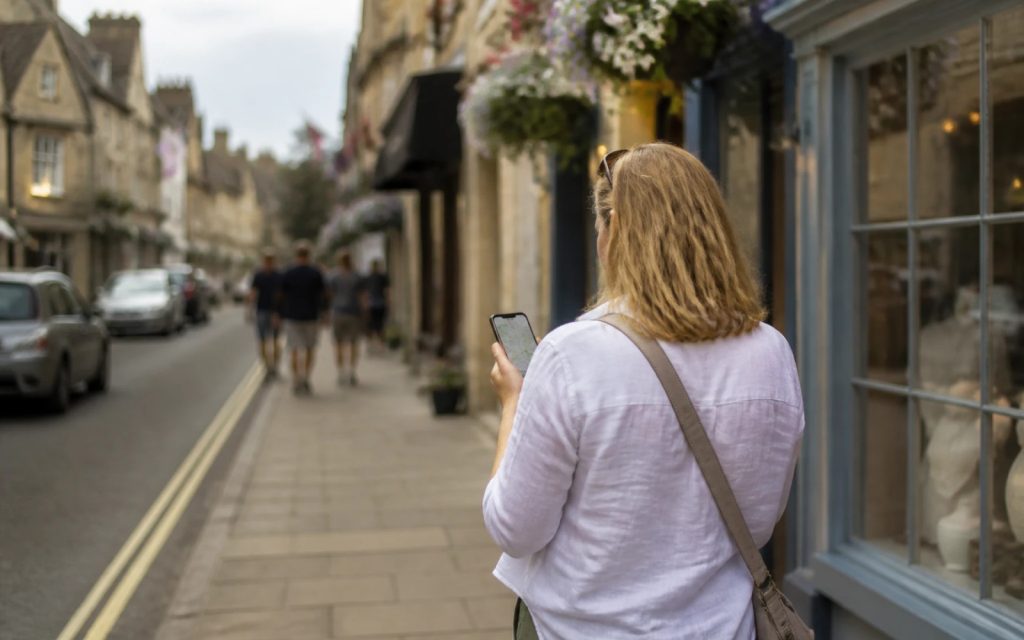
Most of that time is on a smartphone: 75% of online time for men and 79% for women, according to the same report. For local businesses, that means the first impression a customer gets is almost always on a small screen, often while they are out and about or standing in the room that needs the work done.
Search and maps: where local discovery happens
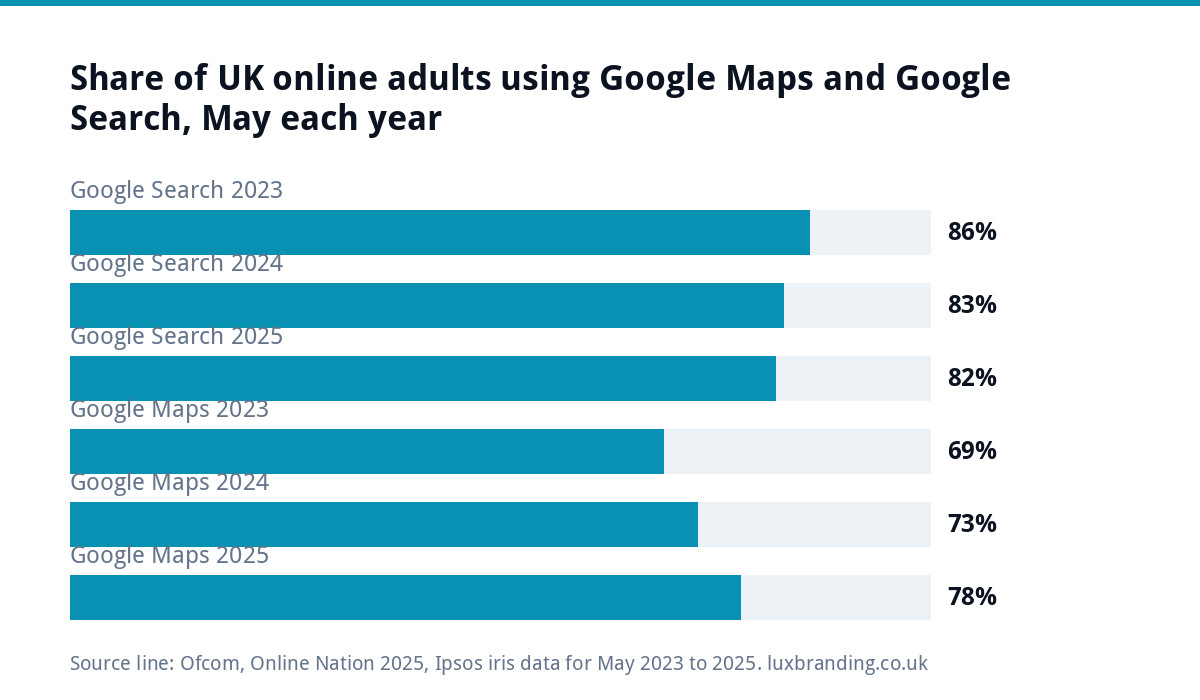
Ofcom reports that Google Search was used by 82% of UK online adults in May 2025, a slight fall from 83% in 2024 and 86% in 2023. Google Maps went the other way, reaching 78% in 2025, up from 73% in 2024 and 69% in 2023, with average time spent per person rising to 153 minutes across the month of May 2025, from 139 minutes a year earlier.
On phones specifically, Google Maps was the third most-used smartphone app, used by 77% of adult smartphone users. Apple Maps was far behind in 59th place at 15%, and Waze at 11%.
The competition regulator confirms the scale. In its October 2025 decision to designate Google with strategic market status in search, the CMA said more than 90% of searches in the UK take place on Google’s platform. Ofcom puts the number of Google web searches from the UK at about 3 billion a month.
For a local business, the rising Maps figures matter most. Your Google Business Profile is what appears in Maps, and Maps is increasingly where people choose a local business, not just where they find directions.
Reviews: the numbers that decide the click
There is no recent public UK survey of review behaviour on the same scale, so the most-cited source is BrightLocal’s Local Consumer Review Survey 2026, published on 11 February 2026. It surveyed a panel of 1,002 US adults, so treat the figures as a strong signal rather than a UK measurement. It found:
- 97% of consumers read reviews for local businesses, and 41% “always” read them when browsing for businesses.
- 92% care about star ratings when choosing a business.
- 68% will only use a business with four or more stars, and 31% only with 4.5 stars or more.
- Consumers use an average of six review sites when choosing businesses.
- Apple Maps nearly doubled in use for this purpose, from 14% in 2025 to 27%.
Recency and volume: why recent reviews beat a big old batch
Two BrightLocal 2026 findings explain why a steady trickle of reviews matters more than a big batch once:
- 47% of consumers won’t use a business that has fewer than twenty reviews. A new or quiet profile is filtered out before anyone reads it.
- 74% seek reviews written in the last three months. Old reviews, however glowing, suggest a business that has gone quiet or changed hands.
The practical answer is a habit rather than a campaign: ask every happy customer, at the moment the job is finished, with a direct link. If reviews you had have vanished from your profile, our guide to Google reviews that disappeared covers the causes.
Responding to reviews
BrightLocal’s 2026 survey found 89% of consumers expect business owners to respond to reviews. It also found negative reviews deter 77% of consumers, and that 85% are more likely to use a business after reading positive reviews.
A reply is read by every future customer who looks at the review, not just the person who left it. A short, calm, specific reply to a bad review often does more for trust than another five-star rating. Replying to positive reviews matters too, as it shows the profile is actively managed.
The competition: how many businesses are chasing local customers
The government’s Business Population Estimates 2025, published on 2 October 2025, put the number of UK private sector businesses at 5.7 million at the start of 2025. Small businesses, with 0 to 49 employees, made up 99.18% of them, and 4.3 million (75%) employed nobody apart from the owners.
Most of those businesses compete locally, and most of them are run by people with no time for marketing. That is the opportunity: in many towns and trades, the local map results are won by the business that simply keeps its profile complete and its reviews current.
What the numbers mean for a local business
- Finish your Google Business Profile. With Maps used by 78% of online adults, an incomplete profile is a shop with the lights off. Our free Google Business Profile optimisation checklist covers every field.
- Design for the phone. Most online time is on a smartphone, so test your website and profile on one. Tap the call button, open the directions, and read your opening hours on the small screen exactly as a customer would.
- Ask for reviews every week. Volume and recency both count: twenty reviews and something from the last three months are the thresholds in BrightLocal’s data.
- Reply to every review. Briefly, politely, and with something specific.
- Check you appear for the basics. Search your business name and your main service plus town. If your website is missing, our guide to a website not showing on Google explains the usual causes.
Methodology and sources
Every figure on this page was read on the publisher’s own page or report in October 2026. Figures attributed to a US panel are labelled as such. We have not included any figures of our own.
Two gaps are worth knowing about. First, we could not find a recent, public, UK-only survey of how consumers use reviews on the scale of BrightLocal’s US panel, which is why those figures are labelled. Second, there is no public UK figure for how many searches are “near me” or local in intent; we did not find one from a public body or a survey with a published method, so we have not quoted one here. If a statistic about local search has no named source and date, treat it with caution.
| Source | Published | Coverage |
|---|---|---|
| Ofcom, Online Nation 2025 | 10 December 2025 | UK adults, mostly May 2025 data |
| Competition and Markets Authority, search SMS decision | 10 October 2025 | UK |
| BrightLocal, Local Consumer Review Survey 2026 | 11 February 2026 | US panel of 1,002 adults |
| Department for Business and Trade, Business Population Estimates 2025 | 2 October 2025 | UK private sector businesses |
Getting your local search basics right
If you would rather hand it over, our Google Business Profile setup and optimisation is £199 and covers categories, keywords, photos, a review strategy and tracking. Our guide to Google Business Profile setup costs compares the options. For wider rankings, our SEO service is £249 a month, and all fixed prices are on our pricing page.
Get the UK SEO DIY Audit Checklist (free)
A 32-point checklist UK SMEs can run against their own website in an afternoon. Surfaces the quick wins before paying for a paid audit.
No spam. UK GDPR compliant. We only use your email to send this resource, unless you tick the box to hear from us.
Frequently asked questions
How many people in the UK use Google Maps? +
Ofcom's Online Nation 2025 report found Google Maps was used by 78% of UK online adults in May 2025, up from 73% in 2024 and 69% in 2023. On phones, it was the third most-used smartphone app, used by 77% of adult smartphone users, far ahead of Apple Maps at 15%.
What share of UK searches happen on Google? +
The Competition and Markets Authority said in October 2025, when it gave Google strategic market status in search, that more than 90% of searches in the UK take place on Google's platform. Ofcom puts Google web searches from the UK at about 3 billion a month.
How many reviews does a local business need? +
BrightLocal's Local Consumer Review Survey 2026, a US panel, found 47% of consumers will not use a business with fewer than twenty reviews, and 74% look for reviews written in the last three months. A steady flow of recent reviews matters more than a large number collected once.
Do customers expect businesses to reply to reviews? +
Yes. BrightLocal's 2026 survey found 89% of consumers expect business owners to respond to reviews. A reply is read by every future customer who looks at the review, so a calm, specific response to a negative review can do more for trust than another five-star rating.
How many small businesses are there in the UK? +
The government's Business Population Estimates 2025 put the number of UK private sector businesses at 5.7 million at the start of 2025. Small businesses with 0 to 49 employees made up 99.18% of the total, and 4.3 million, or 75%, employed nobody apart from the owners.