Quick answer
Our SEO, from £249 a month, starts with one strong page per service, not a page per town. Google calls near-identical town pages doorway abuse, so twenty “plumber in [town]” copies usually hurt. Build a service page for each job you do, one areas-we-cover page, and a separate town page only where you have real local proof.
This guide gives you the test for when a location page earns its place, a structure that works for a typical trade covering one county, and the mistakes that quietly drag a small site down.
The two page types, defined
A service page answers “do you do this job, how, for how much and why you?” One page for boiler installation, one for boiler repair, one for bathroom fitting. It targets the job, and Google decides which nearby searchers to show it to based on everything else it knows about your business.
A location page answers “do you work here?” It targets a town or district: “electrician in Chelmsford”. Done well, it shows real local work. Done badly, it is the service page again with the town name swapped in, repeated for every town on the map.
The question is not which type is better. It is which one each search actually needs, and whether you have enough genuine material to make a page worth reading.
Why twenty town pages usually backfire
Google’s spam policies describe doorway abuse as pages created to rank for specific, similar queries, and list “pages targeted at specific regions or cities that funnel users to one page” as an example. A set of town pages with the same text and a different place name fits that description almost word for word.
Even when it does not trigger a penalty, the copy-and-swap approach causes three practical problems:
- Google picks one and ignores the rest. Near-identical pages compete with each other, and most end up crawled but not indexed.
- Your strong pages get diluted. Links and attention spread across thin copies instead of building up one page that can rank.
- Customers notice. Someone who lands on “Roofer in Basildon” and reads the same paragraph they saw on “Roofer in Brentwood” trusts you less, not more.
Google’s guidance on helpful, people-first content asks whether you are producing lots of content in the hope that some of it performs. Thin town pages are exactly that.
Service pages vs location pages compared
| Question | Service page | Location page |
|---|---|---|
| Search it targets | The job: “boiler repair”, “loft conversion” | The place: “loft conversions in Reading” |
| What makes it unique | Your method, prices, guarantees, FAQs for that job | Local projects, photos, reviews and details from that town |
| How many you need | One per distinct service you sell | Only where you have real local proof |
| Risk if done badly | Low: a thin page simply ranks poorly | High: copied pages read as doorway pages |
| Who it suits | Every business | Branches, showrooms, or towns with a run of real jobs |
| Effort to do well | Moderate, written once | High, needs fresh local material each time |
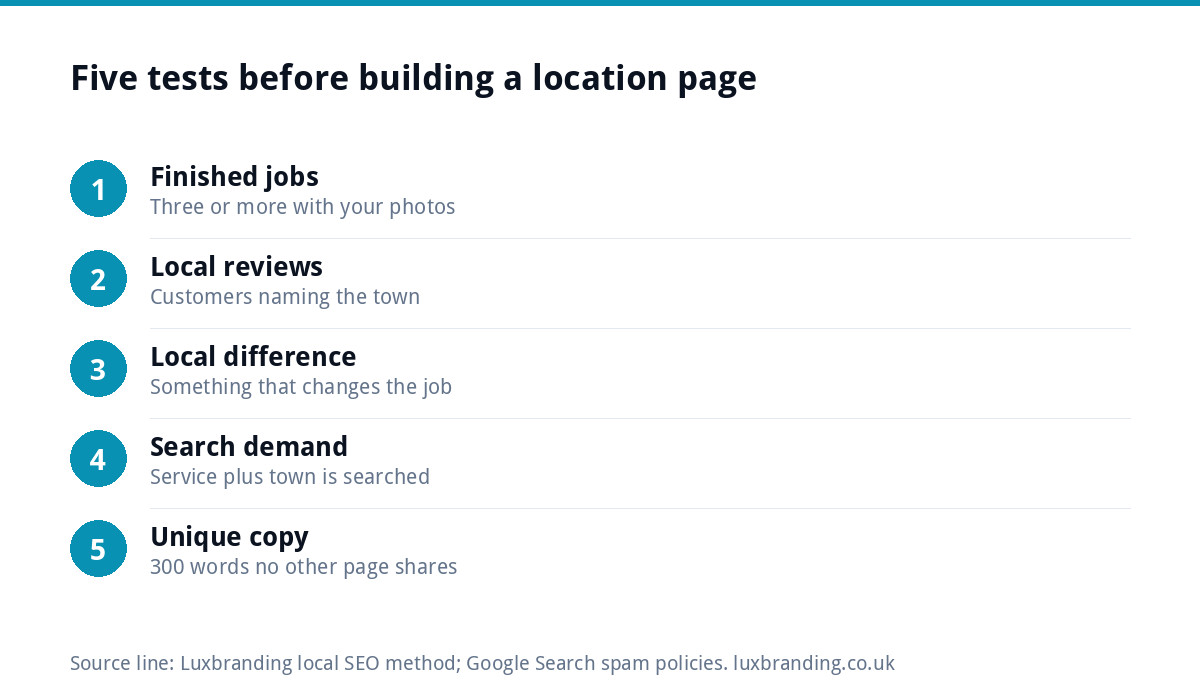
Five tests before you build a location page
Run each town through these questions. If it passes at least three, it may deserve its own page. If not, it belongs on your areas-we-cover page instead.
- Do you have finished jobs there? Three or more projects with your own photos is the minimum to say anything specific.
- Do customers there mention the town? Reviews or testimonials naming the area are proof no competitor can copy.
- Is something genuinely different locally? Conservation areas, a lot of a certain property type, parking rules, council requirements or water hardness that changes the job.
- Do people search for it? Check whether “your service + town” appears in Search Console or in Google’s suggestions as you type.
- Could you write 300 words nobody could paste onto another town page? If the honest answer is no, do not build it.
The structure that works for most trades
For a typical sole trader or small firm covering one county, this layout covers everything Google and customers need without a single thin page:
- Home page stating clearly what you do and the region you cover.
- One page per service, each with its own photos, process, pricing guidance and FAQs.
- One areas-we-cover page listing towns and postcodes, perhaps with a simple map and a line about travel or call-out charges.
- Project or case study pages for real jobs, each naming the town naturally. These do the local work without pretending to be a location page.
- Location pages only for the towns that passed the tests above, or for a genuine second base.
If your site cannot easily hold this kind of structure, a rebuild may be the better fix. Our custom WordPress websites start at £499 for up to 8 pages and include an SEO foundation with schema, meta and a sitemap.
What a good location page contains
If a town earns its own page, make it the most useful page anyone could find about your work there.
| Section | What to include | Why it helps |
|---|---|---|
| Local projects | Two or three jobs with your own before and after photos | Proof that cannot be copied |
| Local detail | Housing stock, access, council or building control points | Shows real knowledge of the area |
| Reviews from the area | Customer comments that name the town | Trust for the reader |
| Response and coverage | Which postcodes, typical lead times, any travel charge | Answers the practical question |
| Links to service pages | The services most booked there | Sends visitors to the full detail |
Where Google Business Profile fits
For “near me” searches and the map pack, your Google Business Profile does more work than any town page. Google’s help page on service areas says you can set up to 20 service areas, that a service-area business has one profile for the whole area, and that the area should be no more than about two hours’ drive from your base.
That means a van-based trade does not need a page per town to appear across its patch. It needs a complete, active profile with the right categories, real photos and steady reviews. Our Google Business Profile optimisation guide walks through it, and we offer profile setup and optimisation for £199.
A worked example: a heating engineer in south Essex
Picture a two-person heating firm based in Basildon, covering about fifteen towns. The tempting plan is fifteen pages called “Boiler Installation in [Town]”. Instead, the site gets five service pages (boiler installation, boiler repair, servicing, power flushing and landlord safety certificates) and one areas-we-cover page listing every town and postcode.
Running the five tests, two towns stand out. Southend is where the firm has done a long run of jobs and has reviews naming the town. Leigh-on-Sea has streets of older properties in conservation areas, where flue routing and appearance rules genuinely change the job. Those two get proper location pages with real job photos. The other towns appear on the areas page and in project write-ups. The result is eight strong pages instead of fifteen thin ones, and nothing on the site is a copy of anything else.
Fixing a site that already has dozens of town pages
If a previous agency built forty near-identical town pages, do not delete them all overnight. Work through them in order:
- List every location page and check which ones have had any clicks in Search Console over the last 12 months.
- Keep and improve the few with clicks or genuine local material, using the section table above.
- Merge the rest into your areas-we-cover page, then redirect each old address to it with a 301 redirect so nothing is lost.
- Remove them from your menus and sitemap, and update internal links.
- Recheck indexing after four to eight weeks.
If you are not sure which pages are dragging you down, our free SEO audit is a quick first check, and the guide to why a website is not showing on Google covers the wider causes.
Common mistakes to avoid
- Listing forty towns in the footer of every page.
- Stuffing town names into service page headings.
- Using stock photos of a town centre to make a page look local.
- Claiming offices or addresses you do not have.
- Building location pages before the core service pages are strong.
How we approach it
When we take on local SEO, the order is always the same: strong service pages first, a clean areas-we-cover page, an optimised Business Profile, then location pages only where the evidence supports them. Our SEO service is £249 a month and covers rankings, content, technical health, link building and reports. Every price is listed on our pricing page.
The shortest version of the rule: write for the job everywhere, and for the town only where you have something true to say about it.
Get the UK SEO DIY Audit Checklist (free)
A 32-point checklist UK SMEs can run against their own website in an afternoon. Surfaces the quick wins before paying for a paid audit.
No spam. UK GDPR compliant. We only use your email to send this resource, unless you tick the box to hear from us.
Frequently asked questions
Should I make a separate page for every town I cover? +
Usually not. Pages that repeat the same text with a different town name read as doorway pages, which Google's spam policies describe. Build one strong page per service and one areas-we-cover page. Add a town page only where you have real local proof such as finished jobs, photos and reviews from that area.
What is a doorway page? +
A doorway page is created to rank for a narrow, similar search and then funnel visitors elsewhere, without being useful in its own right. Google's spam policies give pages targeted at specific regions or cities that funnel users to one page as an example. Copy-and-swap town pages are the most common small-business version.
How do I rank in towns where I do not have an address? +
Set your service areas in Google Business Profile, keep the profile complete and active, and build strong service pages. Google allows up to 20 service areas, and the area should be within about two hours' drive of your base. Project pages that mention real jobs in each town add local relevance naturally.
What should I do with old near-identical location pages? +
Check Search Console for clicks over the last 12 months. Improve the few that earn clicks or have genuine local material, and merge the rest into an areas-we-cover page with 301 redirects so nothing is lost. Then remove them from menus and the sitemap and recheck indexing after four to eight weeks.
Can Luxbranding set up my local SEO? +
Yes. Our SEO service is £249 a month and covers rankings, content, technical health, link building and reports, starting with service pages and your Business Profile rather than thin town pages. Google Business Profile setup and optimisation on its own is £199. Every price is on our pricing page.