Quick answer
Branding for a building product manufacturer has to persuade four audiences at once: specifiers, merchants, installers and end clients. That means one consistent identity across technical data sheets, packaging, merchant displays, vehicles and a website with downloadable documents, with room left for UKCA or CE marks. Our Brand Identity Design is £299.
This guide is for manufacturers and suppliers of roofing, cladding, glazing, bricks, modular buildings and plumbing and heating products, who sell through merchants, distributors and specifiers rather than straight to homeowners. If you install rather than manufacture, our branding guide for trades businesses is written for you.
Who a building product brand has to persuade
A tradesperson’s brand mostly speaks to the person paying the bill. A manufacturer’s brand speaks to a chain of people, and each link wants something different:
- Architects and specifiers want evidence: performance data, certification, drawings and objects they can drop into a specification. The brand signals that the information is complete and current.
- Merchants and distributors want products that sell themselves at the counter and in the yard: clear packaging, recognisable ranges and reliable point of sale.
- Installers want products they trust, can find quickly and can fit without surprises. Familiarity drives repeat choice, and if a specified product is hard to get, installers often look for an equivalent.
- End clients (homeowners, developers, councils) may only see your brand on a brochure, a delivered pallet or the finished product, but it shapes whether they accept a substitute.
A good manufacturer brand works for all four without looking like four different companies. That is the job of a tight identity system and a set of brand guidelines.
Where the brand lives: touchpoints and who sees them
Most manufacturers have far more touchpoints than they realise, and the oldest ones (a data sheet template from years ago, an old pallet label) are usually the ones letting the brand down. Map them before you design anything.
| Touchpoint | Specifiers | Merchants | Installers | End clients |
|---|---|---|---|---|
| Technical data sheets and literature | Yes, closely | Sometimes | Yes | Rarely |
| Product and pallet packaging | No | Yes | Yes | On site |
| Merchant point of sale | No | Yes | Yes | Sometimes |
| Exhibition stands | Yes | Yes | Yes | Rarely |
| Delivery vehicles | Rarely | Yes | Yes | Yes |
| Website and document downloads | Yes | Yes | Yes | Yes |
The website is the one touchpoint every audience uses, which is why downloadable technical documents should be easy to find, named consistently and branded the same way as the printed versions.
Making room for UKCA and CE marks
Regulatory marks are not a design afterthought: they need a fixed, legible place on labels, packaging and documents. The government’s guidance on construction products regulation in Great Britain says “the CE mark will continue to be available when placing construction products on the market in Great Britain”, and that businesses using the UK mark must use a UK approved body for testing and certification.
The same guidance says the UK mark should be followed by information including the last two digits of the year it was first affixed, the manufacturer’s name and registered address, the product-type identification code, the reference number of the declaration of performance, the declared performance and, if applicable, the approved body’s number. That is a block of text your label and literature layouts must accommodate cleanly.
The general guidance on using the UKCA marking says the mark must be at least 5mm high unless the relevant legislation sets a different minimum, and must be scaled in proportion with the official templates. It also notes that construction products have their own specific rules, so check the construction guidance and the legislation for your product. A designer’s job is to build a label grid where the marks and declared information always fit, not to decide which mark applies.
Specification platforms and technical documents
Specifiers increasingly find and compare products on specification platforms before they ever see a brochure. NBS Source describes itself with the line “Find, select & specify with confidence”, and says manufacturers list their products so they can be seen and specified by NBS users.
For branding, that means your product names, range structure and documents have to make sense outside your own website. A practical checklist:
- Name ranges and products consistently everywhere: data sheets, platforms, packaging and price lists.
- Use one data sheet template with a fixed structure, so a specifier always finds performance data in the same place.
- Put the issue date and version on every technical document.
- Keep logos, colours and type the same on platform listings as on your own literature.
- Publish downloads on your website with clear file names, not “brochure-final-v3.pdf”.
If you also bid for larger projects, our guide to winning commercial contracts covers how presentation affects tender shortlists.
Sector by sector: what the brand must get right
Roofing
Roofing products are often bought through specialist merchants and fitted by contractors who have strong habits. Many manufacturers sell systems (membranes, tiles, fixings, ventilation) rather than single items. The brand must make the system obvious: a clear range architecture, colour coding that survives a dusty yard, and packaging that installers can identify on a roof. Technical literature should show how components fit together, not just each part in isolation.
Cladding
Cladding is specified with close attention to fire performance, durability and appearance. Specifiers and building control want documentation that is complete, current and easy to verify. The brand should feel precise and transparent: restrained design, clear test and certification information, and finish and colour swatches that look the same in print and on screen. Over-styled marketing can work against trust here.
Glazing and windows
The glazing chain is long: system companies, fabricators, installers and homeowners. Often the system brand and the fabricator brand both appear, so co-branding rules matter. Decide where your name sits on profiles, labels and installer literature, and give fabricators and installers approved artwork so your brand is not redrawn badly on their vans and websites.
Bricks and masonry
Bricks and blocks are chosen on colour, texture and availability. Range names and accurate colour reproduction carry much of the brand. Sample boards, swatch literature and website imagery need careful colour management, and pallet wrapping and labels are seen on site by everyone, so they are a real brand surface, not just logistics.
Modular buildings
Modular manufacturers sell large, considered purchases to developers, councils, schools and businesses, with long sales cycles. The brand has to carry credibility across proposals, case documentation, factory tours, transport and site hoardings. A professional website with clear project information and downloadable documents does a lot of the persuading before a meeting.
Plumbing and heating products
Installers often pick plumbing and heating products at the merchant counter, and familiarity and availability weigh heavily. Packaging must be recognisable at a glance on a crowded shelf, installation manuals must be clear and consistent, and the brand on the product is what the homeowner sees for years. Installer-facing material (manuals, training content, guides) should share the same look as merchant display material.
Rolling out a rebrand without confusing merchants
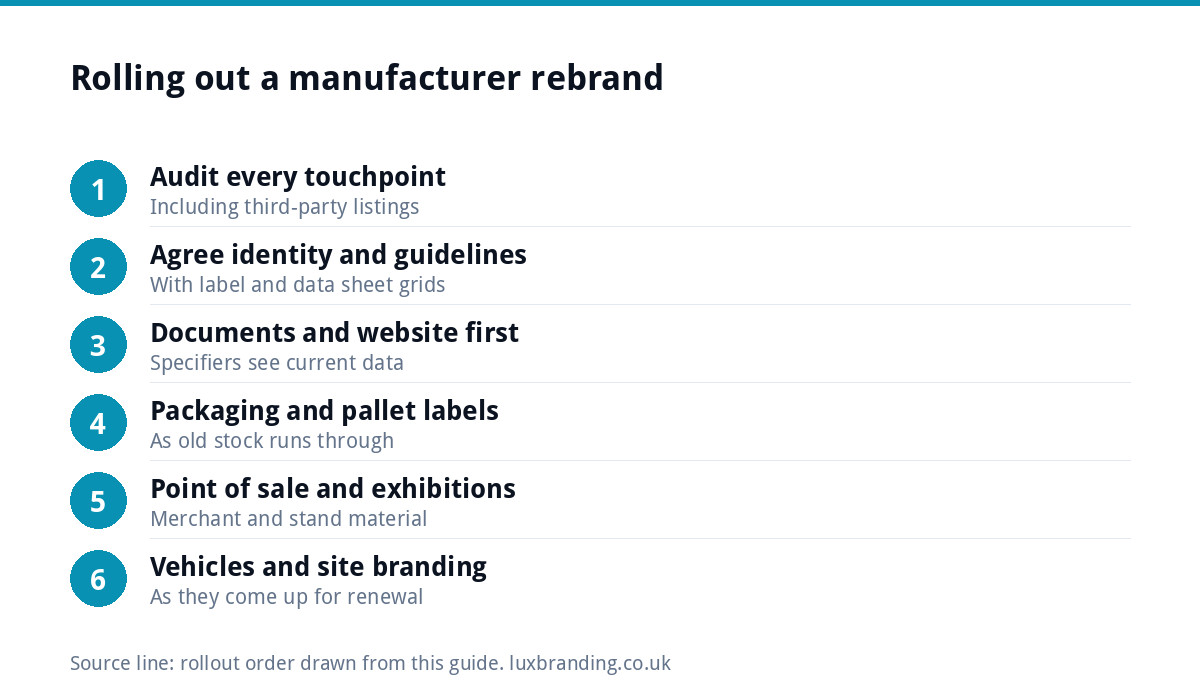
A manufacturer cannot switch everything overnight. Stock in the supply chain still carries the old packaging, and merchants need to recognise both versions during the changeover. A sensible order:
- Audit every touchpoint in the table above, including third-party listings.
- Agree the identity and brand guidelines, including label and data sheet grids.
- Update technical documents and the website first, so specifiers see current information.
- Change packaging and pallet labels as old stock runs through.
- Replace merchant point of sale and exhibition material.
- Update vehicles and site branding as they come up for renewal.
Tell merchants and installers what is changing and when. Our guide on announcing a rebrand to customers covers the communication side.
What drives the cost of a manufacturer rebrand
The cost of rolling out a brand depends far more on the number of touchpoints than on the logo. We do not quote market prices for print, stands or vehicle wrapping, because they vary by supplier; the figures below are our own prices for the design work.
| Element | Our price for the design | What drives the scope |
|---|---|---|
| Brand identity (logo, colours, type, imagery, guidelines) | Brand Identity Design £299 | Number of ranges and sub-brands |
| Full rebrand | Rebrand Package £1,999 | How many touchpoints change at once |
| Product packaging | Packaging Design £99 | Number of products, sizes and variants |
| Merchant posters and banners | Poster & Banner Design £89 | Formats; larger or custom jobs quoted in writing |
| Delivery vehicles | Vehicle signage design from £99 | Fleet size and vehicle types |
| Website with document downloads | Custom WordPress £499 (up to 8 pages) or Premium £1,499 (up to 14 pages) | Page count; bigger sites quoted in writing |
Printing, packaging production, stand building and vehicle fitting are separate costs from your suppliers. See our pricing page for every service, and the rebranding cost guide for a wider breakdown.
Common mistakes manufacturers make
- Brochure-first thinking. The glossy brochure gets attention while data sheets, the documents specifiers actually use, stay years out of date.
- A different look per range. Ranges launched years apart drift into separate brands, and merchants stop seeing them as one family.
- No label grid. Regulatory marks and declared information get squeezed into whatever space is left.
- Uncontrolled partner artwork. Installers and stockists redraw your logo from a website screenshot because nobody gave them proper files.
- Website as an afterthought. Documents are hard to find, so specifiers move on.
How we can help
We are a UK online-only design agency, rated 4.8/5 (Excellent), with 4,500+ projects delivered. Our Brand Identity Design at £299 covers the logo, colours, typography, imagery and brand guidelines. For a full change across every touchpoint, the Rebrand Package is £1,999.
Packaging is one of the biggest brand surfaces for a product business; our packaging design service is £99, and our guide to packaging design for small brands covers the basics. Order online, or email us at support@luxbranding.co.uk with a short description of your ranges and touchpoints.
Get the UK Branding Budget Worksheet (free)
A printable worksheet: decide what your brand needs now and price it against fixed published prices and the IPO trademark fee.
No spam. UK GDPR compliant. We only use your email to send this resource, unless you tick the box to hear from us.
Frequently asked questions
How is branding for a building product manufacturer different from branding for an installer? +
An installer's brand mostly speaks to the customer paying the bill. A manufacturer's brand has to work for a chain of people: specifiers who want complete technical data, merchants who want products that sell at the counter, installers who want familiar products, and end clients who see the finished result. The identity has to hold together across all of them.
Where should a UKCA or CE mark go in our packaging design? +
Build a fixed label grid with a reserved space for the mark and the information that follows it. The general UKCA guidance says the mark must be at least 5mm high unless the relevant legislation sets a different minimum, and construction products have their own specific rules, so check the construction products guidance for your product before finalising the layout.
Why do technical data sheets matter for branding? +
Specifiers rely on data sheets more than brochures when they choose products. A consistent template with performance data in the same place every time, an issue date and version, and the same logo, colours and type as your other material signals that your information is complete and current. Out-of-date sheets undermine an otherwise strong brand.
How much does it cost to rebrand a building product business? +
The design work starts with our Brand Identity Design at £299, which covers the logo, colours, typography, imagery and guidelines. A full rebrand across every touchpoint is our Rebrand Package at £1,999. Printing, packaging production, exhibition stands and vehicle fitting are separate costs from your own suppliers and depend on how many touchpoints you have.
Should we rebrand everything at once? +
Usually not. Update technical documents and the website first so specifiers see current information, then change packaging and pallet labels as old stock runs through the supply chain, followed by merchant point of sale, exhibition material and vehicles. Tell merchants and installers what is changing and when, so they recognise both versions during the changeover.