Quick answer
A mission statement says what your business does now, for whom and how. A vision statement says where you want the business to be in five to ten years. Both are free to write in an afternoon, and our £299 Brand Identity Design then turns them into the look of the brand.
This guide explains the difference with plain examples from trades and small businesses, gives you fill-in templates for each, and shows where the finished statements actually earn their keep.
Mission and vision, defined
The two get mixed up because both sound like corporate wallpaper. They do different jobs.
A mission statement is about today. It describes the work you do, the people you do it for and the way you do it. It should be true on a wet Tuesday in February, not just on a good day. “We fit and service boilers for homeowners across Kent, turning up when we say we will and leaving the house cleaner than we found it.”
A vision statement is about the future. It describes where you are heading and what will be different when you get there. “To be the heating firm Kent homeowners recommend first, with a team of six engineers and no customer waiting more than a day.”
The mission keeps day-to-day decisions honest. The vision tells you, and anyone who joins you, why the effort is worth it.
Mission vs vision side by side
| Question | Mission statement | Vision statement |
|---|---|---|
| Time frame | Now | Five to ten years ahead |
| Answers | What do we do, for whom, and how? | Where are we going, and what will be different? |
| Main audience | Customers, staff, suppliers | You, your team, future hires, partners |
| Should change when | What you offer or who you serve changes | You reach it, or your ambition changes |
| Typical length | One or two sentences | One sentence |
| Test it with | “Is this true today?” | “Would this still excite us in five years?” |
Two other terms often get lumped in. Values are the three or four principles you will not trade away, such as “on time, every time”. A strapline is a short public phrase used in marketing. Both can grow out of your mission, but neither replaces it.
Does a small business really need them?
A sole trader does not need a framed mission on the office wall. But writing both down, even roughly, pays off in three places:
- Decisions. When a job comes in that does not fit, the mission makes saying no easier.
- Hiring. The first person you take on wants to know what they are joining and where it is going.
- Branding and copy. Designers and copywriters work faster and better from a clear statement than from a vague brief.
GOV.UK’s guide to writing a business plan describes a plan as covering objectives, strategies, sales, marketing and financial forecasts. Your vision is where those objectives point, and your mission is the summary that opens the plan.
A fill-in template for each
Mission template
We [what you do] for [who you serve] in [where], by [how you do it differently].
Example: “We design and build garden rooms for homeowners in Hertfordshire, with one fixed quote and one team from groundwork to handover.”
Vision template
In [five or ten] years, we will be [where you want to be], so that [what changes for customers or your community].
Example: “In five years, we will be Hertfordshire’s best-known garden room builder, so that nobody in the county has to project-manage five trades to get one built.”
Fill in the brackets quickly, then cut every word that does not change the meaning. If a competitor could sign your mission without editing it, it is too general.
How to write them in one afternoon
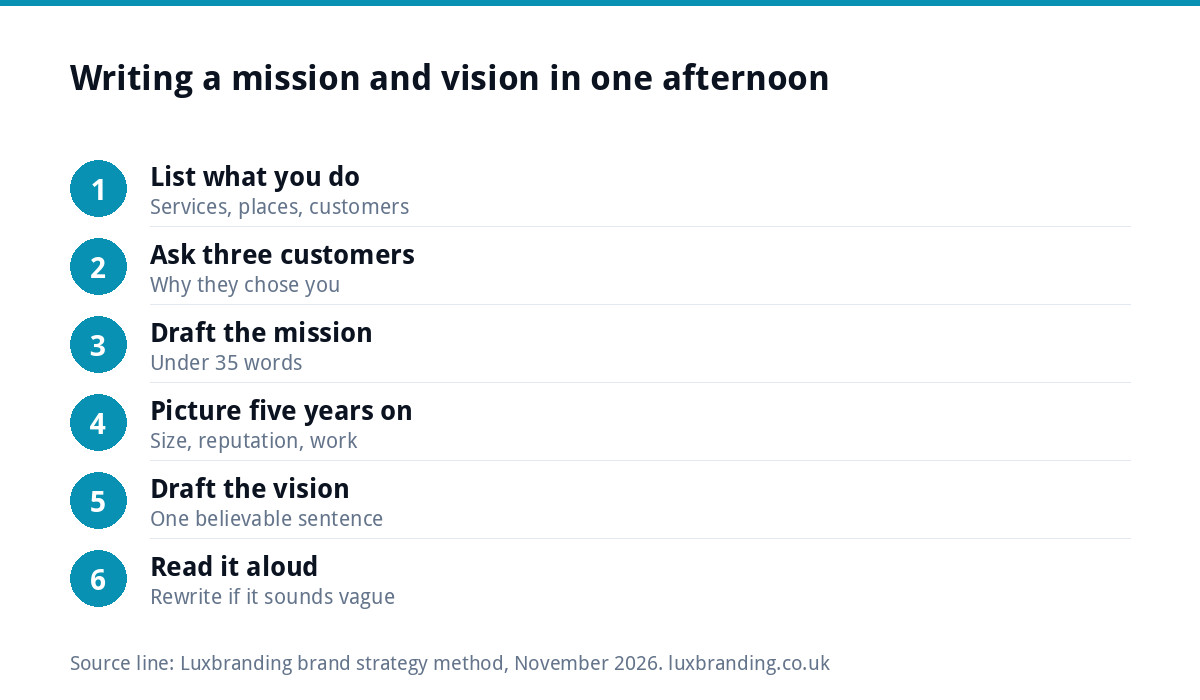
- List what you actually do. Services, places, typical customers. Be specific about who you serve most profitably.
- Ask three good customers why they chose you. Their words are usually better than yours.
- Draft the mission from the template. Keep it under 35 words.
- Picture the business in five years. Size, reputation, the work you want more of, the work you want to stop.
- Draft the vision in one sentence. Make it ambitious but believable.
- Read both aloud to someone who knows the business. If they laugh or look blank, rewrite.
Weak and strong examples
These examples are illustrations written for this guide, not real companies’ statements.
| Weak | Why it fails | Stronger |
|---|---|---|
| “We deliver excellence in everything we do.” | Says nothing; any business could claim it | “We repair flat roofs across Greater Manchester, with photos of every job before we invoice.” |
| “To be the best cleaning company in the world.” | Not believable, gives no direction | “Within five years, to run twelve vans and be the first call for letting agents in Leeds.” |
| “Passionate about customer satisfaction.” | A feeling, not a mission | “We answer every enquiry the same working day and quote within 48 hours.” |
| “Innovative, sustainable solutions.” | Jargon, and a claim you would need to prove | “We fit heat pumps and solar panels for Devon homeowners, and explain the running costs before you commit.” |
Examples by type of business
Seeing the templates filled in for different trades makes it easier to write your own. As before, these are illustrations, not real firms.
- Mobile dog groomer. Mission: “We groom dogs at home across south Manchester, so anxious dogs never have to sit in a busy salon.” Vision: “In five years, three fully booked vans and a waiting list, without ever rushing a dog.”
- Bookkeeper. Mission: “We keep the books for sole traders and small builders in Norfolk, in plain English, with a fixed monthly fee.” Vision: “To be the bookkeeper every new trade business in Norfolk is told about by their accountant.”
- Independent café. Mission: “We serve good coffee and home-baked food to commuters and parents on Chapel Street, open early and never rushed.” Vision: “A second site within five years, run by someone we trained ourselves.”
- Window cleaner. Mission: “We clean windows, gutters and conservatories for homes in Swindon on a fixed four-weekly round, with a text the day before.” Vision: “To run four rounds and give two local school leavers a start in the trade each year.”
Notice what they share. Each mission names a real service, a real place and one specific promise. Each vision has a number or a visible change in it, so you will know when you have got there.
Careful with claims you cannot prove
Statements used in marketing are advertising claims. The ASA’s guidance on substantiation says marketers must hold documentary evidence to prove claims consumers are likely to see as objective. “The fastest electrician in Bristol” or “the most eco-friendly builder in Wales” invites the question: says who?
Environmental words need extra care. The CMA’s Green Claims Code exists to help businesses meet consumer law when they make environmental claims. If “sustainable” or “eco” is part of your mission, make sure you can show what it means in practice.
Your internal vision can be as bold as you like. The moment a line goes on your website or van, it should be something you can back up.
Where to use them once written
- About page: the mission, in plain words, near the top.
- Design brief: both, so the designer knows what the brand must express.
- Brand guidelines: a short section at the front, so suppliers and staff see it first. Our guide to brand guidelines costs covers what goes in them.
- Job adverts and staff induction: the vision especially.
- Quotes and proposals: one line of the mission in the opening paragraph.
If your brand looks different on the van, the website and the invoice, the mission is often the missing anchor. Our article on fixing an inconsistent brand shows how to pull it back together.
When to rewrite them
Review both once a year, and straight away if you add a major service, move into a new area, take on staff or rebrand. A mission that no longer describes what you do is worse than none, because it tells customers and staff the wrong story. If your vision has been reached, celebrate, then write the next one.
From statements to a brand people recognise
A mission and vision tell people what you stand for. The logo, colours, type and photography make them feel it before they read a word. That is the difference our guide to brand identity vs logo design explains, and it is why trades firms that look organised win more of the larger jobs, as our guide to branding for trades businesses sets out.
Our Brand Identity Design is £299 and covers your logo, colours, typography, imagery and brand guidelines, and your mission and vision make a useful part of the brief. Every price is on our pricing page.
Get the UK Branding Budget Worksheet (free)
A printable worksheet: decide what your brand needs now and price it against fixed published prices and the IPO trademark fee.
No spam. UK GDPR compliant. We only use your email to send this resource, unless you tick the box to hear from us.
Frequently asked questions
What is the difference between a mission and a vision statement? +
A mission statement describes what your business does today, for whom and how. A vision statement describes where you want the business to be in five to ten years and what will be different then. The mission guides daily decisions; the vision gives direction and motivation to you and anyone who joins you.
Which comes first, mission or vision? +
For a small business, write the mission first, because it has to be true today and is easier to test against real work. Then write the vision as the direction that mission is heading in. Some people prefer to start with the vision, which is fine, as long as the mission stays grounded in what you actually do.
How long should a mission statement be? +
One or two sentences, ideally under 35 words. It should name what you do, who you serve and how you do it differently. If a competitor could sign it without changing a word, it is too vague. Short, specific statements are easier for staff to remember and for designers to work from.
Can I put my mission statement on my website? +
Yes, and the About page is the natural place. Once a statement is public, it counts as a marketing claim, so make sure anything objective, such as fastest, greenest or best-rated, can be backed up with evidence. Your internal vision can be bolder than what you publish.
Can Luxbranding design a brand from my mission and vision? +
Yes. Send your mission and vision with the brief for our Brand Identity Design, which is £299 and includes your logo, colours, typography, imagery and brand guidelines. The statements help us design a brand that expresses what you stand for. Every price is on our pricing page.