
Quick answer
A one-page marketing plan answers seven questions on a single sheet: your goal for the next 90 days, who you serve, what you offer them, which two or three channels you will use, your budget in money and hours, a month-by-month calendar, and the one number you will check. Fill it in once, then review it each quarter.
This page gives you the template as a table you can copy into a document or onto paper, a filled-in example for a small trade business, and the rules that stop the plan from becoming another file nobody opens.
Why one page beats a marketing strategy document
Most small businesses do not lack marketing ideas. They lack a decision about which three ideas to stick with long enough to work. A forty-page strategy hides that decision; a single page forces it. If a channel does not fit in the box, you are not doing it this quarter.
This is a marketing plan, not a business plan. It assumes you already know what you sell and roughly what it costs you. If you need the wider plan for a bank or a grant application, GOV.UK’s write a business plan page links to free business plan templates. Come back to this sheet once that is done.
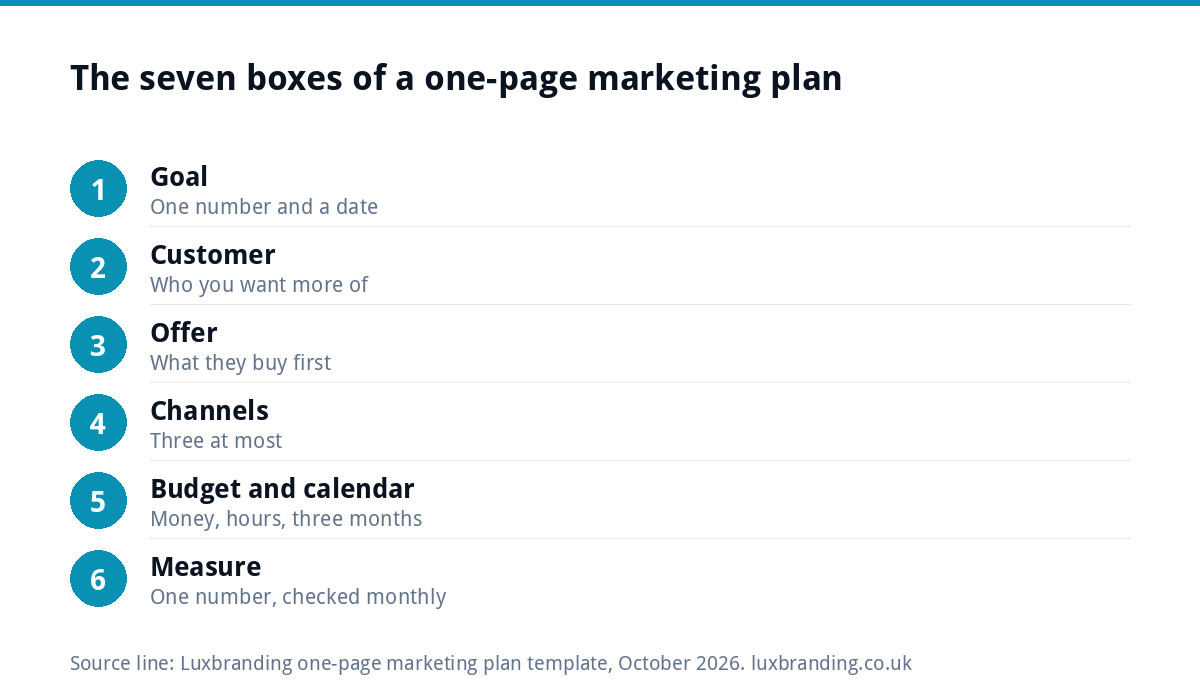
The template: seven boxes to copy
Copy this table into a document, a spreadsheet or the back of an envelope. Answer each question in one or two lines. If you need more than that, you have not decided yet.
| Box | The question to answer | Keep it to |
|---|---|---|
| 1. Goal | What one result do we want in the next 90 days? | One number and a date |
| 2. Customer | Who is the best customer we want more of, and where are they? | One sentence |
| 3. Offer | What do we want them to buy or book first, and why us? | One offer, one reason |
| 4. Channels | Which two or three places will we show up, consistently? | Three at most |
| 5. Budget | How much money and how many hours a month? | Two figures |
| 6. Calendar | What happens in month one, two and three? | Three short lines |
| 7. Measure | Which number tells us it is working, and when do we check? | One number, one day a month |
Box 1 and 2: goal and customer
The goal should be something you can count: enquiries, booked jobs, new regular customers, product sales. “Raise awareness” is not a goal because you cannot tell whether you hit it. “Twelve new monthly maintenance customers by the end of March” is.
The customer box is where most plans go vague. “Homeowners” is not a customer; “homeowners in north Leeds with gardens they no longer have time for” is. The narrower the description, the easier every other box becomes, because you know where those people look and what they care about.
Box 3: the offer
Pick the one thing you want a new customer to buy first. For a gardener it might be a seasonal tidy-up that leads to a monthly visit. For a café it might be a weekday lunch deal. For an accountant it might be a fixed-fee tax return. Then write one reason someone should choose you for it, in words a customer would use.
The offer also has to look consistent wherever it appears. If your van, website and social pages all look different, our guide to fixing a brand that looks inconsistent everywhere is a quick read before you spend on promotion.
Box 4: choosing channels by situation
Two or three channels done every week beat seven channels done when you remember. Use this table to pick.
| Your situation | Channels that usually fit | What they need from you |
|---|---|---|
| Local service, customers search when they need you | Google Business Profile, website, reviews | A complete profile and steady reviews |
| Local service, customers do not search yet | Leaflets, local social media groups, referrals | A clear offer and repeated drops |
| Visual work (food, beauty, landscaping, interiors) | Instagram or TikTok, plus Google Business Profile | Photos or short videos every week |
| Business-to-business | LinkedIn, email, website case studies | Useful posts and a contact list |
| Need enquiries quickly, have budget | Google Ads or Meta ads, sent to a landing page | A budget and a page built to convert |
If you are local, the free channel almost everyone underuses is the Google Business Profile; our Google Business Profile optimisation guide covers it in detail.
Box 5: budget in money and hours
Write two numbers: what you will spend a month, and how many hours you will give it. Hours matter as much as pounds. A free channel that needs five hours a week is not free if those hours come out of paid work.
If the hours box is the problem, that is usually the moment to hand one channel over. Our social media marketing management service is there for when the weekly posting never happens, and our Google Ads campaigns service runs paid search for businesses that need enquiries faster. If you are weighing up organic search instead, our guide to how much SEO costs in the UK sets out the options.
Boxes 6 and 7: the calendar and the one number
The 90-day calendar
Three lines, one per month. Each line names what you will do, not what you hope will happen. For example:
- Month 1: finish the Google Business Profile, add 20 photos of recent work, ask the last ten customers for a review.
- Month 2: one leaflet drop to 2,000 homes in two target postcodes, with a tracked offer.
- Month 3: post two before-and-after photos a week; repeat the leaflet drop if month two produced enquiries.
If leaflets are in your plan, design matters more than volume: a clear headline, one offer and a way to respond. Our flyer design service produces print-ready leaflets you can hand to any printer.
The one number
Pick the number that proves the plan works and check it on the same day every month. For most small businesses, it is enquiries by source: ask every new customer where they heard of you and keep a tally. That single habit will tell you more than any dashboard.
If your website is one of the channels, check it is actually being found before you pour effort into it. Our free SEO audit gives you a quick read on the basics.
A filled-in example: a two-person landscaping business
- Goal: 12 new monthly maintenance customers by 31 March.
- Customer: homeowners in three north Leeds postcodes with medium gardens and little spare time.
- Offer: a spring tidy-up at a fixed price, which rolls into a monthly visit; we turn up on the same day every month.
- Channels: Google Business Profile, leaflets, before-and-after posts on Instagram.
- Budget: a set monthly amount for print and distribution; three hours a week.
- Calendar: as in the example above.
- Measure: new maintenance customers, by source, checked on the first Monday of each month.
Four ways a one-page plan fails
- The goal is a feeling. “Get our name out there” cannot be checked, so the plan can never succeed or fail. Put a number in box one.
- Every channel makes the cut. If the channels box lists six things, the plan has not chosen anything. Cross out until three remain.
- The hours box is empty. Money is easy to write down; time is what actually runs out in a busy month. Be honest about the hours, then plan to them.
- Nobody looks at it. Pin the sheet where you do your paperwork and put the monthly check in your calendar as a fixed appointment with yourself.
The rules your marketing must follow
Whatever goes in the channels box, two sets of rules apply. Ads and promotional claims in the UK fall under the CAP Code, and the Advertising Standards Authority says the code must be followed by all advertisers, agencies and media; “the best in town” needs evidence or it needs to go. And if email or text is a channel, the ICO’s electronic mail marketing guidance sets out when you need consent and when the soft opt-in for existing customers applies.
Review it every quarter, then rewrite it
At the end of 90 days, put the sheet next to the number. Keep the channel that produced enquiries, drop the one that did not, and change only one thing at a time so you can tell what worked. A plan that changes every quarter is not a failure; a plan that never changes is not being read. When you need help with a channel, everything we do with a fixed price is on our pricing page.
Get the UK SEO DIY Audit Checklist (free)
A 32-point checklist UK SMEs can run against their own website in an afternoon. Surfaces the quick wins before paying for a paid audit.
No spam. UK GDPR compliant. We only use your email to send this resource, unless you tick the box to hear from us.
Frequently asked questions
What should a one-page marketing plan include? +
Seven things: a 90-day goal you can count, a precise description of the customer you want more of, the first offer you want them to take, two or three channels, a budget in money and hours, a month-by-month calendar, and the one number you will check each month to see whether the plan is working.
How many marketing channels should a small business use? +
Two or three, done consistently every week. More than that spreads a small team too thin and makes it impossible to tell which channel produced the work. Start with the channels your best customers already use, such as Google Business Profile for local services or Instagram for visual work, and add one only when the others run smoothly.
How often should I update my marketing plan? +
Review it every 90 days. Compare the result with your goal, keep the channels that produced enquiries, drop the ones that did not, and change one thing at a time so you can see what made the difference. A plan that never changes is usually a plan nobody is reading.
Is a marketing plan the same as a business plan? +
No. A business plan covers the whole business, including finance, staffing and operations, and is often written for a bank or investor. A one-page marketing plan covers only how you will win customers over the next quarter. GOV.UK's business plan page links to free business plan templates if you need the longer document.
How do I know if my marketing is working? +
Ask every new customer where they heard about you and keep a simple tally by source. Check it on the same day each month against your 90-day goal. That habit tells a small business more than any dashboard, because it measures enquiries and paying customers rather than clicks, likes or impressions.