
Quick answer
For most UK small businesses, GA4 is the sensible default: it costs £0 and links straight to Google Ads and Search Console. Choose Plausible if you want simple, cookie-free numbers on one page for a small monthly fee. Choose Matomo if you want full control and are happy to self-host it or pay for its cloud version.
This guide compares the three on cost, privacy, ease of use and what each is genuinely good at, then gives a quick way to decide based on how your business actually wins customers.
What each tool is
Google Analytics 4 (GA4) is Google’s free analytics platform and the one most websites already have installed. It tracks visits, traffic sources, pages and actions such as form submissions and purchases, and it connects to Google Ads so you can see which ads bring enquiries.
Plausible is a lightweight, privacy-focused alternative. Its website describes it as using no cookies and no persistent identifiers, with visitor data processed on servers owned by European companies that never leaves the EU. The code is open source, so it can be self-hosted.
Matomo is a full-featured analytics platform designed as an alternative to Google Analytics, which you can install on your own server for free or pay to have hosted. It sits between the other two: more depth than Plausible, more control over your data than GA4.
GA4 vs Matomo vs Plausible at a glance
| Question | GA4 | Matomo | Plausible |
|---|---|---|---|
| Cost | Free | Free to self-host; Cloud is a monthly fee | Monthly fee; self-hosting possible |
| Ease of use | Steep learning curve | Moderate, familiar layout | Very simple, one dashboard |
| Cookies | Yes, by default | Configurable, can run without | No cookies |
| Where data lives | Google’s servers | Your server, or Matomo’s cloud | EU servers, or your own |
| Google Ads link | Built in | Not built in | Not built in |
| Depth of reports | Very deep | Deep | Essentials only |
| Best for | Businesses running Google Ads or selling online | Data control, regulated sectors, developers on hand | Small sites wanting clean, simple numbers |
What they cost
At the time of writing, November 2026, the published prices were as follows. Prices change, so check each page before signing up.
- GA4: free for standard properties. Google also sells an enterprise version, which small businesses do not need.
- Plausible: its site lists Starter at $9 a month, Growth at $14 and Business at $19, with two months free on yearly billing and a 30-day free trial.
- Matomo: its pricing page lists the self-hosted On-Premise version as free forever, and Cloud plans from 29 a month before tax. Paid add-on bundles for self-hosting are priced separately.
“Free” self-hosting is not quite free. It needs a server, updates and someone to look after it. If your website is on managed hosting, ask whether a self-hosted analytics tool can run alongside it.
Privacy and cookie consent
Under UK law, storing or reading information on a visitor’s device, which includes most analytics cookies, normally needs consent. Since 5 February 2026, the amended Privacy and Electronic Communications Regulations include an exception for statistics. Schedule A1 allows storage or access where the sole purpose is collecting statistics about how the service is used in order to improve it, visitors get clear information about it and a simple, free way to object, and any sharing is only to help improve the service.
What that means in practice:
- Plausible says it uses no cookies at all, so the cookie question largely falls away, though you should still describe it in your privacy notice.
- Matomo can be configured to run without cookies or with tightly limited data, which can fit the statistics exception when set up carefully.
- GA4 uses cookies by default and sends data to Google. If you link it to advertising features, it is doing more than statistics, so a consent banner remains the safe approach.
This is a summary, not legal advice. If your sector handles sensitive data, take advice before choosing.
Where GA4 wins
- Google Ads: conversions flow straight back to your campaigns, which helps automated bidding find more enquiries.
- Search Console link: see search terms and landing pages in one place.
- E-commerce tracking: product views, baskets and purchases with revenue.
- Price: nothing to pay, whatever your traffic.
The downsides are real: it is hard to learn, reports hide in menus, and with a consent banner you will see fewer visits than really happened, because people who decline are not counted. GA4 also keeps user-level data for either 2 or 14 months, according to Google’s data retention help page, so set it to 14 months on day one if you want year-on-year comparisons.
Where Plausible and Matomo win
Plausible suits a trade or local service business that wants to know three things each month: how many people visited, where they came from and which pages they looked at. The whole dashboard fits on one screen, and the script is small, which helps page speed. Our guide to website speed for small businesses explains why that matters.
Matomo suits businesses that want GA4-style depth with the data kept on their own server, such as clinics, solicitors or firms with strict client confidentiality, and that have a developer or a host who can manage it.
Which one should you choose?
| Your situation | Our suggestion | Why |
|---|---|---|
| Running or planning Google Ads | GA4 | Conversion data feeds your campaigns |
| Online shop | GA4 | Detailed e-commerce reports at no cost |
| Trade or local service, no ads | Plausible or GA4 | Plausible if you want simplicity and no banner |
| Sensitive sector, data must stay in-house | Matomo self-hosted | Full control of where data lives |
| Nobody will ever look at the reports | The simplest one | An unread dashboard is worth nothing |
You can also run two at once. Some businesses keep GA4 for advertising data and Plausible for a quick, honest view of traffic. Just mention both in your privacy notice.
A worked example: two businesses, two answers
A roofing firm in Kent spends a few hundred pounds a month on Google Ads and gets most of its work by phone. For them, GA4 is the clear choice. Calls from the website and form submissions can be marked as key events and sent back to Google Ads, which lets the campaigns learn which searches turn into jobs. Without that link, the ads are optimised for clicks rather than calls, which is how small budgets get wasted. The cost is learning GA4 well enough to read two or three reports each month, or having someone do it for them.
A wedding florist in the Cotswolds runs no ads at all. Her enquiries come from Instagram, Google searches for her name and recommendations from venues. She wants to know whether people find her gallery pages and which venues’ websites send visitors. Plausible gives her that on one screen, with no banner covering her photography and no menus to learn. For her, the small monthly fee buys something GA4 does not: numbers she will actually look at.
Neither choice is wrong. The right tool is the one that answers the questions your business actually asks, and that someone in the business will open every month.
Switching tools later
Historic data does not move between tools, so a switch means starting a fresh baseline. If you are thinking of changing, run the new tool alongside the old one for a month or two, compare the numbers, then remove the old script. Expect the totals to differ: each tool counts visitors slightly differently, and consent banners hide some visits from GA4 that a cookie-free tool may still see.
Setting up whichever you choose
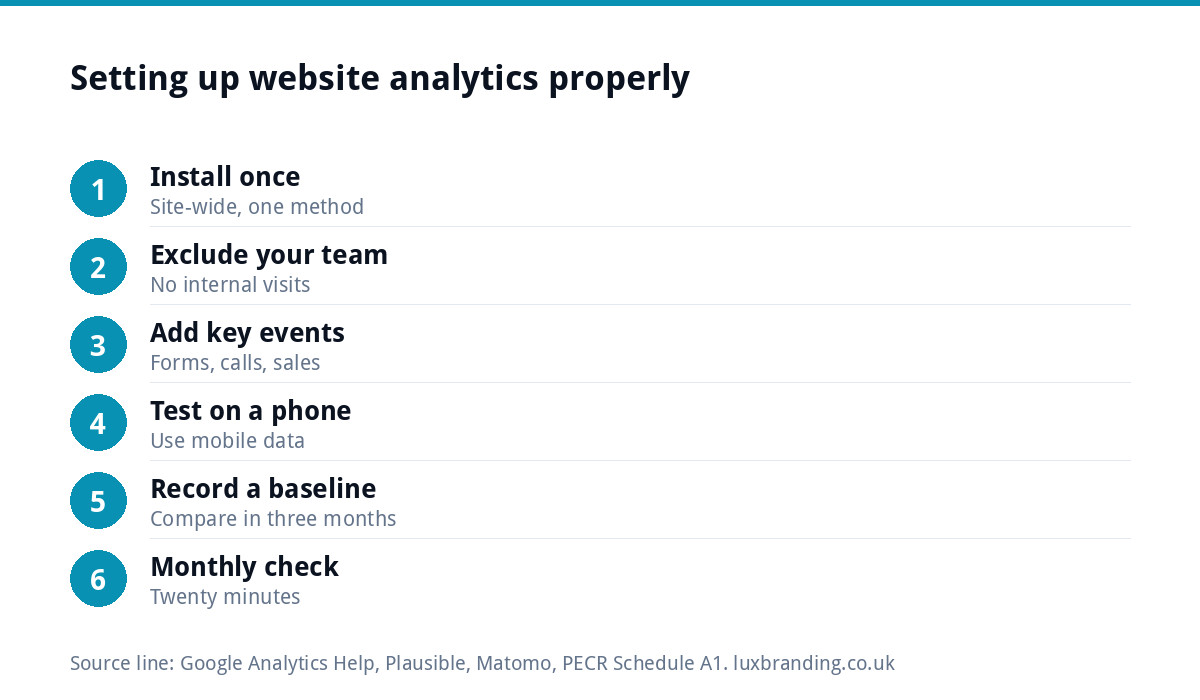
- Install the tracking code once, site-wide, preferably through your theme or a tag manager rather than several plugins.
- Exclude your own visits and your team’s, so internal browsing does not inflate the numbers.
- Set up goals or key events: form submissions, phone link taps, bookings, purchases.
- Test each goal yourself on a phone, using mobile data.
- Write down your starting numbers so you can compare in three months.
- Book a monthly 20-minute check in your calendar.
If your numbers fall suddenly after a change, our guide to sudden traffic drops helps you work out whether the problem is real or a tracking fault.
What we do on our builds
Every custom WordPress website we build (from £499) includes Google Analytics set up and connected, plus contact forms connected to your inbox. For ongoing help reading the numbers and acting on them, our SEO service is £249 a month and includes monthly reports. If you just want a quick view of where your site stands, start with our free SEO audit. Every price is on our pricing page.
Get the UK SEO DIY Audit Checklist (free)
A 32-point checklist UK SMEs can run against their own website in an afternoon. Surfaces the quick wins before paying for a paid audit.
No spam. UK GDPR compliant. We only use your email to send this resource, unless you tick the box to hear from us.
Frequently asked questions
Is GA4 free for small businesses? +
Yes. Standard Google Analytics 4 properties are free, whatever your traffic. Google sells an enterprise version for very large organisations, which small businesses do not need. The real cost of GA4 is time: it has a steep learning curve, so set up key events and a simple monthly report from the start.
Does Plausible need a cookie banner? +
Plausible says it uses no cookies and no persistent identifiers, and that no cookie banner is required for it. You should still mention it in your privacy notice. If your site uses other tools that set cookies, such as embedded videos or advertising pixels, you may still need a banner for those.
Is Matomo better than Google Analytics? +
Not better, different. Matomo offers similar depth to GA4 but lets you keep the data on your own server, which suits sensitive sectors. GA4 is free and links directly to Google Ads. Matomo's self-hosted version is free, but it needs a server and someone to maintain it.
Do analytics cookies need consent in the UK? +
Normally, yes. Since 5 February 2026, amended PECR rules include an exception where analytics is used solely for statistics to improve your site, with clear information and a simple way to object. Tools sharing data for advertising go beyond that, so a consent banner remains the safe approach for GA4 linked to ads.
Can Luxbranding set up analytics on my website? +
Yes. Every custom WordPress website we build, from £499, includes Google Analytics set up and connected, so tracking is in place from launch day. Our SEO service at £249 a month includes monthly reporting, so someone reads the numbers and acts on them.