Quick answer
Location matters less than process. An online agency works by email, video call and shared files, often at fixed prices published upfront, such as a £129 logo. A local agency offers face-to-face meetings and local knowledge, usually quoted per project or day. Choose on portfolio, clear pricing, who owns the finished work and how they communicate.
Small business owners often assume a designer down the road is safer, because you can knock on the door if something goes wrong. Sometimes that is true. But most design work, including logos, branding and websites, is now delivered digitally whoever does it, and the things that decide whether a project goes well have little to do with postcode. This guide compares the two honestly, including where local still wins.
What actually differs
| Factor | Online agency | Local agency |
|---|---|---|
| Meetings | Video calls, email, written briefs | In person, plus calls and email |
| Pricing | Often fixed packages published on the website | Often quoted per project or by day rate |
| Speed | Set turnarounds; no travel time | Depends on diary and meeting schedule |
| Choice | Any agency in the UK whose work you like | Limited to those within reach |
| Local knowledge | Comes from your brief and research | Knows the area, competitors and suppliers |
| On-site work | Not available; files supplied to local fitters and printers | Can photograph premises, visit sites, meet printers |
| Records | Everything in writing by default | Decisions can live in conversations |
None of these makes one type better across the board. They suit different projects and different people.
Where an online agency tends to win
- Price transparency. Many online agencies publish fixed prices, so you know the cost before you speak to anyone. That makes comparing quotes far easier.
- Choice of style. You can pick the agency whose portfolio matches the look you want, not the one that happens to be nearby.
- Everything in writing. Briefs, feedback and approvals sit in email or a project system, which avoids “I thought we agreed” disputes later.
- Fitting around your day. Feedback on concepts can be given at 9pm after the last job, not squeezed into a meeting during working hours.
Where a local agency tends to win
- Face-to-face comfort. Some owners simply prefer to sit across a table, and that is a fair reason.
- On-site work. Photographing your premises, measuring a shopfront or meeting your sign-fitter is easier in person.
- Local network. A good local agency may know printers, photographers and sign-makers in the area.
- Local market insight. They may know your competitors and the area’s customers first-hand, though a good brief closes much of that gap.
Things that matter more than location
Whether the agency is in the next street or the other end of the country, these decide how the project goes:
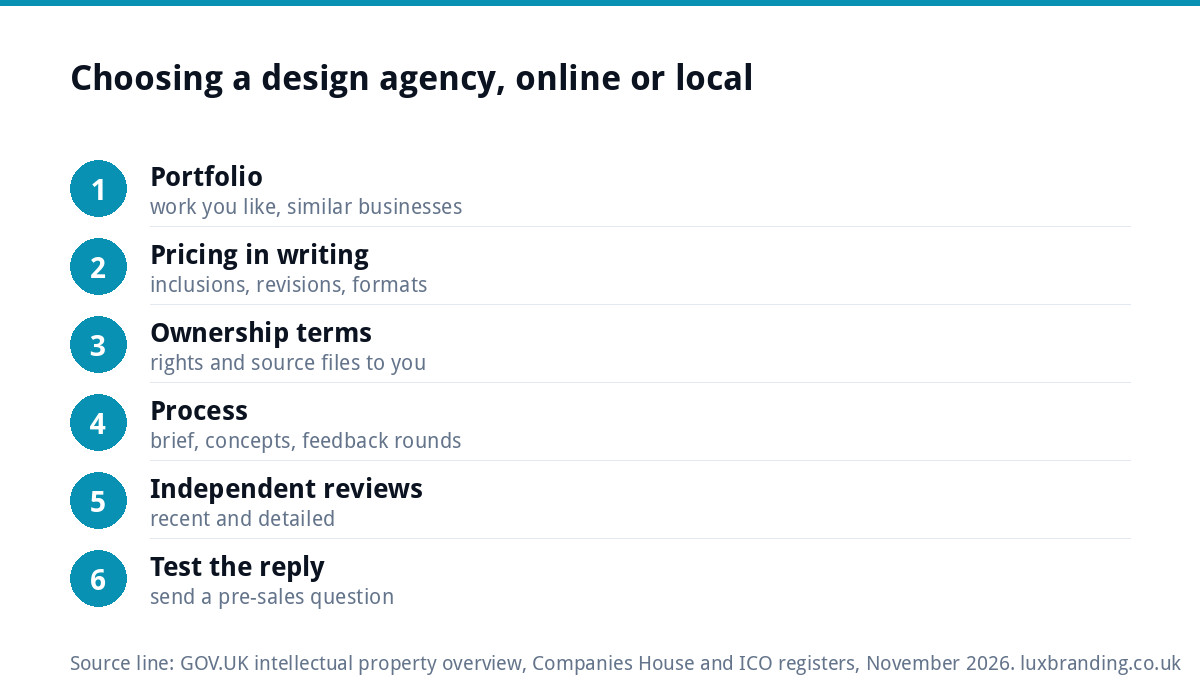
- A portfolio you like, with work for businesses similar to yours.
- Clear pricing and inclusions: how many concepts and revisions, which file formats, what happens if you want more.
- Ownership in writing. Who owns the logo, the website code and the files once you have paid.
- A defined process: what they need from you, when you see first ideas and how feedback works.
- Real reviews on independent platforms, not just testimonials on their own site.
- A named route for problems after launch, such as a support email and what support is included.
Ownership: the question to ask either way
Paying for design does not automatically make you the owner of it. The government’s intellectual property overview explains that a self-employed creator usually owns the intellectual property in their work, even if it was commissioned by someone else, unless their contract gives the rights to the client. So whichever agency you use, check the terms say the rights transfer to you on payment, and that you receive the source files, not just a PNG. Our guide to logo copyright and trade marks covers the detail.
Checks before you hire, online or local
| Check | How | What good looks like |
|---|---|---|
| Is the company real? | Search the Companies House register if they trade as a limited company | Active company, accounts filed, name matches |
| Do they handle personal data properly? | Search the ICO register of fee payers | Registered, if the business needs to pay the fee |
| Is the price fixed? | Read the package page or written quote | Price and inclusions in writing before work starts |
| Who owns the result? | Read the terms | Rights and source files passed to you on payment |
| What do customers say? | Independent review sites and Google | A strong rating with recent, detailed reviews |
| Can you reach them? | Send a pre-sales question | A clear, prompt answer from the business |
Common worries about going online, answered
“They will not understand my local market”
A designer does not need to live in your town to understand who your customers are; they need a good brief. Tell them the area you cover, the type of customer you want more of, the competitors people compare you with and what makes you different. A designer in another city working from a clear brief usually produces better work than a local one guessing. Where local detail really matters, such as a reference to a landmark or a regional colour, say so.
“What if I need changes after the work is finished?”
Ask before you buy what support is included and what later changes cost. A fixed-price logo edit or a defined support period is easier to plan around than an open-ended hourly rate. Make sure you hold the source files, so that any designer can make changes in future, not only the one who created them.
“What if the agency stops trading?”
This risk is the same for local and online businesses. The protection is the same too: own your domain name in your own account, keep copies of your logo files and website login details, and make sure the terms give you the rights. Then the work is yours, whatever happens to the supplier. Our guide to web designers overcharging covers the warning signs to look for in any quote.
“I will not be able to explain what I want”
Most people cannot describe a logo in words, and they do not need to. Collect pictures of logos, websites, vans or shopfronts you like, and a few you dislike, with a sentence on why. That gives a designer more to work with than an hour of conversation, and it works just as well by email as across a desk.
Making an online project feel local
If you go online, a few habits make the experience as smooth as working with someone round the corner:
- Write a short brief: what you do, who your customers are, three businesses whose look you like and three you do not.
- Send photos of where the logo will live: the van, the shopfront, the workwear.
- Give feedback in one consolidated message per round, with a decision maker named.
- Ask for mockups showing the design in real use before you approve.
- Keep every file and approval in one email thread or folder.
Local suppliers still play their part. An online agency designs the files; your local printer, sign-maker or embroiderer produces them, and a good agency supplies print-ready artwork they can use without fuss.
How we work
We are a UK online-only design agency, rated 4.8/5 Excellent, with 4,500+ projects delivered for businesses across the country. Prices are fixed and published. Our logo design is £129 one-off with unlimited concepts, every file format and stacked, horizontal and icon-only layouts, with concepts in 48 hours. Brand identity design is £299, and a custom WordPress website is £499 one-off, hand-coded, with no platform lock-in and the code yours to host anywhere. You order online and the project runs by email, so every decision is in writing.
If you want to compare costs first, the logo cost calculator and website cost calculator give quick figures, our guide to branding costs in the UK covers the wider market, and every price is on our pricing page.
The verdict
Choose local if face-to-face meetings matter to you or the job needs someone on site. Choose online if you want fixed prices, a wider choice of style and everything in writing. Either way, judge the agency on portfolio, pricing, ownership terms and how quickly and clearly they answer your first question. That tells you far more than their postcode. A good agency, wherever it is based, will be happy to show you its process and terms before you pay a penny.
Get the UK Branding Budget Worksheet (free)
A printable worksheet: decide what your brand needs now and price it against fixed published prices and the IPO trademark fee.
No spam. UK GDPR compliant. We only use your email to send this resource, unless you tick the box to hear from us.
Frequently asked questions
Is it better to use a local design agency? +
Not necessarily. Local suits owners who want face-to-face meetings or jobs needing someone on site, such as photographing premises. Online agencies often publish fixed prices, offer a wider choice of style and keep everything in writing. Portfolio, clear pricing, ownership terms and communication matter more than location.
How do online design agencies work? +
Usually you order or agree a package online, send a brief and reference images, then receive concepts by email or a project link. Feedback is given in writing, sometimes with video calls, and final files are delivered digitally. Your local printer, sign-maker or embroiderer then produces physical items from the print-ready files.
How do I check an online agency is legitimate? +
Search the Companies House register if it trades as a limited company, and the ICO register of fee payers if it handles personal data. Read independent reviews, check prices and inclusions are in writing, and send a pre-sales question to see how quickly and clearly the business replies.
Who owns a logo designed by an agency? +
It depends on the contract. Government guidance explains that a self-employed creator usually owns the intellectual property in commissioned work unless their contract gives the rights to the client. Whoever you use, make sure the terms transfer the rights to you on payment and that you receive the source files.
How much does an online design agency charge? +
Prices vary widely. Ours are fixed and published: logo design is £129 one-off with all layouts and file formats, brand identity design is £299, and a custom WordPress website is £499 one-off. You can see every price on our pricing page before you speak to anyone.