
Quick answer
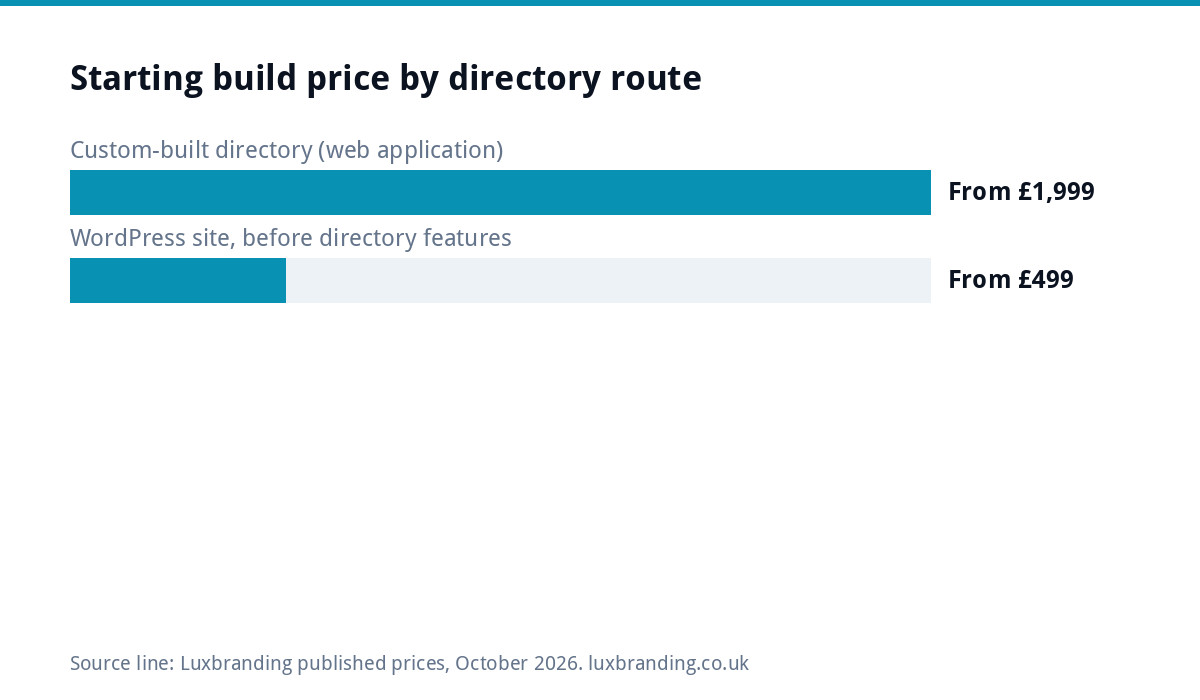
A UK directory website costs from our £499 custom WordPress website plus a directory plugin licence for a simple listings site, with directory features quoted in writing first. A custom-built directory with accounts, paid listings and search filters starts at £1,999. Hosting, maps, payment fees and plugin renewals are ongoing costs.
A directory looks simple from the outside: a list of businesses, a search box and a page for each listing. The price depends on what happens behind it: who adds the listings, whether they pay, how people search, and how much you check before anything goes live. Below are the three build routes, what drives the price, the running costs most quotes leave out and three worked examples by situation.
What a directory needs, whatever it costs
Every directory, from a single-town trades list to a national marketplace, is built from the same parts:
- Listings: a page per business with details, photos, contact links and a map.
- Search and filters: by category, location, keyword and any special fields such as “accredited” or “24-hour”.
- Submission: either you add listings yourself, or businesses sign up and add their own.
- Moderation: a way to approve, edit and remove listings, and to deal with spam.
- Payments (optional): paid listings, featured spots or subscriptions.
- Accounts (optional): logins for listing owners to update their own details.
Parts 1 to 4 are the core. Parts 5 and 6 are where the cost climbs, because they bring user accounts, payment handling and the personal data that comes with both.
The three build routes and their price
| Route | Typical cost | Best for | Trade-off |
|---|---|---|---|
| WordPress site plus a directory plugin | From £499 for the site, plus the plugin licence; directory features quoted in writing | Local or niche directories, owner-managed listings | Limited by what the plugin can do |
| Custom-built directory (web application) | From £1,999 | Self-service listings, paid tiers, custom search | Higher upfront cost and a longer build |
| Hosted directory builder | Monthly subscription, at the provider’s published price | Testing an idea quickly | You rent the platform and follow its rules |
Route 1: WordPress with a directory plugin
For most first directories, WordPress with a dedicated plugin is the sensible start. The plugin adds listing types, search, maps and submission forms. At the time of writing (October 2026), Directorist’s pricing page, as one example, lists its Starter plan for one site at $129 a year (shown on sale at $116), or a one-off lifetime licence for one site at $379. Other plugins price similarly; compare features before you buy, and check prices on the day.
Our custom WordPress website is £499 one-off for up to 8 pages, hand-coded with no page builders, with an SEO foundation, contact forms, Google Analytics, a written CMS walkthrough and 30 days of support. Directory features such as self-submission, user accounts and paid listings are member-area and lead-generation work, which we quote in writing before any work starts, so you know the full figure up front.
Route 2: a custom-built directory
Once a directory needs things a plugin does not do well, such as complex search, several listing tiers, custom approval steps, an owner dashboard or integration with another system, it becomes a web application. Our web applications start at £1,999 for custom web apps, dashboards and portals. Our guide to web app development costs explains how scope moves that figure, and our guide to a client portal for a small business covers the login side in more detail.
A custom build costs more up front but removes the plugin’s limits and its renewal fee, and the directory works exactly the way your users need.
What pushes the price up
- Self-service listings: sign-up, email verification, password resets and an edit screen for each owner.
- Paid listings: payment forms, invoices, renewals and what happens when a payment fails.
- Advanced search: distance from a postcode, multiple filters, sorting and fast results across thousands of listings.
- Reviews on listings: collecting, moderating and displaying them fairly.
- Importing data: loading an existing spreadsheet of businesses, cleaned and checked.
- Design: custom listing layouts and category pages rather than plugin defaults.
Each of these is reasonable on its own. Asking for all of them on day one is what turns a modest directory into a large project. Launch with the core, then add the next feature once people are using it.
Running costs nobody quotes
The build is a one-off; these come back every month or year:
- Hosting: our website management and hosting is £20 a month with UK hosting, SSL, daily backups, security monitoring and automatic updates.
- Plugin renewals: yearly licences for the directory plugin and any add-ons.
- Maps: Google Maps Platform’s pricing page lists 10,000 free calls per product each month on its Essentials pay-as-you-go tier, with paid subscription plans starting at US$100 a month for 50,000 calls. A small directory usually stays within the free allowance; a busy one may not.
- Payment fees: for paid listings, Stripe’s UK pricing lists 1.5% + 20p per standard UK card.
- Moderation time: approving listings, removing spam and answering owners. Budget a few hours a week once listings open to the public.
- Marketing: a directory is only valuable if people search it, and that takes SEO and outreach to listed businesses.
Worked examples by situation
| Scenario | Route | Build cost | Main running costs |
|---|---|---|---|
| Free directory of trusted trades in one town; you add every listing | WordPress plus plugin | From £499 plus plugin licence; directory setup quoted | Hosting £20 a month, plugin renewal |
| Regional wedding suppliers directory; suppliers pay for a featured listing | WordPress plus plugin with paid listings, or custom if needs grow | Quoted in writing; custom from £1,999 | Hosting, plugin renewals, Stripe fees, moderation |
| National directory with owner dashboards, tiers and postcode search | Custom web application | From £1,999, scoped in writing | Hosting, maps usage, Stripe fees, support |
In the first scenario, the owner’s time adding listings is the biggest real cost. In the second, payments and moderation take over. In the third, the build is the big number, but the custom search and dashboards are what make owners willing to pay.
How directories pay for themselves
Before you spend on the build, decide how the directory will earn its running costs. The common models, from simplest to most involved:
- Featured listings: basic listings stay free, and businesses pay to appear at the top of a category or area. Simple to explain and easy to add later.
- Yearly listing fees: every listing pays. Works for niche directories with clear value, such as accredited suppliers in one trade.
- Sponsorship or advertising: one or two sponsors per category. Needs real traffic before anyone will pay.
- Enquiry forwarding: visitors send a request through the directory and listed businesses receive it. This is lead-generation work, which adds forms, routing and record keeping to the build.
The model shapes the build. Featured listings need payments but not much else; enquiry forwarding needs forms, email delivery and a clear privacy notice. Choose the model first and the quote becomes far more accurate.
Data, content and the law
A directory publishes information about businesses and, once there are accounts, holds personal data about the people who manage them. Plan for a clear privacy notice, terms for listing owners, a way to correct or remove a listing on request, and a process for complaints. If listings include reviews, the rules on fake and incentivised reviews apply to what you publish. None of this is expensive to set up at the start; it is expensive to retrofit after a dispute.
How to brief a directory build
- Who adds listings: you, the businesses, or both?
- Do listings cost money, and how: one-off, yearly, or featured upgrades?
- What fields does a listing need, and which ones are searchable?
- How many listings at launch, and in a year?
- Do you have existing data to import?
- Who approves listings, and how quickly?
Answers to those six questions are enough for a fixed written quote. Our website cost calculator gives a rough figure for the site itself, and every price we publish is on our pricing page.
For the whole market in one place, from DIY builders to full agency builds and the running costs after launch, see what a website costs in the UK.
Start small, then grow
The directories that work usually start narrow: one trade, one region or one niche, done properly. A tight, useful directory with fifty well-checked listings is worth more to users than a sprawling one with thousands of empty profiles. Launch on the simplest route that does the job, prove that people use it, then invest in the features that paying listing owners ask for. If you are unsure which route fits, email your answers to the six briefing questions to support@luxbranding.co.uk, and anything beyond a standard site is quoted in writing before any work starts.
Get the UK Website Project Brief Template (free)
A two-page template for briefing any UK web designer: sitemap, integrations, audience and deliverables. Cuts revision rounds in half.
No spam. UK GDPR compliant. We only use your email to send this resource, unless you tick the box to hear from us.
Frequently asked questions
How much does a directory website cost in the UK? +
A simple listings directory can start from our £499 custom WordPress website plus a directory plugin licence, with the directory features quoted in writing before work starts. A custom-built directory with owner accounts, paid listings and advanced search starts at £1,999 under our Web Applications service. Hosting, plugin renewals, maps and payment fees are ongoing.
Can I build a directory on WordPress? +
Yes. Directory plugins add listing types, search, maps and submission forms to WordPress. As one example, Directorist's pricing page lists a one-site Starter plan at $129 a year at the time of writing. WordPress suits local and niche directories well; a custom build makes more sense once you need complex search, several listing tiers or owner dashboards.
Do Google Maps on a directory cost money? +
Often not for a small directory. Google Maps Platform's pricing page lists 10,000 free calls per product each month on its Essentials pay-as-you-go tier, with subscription plans from US$100 a month for 50,000 calls. A busy directory showing many maps can go over the free allowance, so check usage after launch.
What are the running costs of a directory website? +
Expect hosting (£20 a month with us), yearly plugin renewals, payment fees on paid listings (Stripe lists 1.5% + 20p per standard UK card), possible maps usage charges and your own moderation time. Marketing matters too, because a directory is only valuable to listed businesses if people actually search it.
Should I charge businesses to be listed? +
Many directories launch free to build up listings, then charge for featured spots or extra features once people use the site. Paid listings add payments, renewals and failed-payment handling to the build, which raises the cost. Start with free listings if you are unsure, and add a paid tier once listing owners can see the traffic it brings.