Quick answer
A brand positioning statement is one or two internal sentences that say who you serve, what you offer, how you differ and why anyone should believe it. The fill-in version is: for [customer] who [need], [business] is the [category] that [main benefit], because [proof]. Write it, test it against competitors, then use it to brief every design and copy decision.
A positioning statement is not a slogan and it is not your unique selling point. It is the reference sentence that everything else is checked against: the logo brief, the homepage headline, the price you charge. This guide gives you the template, a worked example, the tests that separate a useful statement from a vague one, and how to put it to work.
What a positioning statement is (and is not)
Three things often get mixed up:
- Positioning statement. An internal sentence describing the place you want to hold in customers’ minds. It is written for you, your staff and your suppliers, not for customers.
- Unique selling point. One specific difference, such as same-day call-outs. It is one ingredient of the positioning statement.
- Strapline or slogan. A short public line derived from the positioning, written to be memorable.
Because the positioning statement is internal, it can be plain and even a little clumsy. Its job is clarity. The polished public versions come later, built on top of it.
The fill-in template
Copy this and fill each part in turn. Each part has one job.
| Part | Prompt | Example (a hypothetical electrician) |
|---|---|---|
| For | Your main customer, described narrowly | For landlords and letting agents in Leicester |
| Who | Their need or frustration | who need electrical safety certificates without chasing contractors |
| Business | Your name | Brightline Electrical |
| Is the | The category they would file you under | is the domestic electrician |
| That | The main benefit they get | that books, tests and certifies within one week |
| Because | Your proof | because we keep slots for agency work and send certificates digitally on the day |
Put together: “For landlords and letting agents in Leicester who need electrical safety certificates without chasing contractors, Brightline Electrical is the domestic electrician that books, tests and certifies within one week, because we keep slots for agency work and send certificates digitally on the day.”
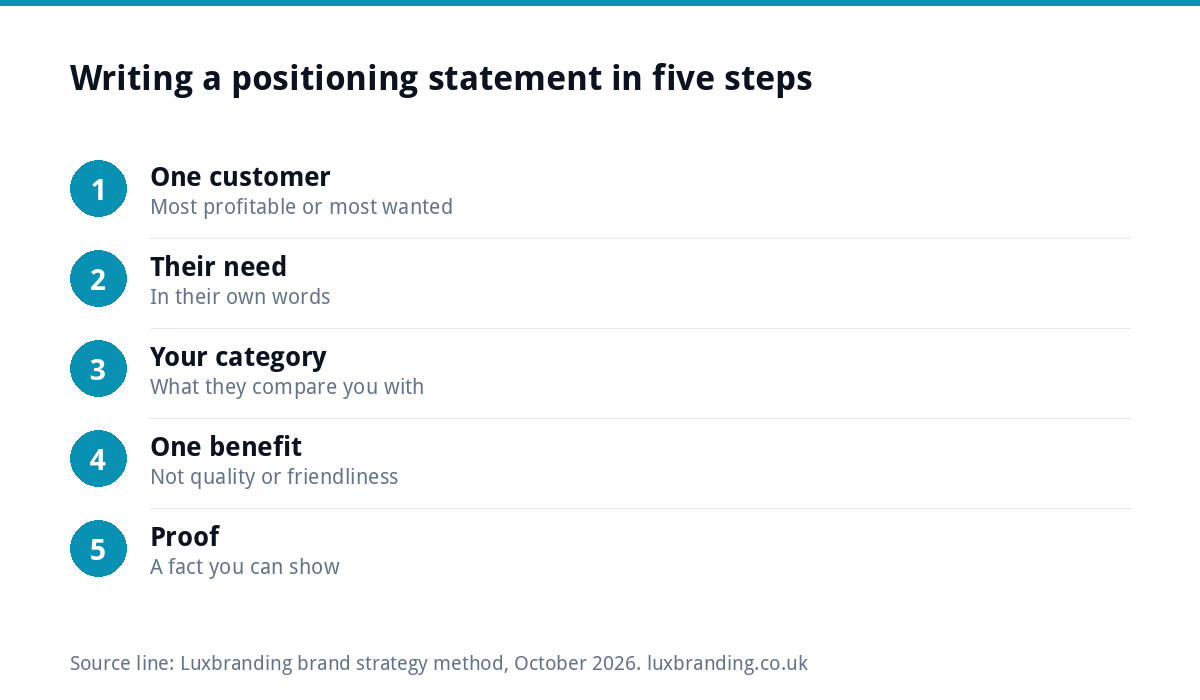
Step 1: pick one main customer
The most common mistake is trying to describe everyone. “Homeowners and businesses across the Midlands” gives you nothing to design around. Choose the customer who is most profitable, most frequent or the one you want more of. You will still serve others; the statement simply decides who the brand is built for.
Look at your last twenty jobs or sales. Who paid the best, came back or referred others? That group is usually the right starting point, even if it is smaller than you expected.
Steps 2 and 3: the need and the category
Describe the need the way a customer would say it on the phone, not the way your industry describes it. “Need their boiler fixed before the weekend” beats “require heating system maintenance solutions”. If you are not sure, read your enquiry emails and reviews and borrow their phrases.
Then choose your category honestly. The category is what customers would compare you with. A bakery that mainly does wedding cakes should probably say “wedding cake maker”, not “bakery”. A narrower category is easier to stand out in and makes the benefit more believable. If your category is unclear, ask a few customers what they would have searched for to find you.
Step 4: state one benefit, not five
Choose the single benefit that matters most to the customer in step 1 and that competitors do not clearly offer. Quality, reliability and friendliness rarely qualify on their own because everyone claims them. Speed, specialism, a guarantee, a price model or a process usually work better because they can be shown.
Step 5: give a reason to believe
The “because” is what makes the statement honest. It should be a fact you can prove: a process, a qualification, a track record, a guarantee you actually offer. If you later use the claim in advertising, the Advertising Standards Authority’s guidance on substantiation is clear that you must hold evidence for objective claims before making them, and the government’s guide to marketing and advertising law sets out the wider rules. Building the proof into the statement from day one keeps the brand on the right side of both.
Testing your statement
Run your draft through these tests. If it fails one, rewrite that part.
| Test | Fail looks like | Pass looks like |
|---|---|---|
| Competitor swap | A rival’s name fits just as well | Only your business fits |
| Customer recognition | Customers would not recognise the need | They would say “yes, that’s my problem” |
| Proof | The “because” is an adjective | The “because” is a fact you can show |
| Plain words | Jargon and buzzwords | Something you would say out loud |
| Decision test | It does not help you say no to anything | It tells you which jobs, prices and designs fit |
The plain words test is worth taking seriously. The Plain English Campaign has promoted clear writing for decades, and the same principles apply to an internal statement as to a customer letter: short words, active sentences, no jargon.
Three more examples, from weak to strong
Seeing a vague statement rewritten is the fastest way to understand the method. All three businesses are hypothetical.
A cafe. Weak: “For everyone who loves great coffee, Corner Cup is the cafe that offers quality and a warm welcome.” Strong: “For commuters at Harrogate station who have five minutes, Corner Cup is the takeaway coffee bar that has your order ready when you arrive, because you can order ahead by text and we hold it for ten minutes.”
An online shop. Weak: “For people who want nice candles, Ember and Oak sells premium candles.” Strong: “For gift buyers who leave it late, Ember and Oak is the candle maker that delivers wrapped gifts next day across the UK, because we wrap to order every afternoon and post by 5pm.”
A cleaner. Weak: “For homes and businesses, Spark Cleaning is a reliable cleaning company.” Strong: “For holiday let owners in the Lake District, Spark Cleaning is the changeover cleaner that turns properties around between guests on the same day, because our teams are scheduled around check-out times and photograph every room when finished.”
In each case the strong version names one customer, one situation, one benefit and a fact behind it. It also makes design decisions easier: the cafe needs a brand that reads instantly at a glance, the candle maker needs gift-worthy packaging, and the cleaner needs to look dependable to property owners who are not there to check.
Putting the statement to work
A positioning statement earns its keep when it shapes decisions. Use it in four places:
- Design briefs. Give it to whoever designs your logo and identity. “Landlords who want speed and paperwork done” points to a very different look from “families wanting a friendly local electrician”. Our guide to brand identity versus logo design explains what an identity project adds.
- Website copy. The homepage headline is usually a customer-facing version of the “that” and “for” parts.
- Pricing. If your benefit is speed or specialism, your price can reflect it.
- Saying no. Work that does not fit the statement can be priced differently or referred elsewhere.
For trade businesses, our guide to branding for trades businesses shows how positioning carries through to vans, workwear and paperwork.
When to rewrite it
Review the statement once a year, or sooner if something important changes: a new main customer group, a new service, a new competitor doing exactly what you do, or a move upmarket. If the statement changes a lot, the visual identity may no longer fit. Our guide to when to rebrand a business covers how to tell whether you need a refresh or a full change. And if your materials have already drifted apart over the years, see our guide to a brand that looks inconsistent everywhere.
From statement to identity
Once your positioning is written, the visual identity should express it. Our Brand Identity Design is £299 and includes the logo, colours, typography, imagery and brand guidelines; send your positioning statement with the brief and we design to it. If you only need the mark, Logo Design is £129 with every layout and file format. All prices are on our pricing page.
Get the UK Branding Budget Worksheet (free)
A printable worksheet: decide what your brand needs now and price it against fixed published prices and the IPO trademark fee.
No spam. UK GDPR compliant. We only use your email to send this resource, unless you tick the box to hear from us.
Frequently asked questions
What is a brand positioning statement? +
An internal sentence or two describing who you serve, what you offer, how you differ and why anyone should believe it. It is written for you, your staff and suppliers rather than customers, and it acts as the reference point for design briefs, website copy, pricing and decisions about which work to take on.
What is the difference between a positioning statement and a USP? +
A unique selling point is one specific difference, such as same-day call-outs. A positioning statement is the fuller sentence that includes the customer, their need, your category, your main benefit and the proof. The USP usually becomes the benefit or the proof inside the positioning statement.
What is a simple positioning statement template? +
For [customer] who [need], [business] is the [category] that [main benefit], because [proof]. Fill each part narrowly: one main customer, their need in their own words, the category they would compare you in, one benefit competitors do not clearly offer, and a fact you can prove.
Should customers see my positioning statement? +
Not usually in its raw form. It is an internal tool, so it can be plain and slightly clumsy. Customer-facing lines such as your homepage headline and strapline are written from it. If you do use any claim publicly, make sure you can prove it, as advertising rules require evidence for objective claims.
Can Luxbranding design a brand identity from my positioning statement? +
Yes. Send your positioning statement with the brief for our Brand Identity Design, £299, which includes the logo, colours, typography, imagery and brand guidelines, and we design to it. Logo Design on its own is £129 with every layout and file format. Prices are on our pricing page.