Quick answer: nursery website costs
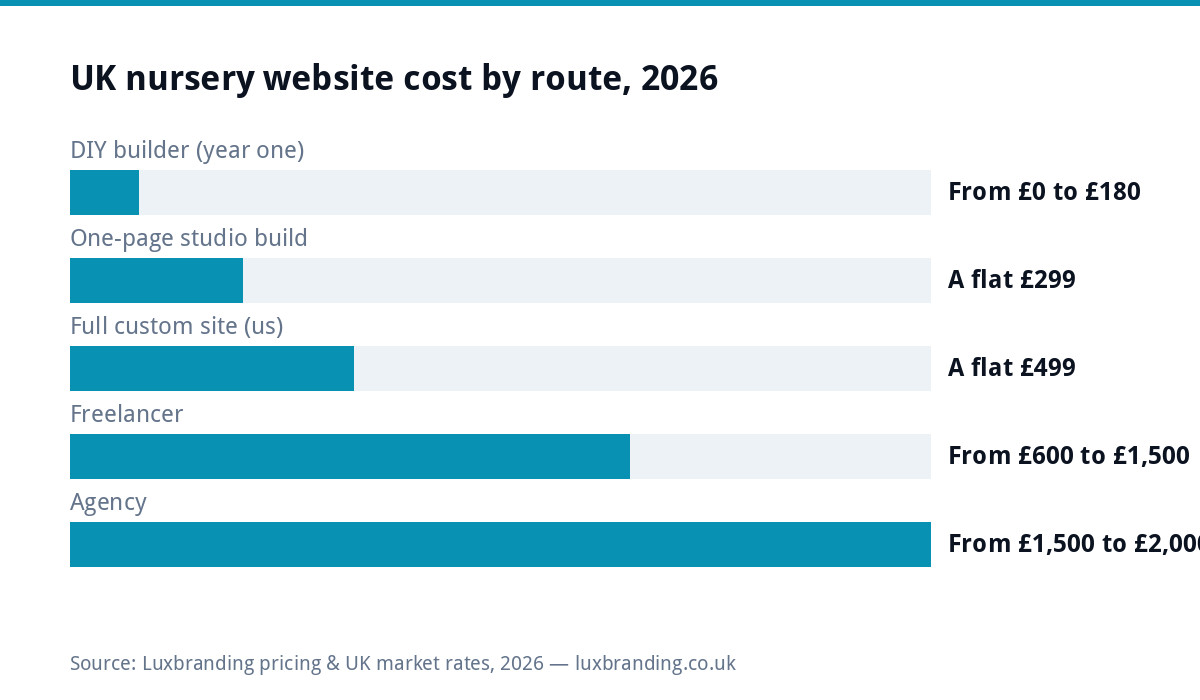
A nursery or preschool website costs £299 to £700 at fixed prices in the UK: our one-page build is £299 and a full custom WordPress site is £499. Freelancers and agencies quote £600 to £2,000 for the same scope. Ongoing costs are a £10 to £30 domain and about £20 a month for managed hosting, updates and security, which matters more than usual in a sector holding children’s data. Fixed figures are public on our price list; benchmark any quote with the free website cost calculator.
What parents actually do on a nursery website
They arrive from a search or a recommendation, and they audit: Ofsted grade, fees, sessions, food, staff warmth, and whether the place feels safe and loved. Then they either book a visit or leave. Every design decision follows from that sequence. The site is not a prospectus; it is a visit-generating machine wearing a reassuring face. Nurseries with waiting lists still need it, because list position pressure is exactly what convinces on-the-fence parents to commit early.
Cost table: routes for early-years settings
| Route | Upfront | Suits | Caution |
|---|---|---|---|
| DIY builder | £0 to £180/year | Childminders | Templates handle safeguarding photos badly |
| One-page studio build | £299 | Single settings, preschools | Less room for policy pages |
| Full custom site | £499 | Nurseries, growing groups | Needs your content and consents |
| Freelancer | £600 to £1,500 | Custom needs | Continuity of support |
| Agency | £1,500 to £2,000+ | Multi-site groups | Rarely justified below that |
Ofsted on the website: own the conversation
Parents check the register regardless, so meet them there: link your latest report on the official Ofsted reports site, quote the grade and a line or two of inspector language you are proud of, and date it. A Good or Outstanding badge near the top of the homepage does more trust work than any paragraph of your own. If the last inspection was harder, a factual sentence plus what changed since reads as integrity, and integrity is the product parents are buying.
Photography with safeguarding built in
Early-years websites carry a duty most sectors never think about. The professional pattern: written parental consent specifically covering website use, no identifiable children where avoidable, and storytelling through hands, activities, artwork, environments and staff instead. It photographs beautifully, ages well as cohorts change, and removes an entire risk category. Guidance from the Early Years Alliance covers consent and image policy well. A builder template will happily let you upload anything; a sector-aware build defaults to safe.
The waiting-list form: your conversion point
The form should capture child’s age, sessions wanted, preferred start, and funded-hours status, then book the visit. Nothing else. Auto-acknowledge instantly, because anxious parents refresh inboxes, and respond personally within the day. Settings with genuine waiting lists should say so with typical wait times per room: scarcity stated honestly accelerates decisions. This one form, done properly on a £499 custom build, outperforms glossy prospectus sites that funnel everything into a generic contact box.
Fees, funded hours and the transparency dividend
Publish indicative fees: daily and weekly rates by age room, what is included, and which funded entitlements you accept. Parents plan childcare budgets months ahead, and fee-silent sites generate mismatched enquiries while quietly losing organised families to settings that publish. You are not committing to prices forever; you are filtering your enquiry pipeline to people who can actually enrol. The same transparency logic that runs through every sector we price, it turns out, holds hardest where family budgets are involved.
Worked example: 40-place nursery replaces the PDF era
A single-site nursery running on a dated site with a PDF prospectus orders the £499 build: Ofsted Good badge and linked report, fee table by room, safeguarding-safe gallery, staff wall with real warmth, policy downloads, and the waiting-list form wired to the manager’s inbox. Domain £14, hosting £20 a month. Visits booked per month go from around three, mostly phone, to nine, mostly form, and September enrolment fills two months earlier than the previous year. Two funded places cover the entire build cost within weeks.
Parent-portal expectations: what to build vs buy
Daily diaries, photos home, invoicing and registers live in specialist early-years apps, and parents increasingly expect one. Do not have your website developer rebuild them: the platforms cost £30 to £100 a month, integrate with your operations, and carry the data-protection load. The website’s job is the front door: convince, inform, book the visit, and link to the portal parents already use. Keeping those roles separate keeps both costs sane, the same build-versus-buy line we draw for tutors in our website cost guide and across education-adjacent sectors.
Ongoing costs and quiet obligations
Domain £10 to £30 a year; managed hosting £20 a month with updates, backups and security handled, not optional in a sector where a hacked site would sit under your safeguarding reputation; and an annual content pass: staff changes, fee updates, new term dates, refreshed gallery. Budget an hour a term. Skip: paid directories once your own site ranks locally, and video tours until the basics convert, though a phone-shot welcome from the manager costs nothing and warms every page it sits on.
By situation: what to buy
Childminder: £299 one-pager with consent-safe photos and your grade; it will be the best presence in your postcode. Preschool or single nursery: the £499 build is the sweet spot, room for policies, rooms and the proper form. Growing group, two to four sites: full site with genuine per-setting pages, shared brand, local proof each. New setting pre-registration: launch a coming-soon one-pager with the waiting-list form the day the lease signs; lists build before doors open. Out-of-school club: one-pager plus term-date updates, keep it light.
Policies and downloads: the reassurance library
Parents rarely read policies before visiting, but they check the policies exist, and the checking is the point. A tidy downloads section, safeguarding, illness and medication, food and allergies, behaviour, late collection, settling-in, signals an organised setting before a single visit. Keep them as dated PDFs with version numbers, refresh annually, and mirror the key points in plain English on the page itself: “we are nut-free, here is how medicines work, here is what settling-in looks like week by week”. Ten minutes of plain-language summarising converts more parents than the documents themselves, because it shows the setting can explain itself the way it will explain their child’s day.
The second audience: staff you are trying to recruit
Early-years recruitment is hard everywhere, and candidates research settings exactly like parents do. A short careers section earns its place on any nursery site: current openings, what the setting pays against sector norms, training and progression genuinely offered, and a line from a real staff member on why they stay. Settings report that a warm, honest careers page halves agency dependence over a year, which at typical agency fees pays for the entire website several times over. The same photography and tone that reassure parents recruit practitioners; the website simply needs to remember it is talking to both.
What to do next
Order the £299 one-page build or the £499 custom site built around visits, safeguarding-safe imagery and the waiting-list form. Or take sixty seconds with the free website cost calculator to see what your specific requirements should cost before you take any quotes.
Get the UK Website Project Brief Template (free)
A two-page template for briefing any UK web designer: sitemap, integrations, audience and deliverables. Cuts revision rounds in half.
No spam. UK GDPR compliant. We only use your email to send this resource, unless you tick the box to hear from us.
Frequently asked questions
How much does a nursery website cost in the UK? +
A professional nursery site costs £299 to £700 fixed-price, £600 to £2,000 through freelancers and agencies. Our one-page build is £299 and a full custom WordPress site £499, both built around waiting-list enquiries and safeguarding-appropriate content.
Should a nursery link its Ofsted report? +
Yes, directly and proudly if the grade is good, and factually even if not, with a short note on improvements underway. Parents will find the report anyway on the official register; linking it yourself signals confidence and saves them the search.
What photos can a nursery legally use on its website? +
Only images with explicit written parental consent for website use, and best practice avoids identifiable children entirely: hands, backs of heads, activities and environments tell the story without safeguarding risk. Never name children in captions.
What is the most important feature on a nursery website? +
The visit-booking and waiting-list form. Nursery decisions are made in person; the website exists to get the visit booked, so fees guidance, sessions offered and an easy form beat everything else including virtual tours.
Should nurseries publish their fees online? +
Publish at least indicative daily and weekly rates plus funded-hours acceptance. Parents budget before they visit, and fee-silent websites lose exactly the organised families nurseries want, while attracting time-consuming enquiries from mismatched budgets.