
Quick answer
If your web developer registered your domain in their own name, ask them in writing to make your business the registrant. For a .uk domain that is a Registrant Transfer, which Nominet lists at £10 plus VAT. For a .com, the registrar changes the registrant, and you can then move it to your own account using a transfer code.
This guide is for when your developer is still around and the relationship is fine or at least civil, but the domain is in their name. Our UK domain names guide covers domains in general; here we focus on getting control back without breaking your website or email.
Why this happens (and why it matters)
Developers often register domains for clients because it is quicker: they already have an account with a registrar, they handle the settings, and the client does not have to learn anything. Usually there is no bad intent.
The problem comes later. Whoever is named as the registrant is the legal holder of the domain. If the developer retires, falls out with you, stops paying the renewal or simply stops answering, your website and email depend on someone else. The address on your van, cards and quotes is not really yours.
Signs your domain may not be in your name:
- You have never received a renewal reminder for it.
- Your developer’s invoices include “domain renewal” as a line.
- You do not have a login for any domain registrar.
- Nobody can tell you which company the domain is registered with.
- You set up the business before the website, and the developer “sorted the domain”.
None of these proves anything on its own, but if two or more apply, do the lookup in step 1 today. It takes five minutes, and it is far easier to sort out while you and your developer are on good terms than after something has gone wrong.
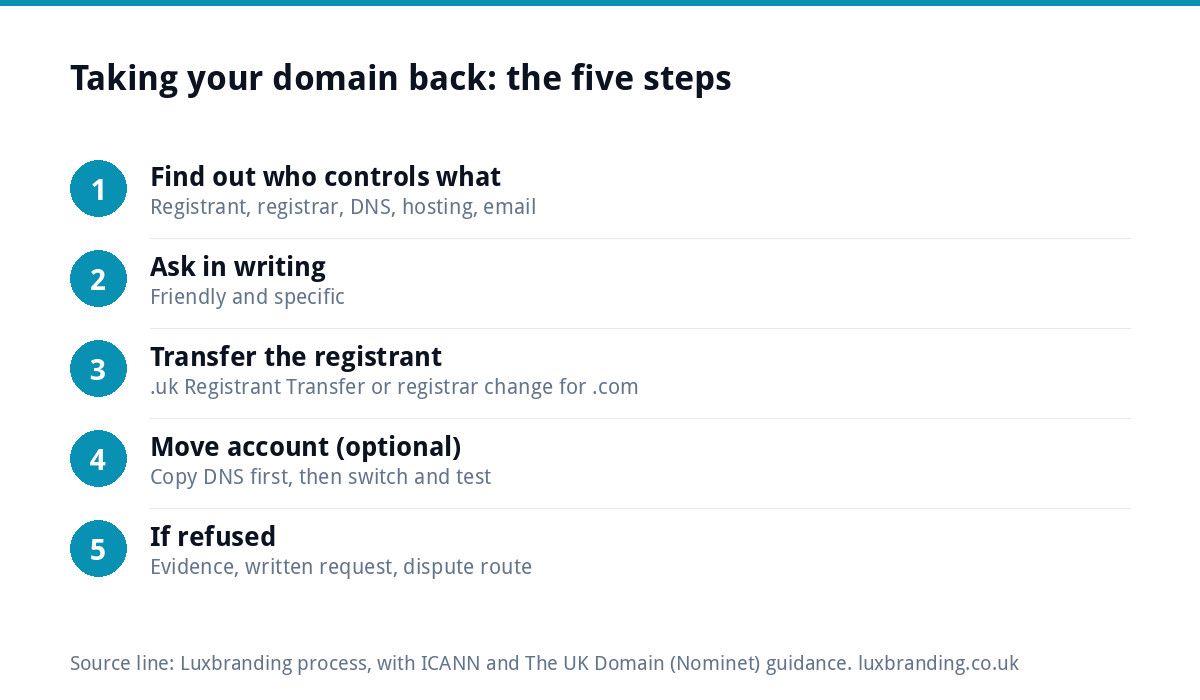
Step 1: find out exactly what they control
A domain has several layers, and different people can control each one. Work out who holds which before you ask for anything.
| Layer | What it means | Who should hold it |
|---|---|---|
| Registrant | The legal holder of the domain | Your business |
| Registrar account | The account at the company the domain is registered through | An account in your name, or your developer acting for you with your consent |
| DNS settings | Where the website and email point | Whoever manages your site, with you able to see them |
| Hosting | Where the website files live | Your choice of host |
| Where your mailboxes live | Your choice of provider |
For a .com, .net or similar domain, ICANN’s registration data lookup shows the registrar and, where not hidden for privacy, registrant details. For a .uk domain, Nominet’s own lookup tool shows similar information. If the registrant shows the developer’s name or company, you have your answer.
Step 2: ask politely, in writing
Most developers will agree straight away once asked clearly. Keep it friendly and specific.
“Hi, as part of tidying up our business admin, we would like our company to be the registered holder of our domain. Could you change the registrant to [business name] with [email address] as the contact? We are happy for you to keep managing the settings as now. Thanks.”
Note the last line. Asking to be the registrant is not the same as sacking your developer. They can keep managing the site and DNS if you are happy with them; you are just making sure the asset is in the right name. Send the message by email rather than a text or a call, so there is a dated record of what you asked for and when.
Step 3: transfer the registrant (the important bit)
For .uk domains
The UK Domain’s guidance on transferring a domain to someone else says that changing the registrant name completely needs a Registrant Transfer. It gives examples such as moving a domain from an individual to a limited company. The registrar may be able to do it; otherwise the current registrant can start it in their Nominet Online Services account. Nominet’s transfer service costs £10 plus VAT, even for several domains, and either party can pay.
For .com and other generic domains
The registrant change is done through the registrar, usually by the developer in their account. ICANN’s guidance for domain name holders explains two points worth knowing:
- After a change to the registrant name, the domain cannot be moved to a different registrar for 60 days, unless the registrar offers an opt-out (they do not have to).
- If the plan is to move registrar too, ICANN suggests completing the registrar transfer before changing contact details.
.uk and .com compared
| Question | .uk (.co.uk, .uk) | .com and similar |
|---|---|---|
| Who runs the registry | Nominet | Various registries under ICANN rules |
| How the holder changes | Registrant Transfer | Registrant change at the registrar |
| Published fee for the change | £10 plus VAT (Nominet) | Depends on the registrar |
| Moving to your own registrar account | Change of registrar (different process) | Transfer using an Auth-Code |
| Lock after a holder change | Check with your registrar | 60 days before a registrar transfer, unless opted out |
Step 4: move it to your own account (optional)
Once you are the registrant, you can leave the domain where it is, with your developer managing it, or move it into a registrar account you control. For a generic domain, ICANN says an Auth-Code is needed to move registrars, and your registrar must provide it within five calendar days of your request. For .uk domains, changing registrar is a separate process from changing the registrant.
Either way, before anything moves:
- Ask for a copy of all current DNS records (screenshots are fine).
- Recreate those records at the new registrar or DNS host before switching.
- Check your website and send test emails both ways after the switch.
- Keep the old account open for a week in case something was missed.
Email is the part most often broken by a domain move. If messages start bouncing or landing in spam afterwards, our guide to business emails going to spam covers the records to check.
Step 5: if they say no, or want a fee
Stay calm and gather facts before you escalate.
- Check your paperwork. Find invoices showing you paid for the domain, and any contract or terms about ownership.
- Ask what the fee covers. A modest admin fee for doing the work is not unreasonable. A large “release fee” for a domain you paid for is worth questioning.
- Put the request in writing again, with your evidence, and a reasonable deadline.
- For .uk domains, Nominet runs a dispute resolution service for genuine disputes over who should hold a domain. Read its process on Nominet’s site before relying on it.
If the developer has stopped responding altogether, the problem is bigger than the domain. Make sure you have a backup of your website and access to your email before anything else.
A worked example
Say a landscaping firm’s site was built by a freelancer five years ago, who registered yourlandscaping.co.uk under their own name. The freelancer still hosts the site and is happy to carry on. The owner asks for the domain to be put in the company’s name. The freelancer starts a Registrant Transfer in Nominet Online Services, the owner follows the emailed instructions, the company pays the £10 plus VAT, and nothing about the website or email changes. Twenty minutes of admin removes a risk the business had been carrying for five years.
Set it up properly from now on
- Your business is the registrant on every domain you use, including old ones that redirect.
- Renewal reminders go to an email address you check, not the developer’s.
- Auto-renew is on, with a card that will not expire unnoticed.
- You hold a login to the registrar account, even if someone else manages it.
- You keep a list of every domain, registrar and renewal date.
If you are also reviewing what you pay your web company, our guide to web designers who overcharge helps you judge it, and our website hosting cost guide shows typical prices.
Where we fit
Our Website Management and Hosting plan is £20 a month, with UK hosting, SSL, daily backups, security monitoring, automatic updates and up to three business email mailboxes. With the websites we build, you own the code and can host it anywhere. See the website management and hosting page, and every price on our pricing page. If you are stuck mid-transfer, email support@luxbranding.co.uk with your domain name and what you have tried.
Get the UK Website Project Brief Template (free)
A two-page template for briefing any UK web designer: sitemap, integrations, audience and deliverables. Cuts revision rounds in half.
No spam. UK GDPR compliant. We only use your email to send this resource, unless you tick the box to hear from us.
Frequently asked questions
How do I know if my developer owns my domain? +
Look up the domain. For .com and similar domains, ICANN's registration data lookup shows the registrar and, where not hidden for privacy, the registrant. For .uk domains, Nominet's lookup tool shows similar details. If the registrant is your developer or their company rather than your business, they are the legal holder.
How much does it cost to transfer a .uk domain into my name? +
Changing the holder of a .uk domain is a Registrant Transfer. Nominet's published fee is £10 plus VAT, even if several domains move at once, and either the current or new registrant can pay. Your registrar may be able to do it for you, or the current registrant can start it in their Nominet Online Services account.
Can I move my domain to another registrar straight after the owner changes? +
For generic domains such as .com, usually not immediately. ICANN says a domain cannot move to a different registrar within 60 days of a registrant name change, unless the registrar offers an opt-out. If you plan to move registrar as well, ICANN suggests doing the registrar transfer first.
Will my website or email stop working during a domain transfer? +
They should not, if the DNS records are copied first. Ask for all current records before anything moves, recreate them at the new provider before switching, then test the website and send emails both ways. Keep the old account open for a week in case something was missed.
What if my developer refuses to transfer the domain? +
Gather your evidence first: invoices showing you paid for the domain and any contract terms about ownership. Ask again in writing with a reasonable deadline. A small admin fee for the work can be fair; a large release fee is worth questioning. For .uk domains, Nominet runs a dispute resolution service for genuine disputes.