Quick answer
Good PVC banner design is one short message, your phone number or web address in large letters, and your logo, laid out at full size with room for hems and eyelets. Trade printers list sizes from 1.5m x 0.5m up to about 4.9m x 3m. Our banner design is £89; larger or custom jobs are quoted in writing first.
This guide covers outdoor PVC and mesh banners for scaffolding, site fencing, shop fronts and event railings. If you need an indoor pull-up stand, our roller banner and exhibition design guide is the better read, and for paper and board prints see the poster design guide.
Where outdoor banners work, and what size to measure for
Outdoor banners are custom-sized far more often than not, because the space decides the size. Measure the railing, fence panel or scaffold bay first, then subtract a margin so the banner can be pulled tight without the ties hitting the corners. At the time of writing (October 2026), Tradeprint’s PVC banners page lists sizes from 1.5m x 0.5m up to 4890 x 3000mm, or a custom size. The table below shows typical placements; the sizes are examples to measure against, not a fixed standard.
| Where it hangs | Example size | Who reads it, and from where |
|---|---|---|
| Shop front or window rail | 1.5m x 0.5m to 3m x 1m | Pedestrians across the pavement, drivers waiting at lights |
| Site fence or Heras panel | About one panel wide, often 3m x 1m or smaller | Passing traffic and neighbours; usually read side-on |
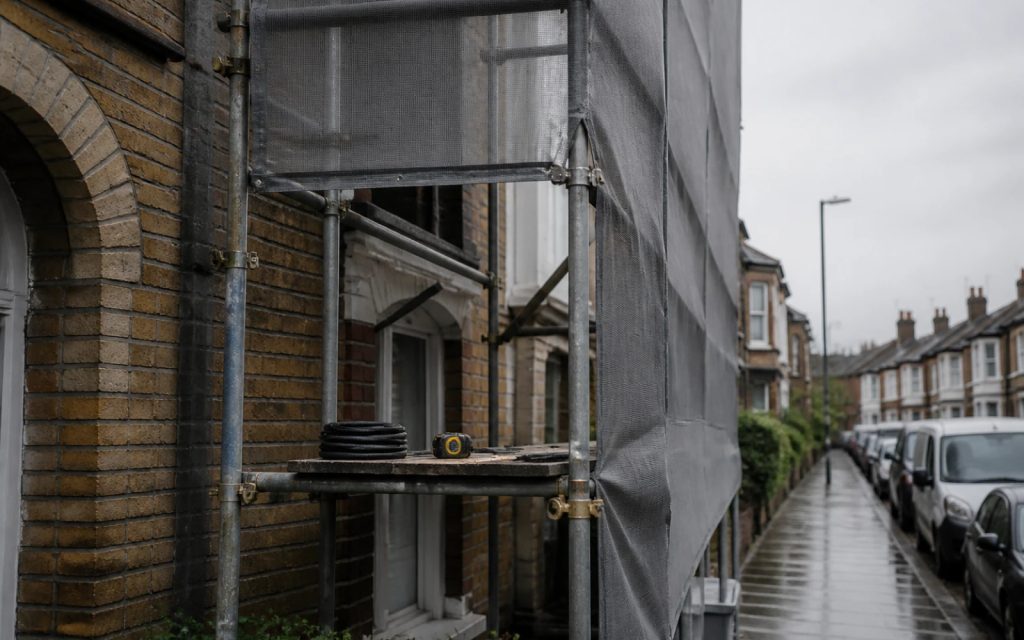
| Scaffold lift on a job | Sized to the scaffold bay | Drivers on the road, the street the job is on |
| Event barrier or railing | Sized to the barrier run | Crowds close up and arrivals from the car park |
| Gable or long wall | Large format, custom | Long-distance traffic; usually needs consent (see below) |
PVC or mesh: choosing for wind
Solid PVC is the default outdoor banner. Tradeprint describes its standard material as 440gsm tear-resistant PVC. It prints strong, saturated colour and works well on walls, shop fronts and sheltered railings.
Mesh is a woven, perforated material (Tradeprint lists 260gsm). In its words, the small perforations “allow wind to pass through the banner rather than push against it”. That matters on scaffolding and open fencing, where a solid banner acts like a sail and can tear eyelets or pull at the structure. The trade-off is that colour reads slightly less vivid, and fine detail fades because part of every letter is holes.
| Factor | Solid PVC | Mesh |
|---|---|---|
| Best for | Walls, shop fronts, sheltered railings | Scaffolding, open fencing, exposed sites |
| Wind load | Catches wind like a sail | Wind passes through the perforations |
| Colour and detail | Strongest, sharpest | Slightly softer; avoid thin lines and small text |
| Design adjustment | Standard layout | Heavier fonts, bigger contact details, fewer elements |
If you are not sure which you need, design for mesh. A layout that works on mesh will always work on solid PVC, but not the other way round.
Hems, eyelets and pole pockets: what the artwork must allow for
Finishing is where banner artwork most often goes wrong.
- Hems fold the edge back to reinforce it. Some printers offer hemmed or unhemmed as an option. A hem eats into the printed edge, so nothing important should sit near it.
- Eyelets are metal or plastic rings punched through the banner for ties. Tradeprint places them 20mm from the edge and then roughly every 500mm. Any letter or logo sitting on that line will have a hole through it.
- Pole pockets are sleeves sewn or welded along the top and bottom so the banner can slide onto a pole or frame. They hide a strip of artwork entirely.
The practical rule: keep text and logos well inside a safe zone. Tradeprint asks for a 50mm safe zone from the trim edge plus 3mm of bleed. Pole pockets need more. Always ask your printer for their template before the layout is finalised, and tell your designer how the banner will be fixed.
Reading distance and letter height
An outdoor banner is read from a distance, often from a moving car, so size the letters for the furthest reader you care about. A widely used sign-trade rule of thumb is roughly 25mm of capital-letter height for every 3 metres of viewing distance. Treat that as a starting point, not a standard: bold fonts read further than thin ones, and drivers only get a glance.
Two practical checks work better than any formula:
- Print the layout on A4, stand back the scaled distance (for a 3m banner read from 30m, that is about 2m from an A4 sheet), and see what you can still read.
- Look at the banner from the actual spot a customer would see it: the junction, the car park entrance, the opposite pavement.
One message: what to put on the banner
Banners fail when they try to be a brochure. A driver gets two or three seconds, so the hierarchy should be:
- One message in a handful of words: what you do or what is happening (“Kitchens fitted”, “Now open”, “Spring open day”).
- The contact route, big: a phone number or a short web address. Pick one if space is tight. Nobody remembers a long URL from a moving car.
- Your logo, large enough to recognise but not competing with the message.
Leave out service lists, social icons and paragraphs. High contrast beats subtle colour. If your logo only exists as a small JPG, it will blur at banner size; our guide to logo file formats explains why vector matters here.
Print-ready file specs for banner artwork
Printers reject or misprint banner files for the same handful of reasons. A file that passes first time usually ticks every line of this checklist:
- Vector where possible: logo and text as vector shapes so they stay sharp at any size.
- CMYK colour, not RGB, so the printed colour is predictable.
- Resolution at full size: photos must hold up at the printed dimensions. Tradeprint asks for 150dpi at 1:1 scale; check your printer’s figure.
- Bleed and safe zone: bleed beyond the trim (Tradeprint asks for 3mm) and a safe zone for hems and eyelets (50mm at Tradeprint).
- Fonts outlined or embedded in a print PDF.
- The printer’s own template for pole pockets or non-standard finishing.
Our print-ready artwork guide covers the general rules, and if a file has already bounced, why printers reject artwork lists the usual fixes.
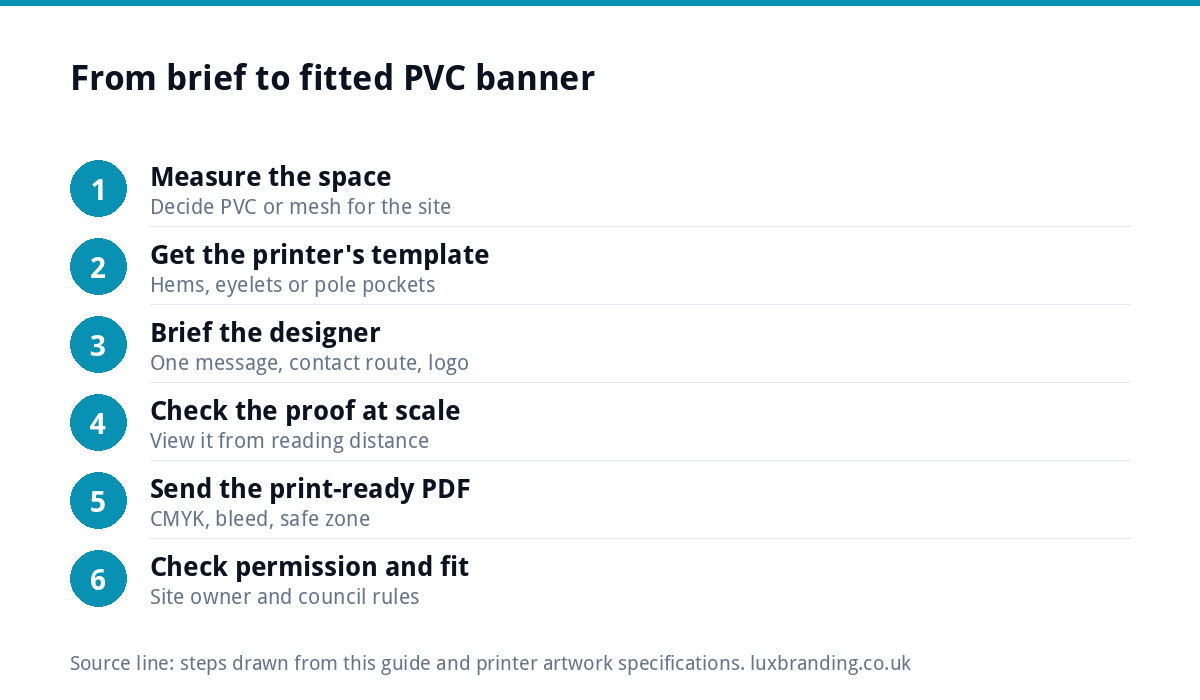
From brief to fitted banner: the steps
Confirm the material and finishing before design starts: a mesh banner with pole pockets needs a different layout from a hemmed PVC banner with eyelets.
- Measure the space and decide PVC or mesh.
- Get the printer’s template and finishing options.
- Brief the designer: message, contact route, logo files, where it hangs.
- Check the proof at scale from reading distance.
- Send the print-ready PDF to the printer.
- Fit with ties, check it is tight, and check permission first.
Permission for scaffold, fence and shop banners in England
Outdoor advertising in England is controlled by the Town and Country Planning (Control of Advertisements) (England) Regulations 2007, available on legislation.gov.uk. The government’s own guide, Outdoor advertisements and signs: a guide for advertisers, was published in 2007 and describes itself as only a guide. Key points from it:
- Every outdoor advertisement must meet five standard conditions, including being kept clean, tidy and safe, and having the permission of the owner of the site.
- Some advertisements have “deemed consent”, meaning no application is needed if you stay within the rules for that class. Others need the planning authority’s “express consent”, and the guide says that includes virtually all posters.
- Class 3(C) lets a firm carrying out building or construction work display its own board at the site, up to 2 square metres, only while the work is taking place. A 3m x 1m scaffold banner is 3 square metres, so check before you hang one.
- Class 3 temporary advertisements must not have letters over 0.75 metres high, must not sit higher than 4.6 metres above ground, and must not be illuminated. Event advertisements must not go up more than 28 days before the event and must come down within 14 days after it.
- Class 5 covers advertisements on the outside of business premises, for the goods or services available there, within its own limits.
Stricter rules apply in conservation areas and Areas of Special Control. The rules are detailed, so check with your local council’s planning department before a large or long-running banner goes up.
What a PVC banner costs: design, print and fitting
A banner has three or four separate costs, often from different suppliers. Third-party prices below are examples at the time of writing, October 2026, and change often; always check the supplier’s own configurator.
| Cost | Who provides it | What drives the price |
|---|---|---|
| Design | A designer (our banner design is £89) | Size, number of layouts, custom or large formats (we quote those in writing first) |
| A printer (Tradeprint showed £18.06 ex VAT for one 1.5m x 0.5m banner in its default configuration) | Size, material (PVC or mesh), quantity, delivery speed | |
| Finishing | The printer, chosen at order | Hems, eyelet type, pole pockets, cable ties |
| Fitting | You, your scaffolder or a sign fitter | Height, access, fixings, whether a scaffold is already up |
| Consent | Your local planning authority, if express consent is needed | The council’s application charge for the type of advertisement |
The biggest hidden cost is a reprint: a phone number through an eyelet or a pixelated logo means printing twice. For an overview of all our prices, see the pricing page.
How we design PVC banners
Our Poster & Banner Design service is £89 one-off. We design PVC outdoor banners in any custom size for shop fronts, fences, scaffolding and outdoor events. Every file is built as vector and supplied in CMYK at 300dpi with bleed and trim marks: a print-ready PDF, the AI source, EPS, a high-res PNG preview, editable text layers and a print specs sheet with material recommendations.
The first draft arrives within 48 hours of brief sign-off, you get two design directions to choose from, and most jobs complete in 3 working days. A banner format needs the layout reworked rather than stretched from a poster, so larger or custom jobs are quoted in writing before work starts. We do not print, but we can recommend suppliers and brief them for you.
If the banner is part of wider site and vehicle branding, our vehicle wrap and signage design service and shopfront signage guide help keep everything consistent. Order online, or email us at support@luxbranding.co.uk with the size, the location and a photo of the space.
Get the UK Print-Ready Artwork Checklist (free)
A one-page checklist for any UK designer or printer covering CMYK, bleed, fonts and resolution. Saves you the pre-press fix-up fees.
No spam. UK GDPR compliant. We only use your email to send this resource, unless you tick the box to hear from us.
Frequently asked questions
What size should an outdoor PVC banner be? +
Measure the space first: the railing, fence panel or scaffold bay. Outdoor banners are usually custom-sized, and trade printers list sizes from 1.5m x 0.5m up to about 4.9m x 3m. Leave a margin so the banner can be pulled tight with ties, and size the letters for the furthest reader you want to reach.
Should I choose a PVC or a mesh banner? +
Choose mesh for scaffolding, open fencing and exposed sites, because the perforations let wind pass through instead of pushing against the banner. Choose solid PVC for walls, shop fronts and sheltered railings, where it gives stronger colour and sharper detail. A layout designed for mesh, with bold fonts and fewer elements, works on both materials.
What file does a printer need for a PVC banner? +
Most printers want a print-ready PDF in CMYK at 1:1 scale, with fonts outlined or embedded, bleed beyond the trim and a safe zone for hems and eyelets. Logos and text should be vector. Photos must hold their resolution at full size. Always check the printer's own template before the layout is finalised, especially for pole pockets.
Do I need permission to put up a banner on scaffolding in England? +
Possibly. The government guide says a firm doing building work can display its own board at the site up to 2 square metres while work is under way, and every advertisement needs the site owner's permission. Larger banners, conservation areas and most posters may need express consent, so check with your local council first.
How much does PVC banner design cost with Luxbranding? +
Our Poster & Banner Design service is £89 one-off. We design PVC outdoor banners in any custom size, built as vector and supplied print-ready in CMYK with bleed. Banner formats need the layout reworked, so larger or custom jobs are quoted in writing before work starts. We do not print, but we can recommend and brief suppliers.