Quick answer
UK website copywriting is usually priced by the day or by the page. The 2026 ProCopywriters survey puts the median freelance day rate at £440, so a single page taking half a day costs around £220, and a five-page site taking two days around £880. Writing it yourself costs time, not money, but needs a careful edit.
These examples are illustrative: the day rate is a published median, but how long your pages take depends on the writer, the brief and how much you already have. This guide explains how copywriters price, what moves the cost, and how to get the most from the budget you have.
How copywriters price website work
Copywriters use four main pricing models. Knowing which one you are being quoted on makes quotes much easier to compare.
| Pricing model | How it works | Good for | Watch out for |
|---|---|---|---|
| Day rate | A fixed price per day, with an estimate of days | Bigger or less defined projects | The estimate growing during the job |
| Per page | A fixed price for each page | Standard sites with clear page lists | What counts as a page, and how long one is |
| Per project | One price for the whole website | Budget certainty | Exactly what is included and how many revisions |
| Per word | A rate for each word written | Blog posts and articles | Paying for length rather than results |
Whatever the model, a good quote states the number of pages, roughly how long each is, how many rounds of changes are included, and whether search work (page titles and meta descriptions) is part of it.
What UK copywriters charge
The most useful published benchmark is the ProCopywriters 2026 Copywriter Survey, based on 573 UK commercial writers. It reports a median freelance day rate of £440, up 10% in two years. A median means half of the writers surveyed charge less and half charge more, so expect quotes either side of it.
Experience, specialism and location all move the rate. A writer who specialises in your sector, or in search-focused website copy, may charge more per day but need fewer days, because they ask the right questions first time.
Illustrative budgets by site size
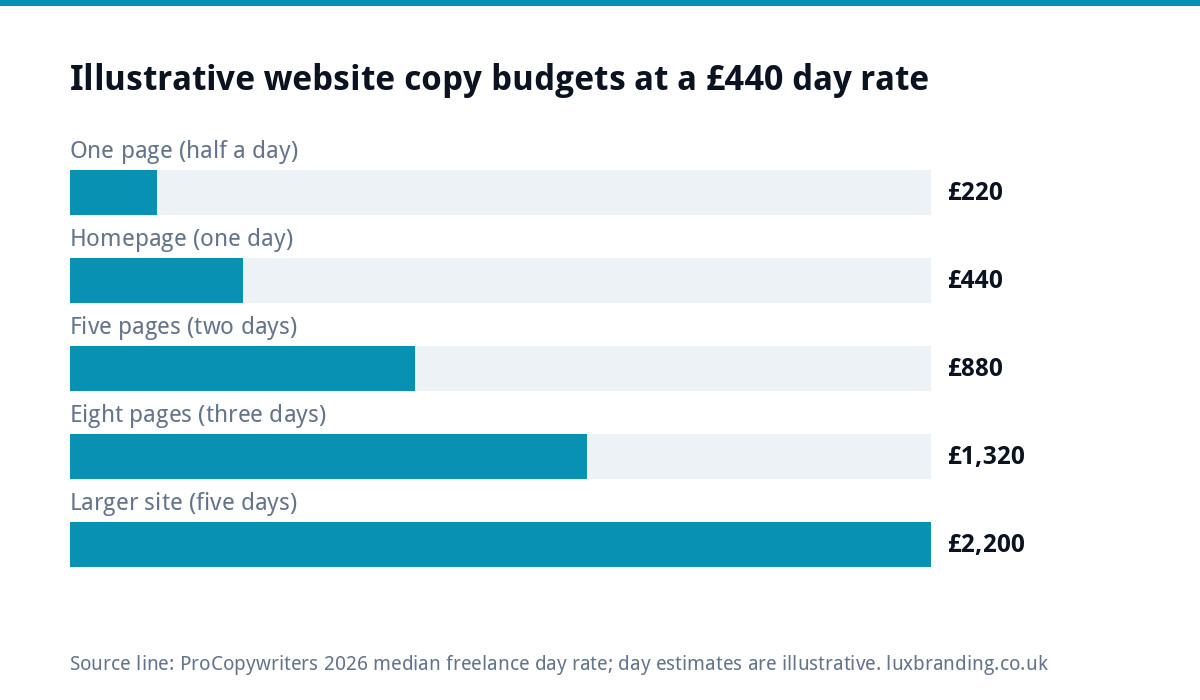
To turn a day rate into a budget, estimate the days. These figures use the £440 median and are illustrations, not quotes:
| Project | Assumed time | Cost at £440 a day |
|---|---|---|
| One landing page or one-page website | Half a day | £220 |
| Homepage rewrite | One day | £440 |
| Five-page small business website | Two days | £880 |
| Eight-page site with service and area pages | Three days | £1,320 |
| Larger site with research and interviews | Five days | £2,200 |
The time a page takes depends far more on how much the writer has to dig out than on how long the page is. If you can answer the brief questions below before the writer starts, the days come down.
What pushes the cost up (and down)
Things that add cost
- No clear list of pages, so the structure has to be worked out first.
- Services that need explaining from scratch, such as technical or regulated work.
- Several people giving feedback, with conflicting changes.
- Extra search research, such as finding which phrases each page should target.
- Tight deadlines.
Things that save cost
- A clear page list and a short brief for each page.
- Your existing quotes, emails and leaflets, which hold the facts the writer needs.
- Photos of real jobs and genuine reviews to draw on.
- One person who signs off the copy.
What good website copy should do for the price
You are not paying for words; you are paying for pages that turn visitors into enquiries and that search engines can understand. Google’s guidance on creating helpful content describes people-first content, made for readers rather than to manipulate rankings, and asks whether a page provides original information and is written by someone who knows the topic well. For a trades or service business, that means real detail: what you do, where, how it works, what it costs, and proof.
Google’s SEO starter guide adds the practical parts: a unique, clear title for each page, a short meta description specific to the page, and text that is easy to read and broken up with headings. Ask whether the writer delivers titles and meta descriptions as well as the body copy. They are short, but they decide how your pages appear in search results.
Worked example: a builder’s five-page site
Say a small building firm is replacing its old website with five pages: home, extensions, loft conversions, about and contact. The owner gets two quotes. One is a per-project price for “website copy”. The other is a day-rate estimate of two days, with page titles and meta descriptions included and two rounds of changes.
The per-project quote looks simpler, but it does not say how many pages, how long each is or whether search elements are included. The owner asks both writers the same questions, sends both the same brief (services, areas, typical job sizes, three sites they like) and compares like for like. The cheaper quote turns out to exclude titles and descriptions, which would have meant paying someone else to write them. At the £440 median day rate, two days is £880, and the owner now knows exactly what that buys.
Questions to ask before you hire
- Can I see website pages you have written for businesses like mine?
- How many pages, roughly how long each, and how many rounds of changes are included?
- Are page titles and meta descriptions part of the job?
- Will you interview me, or work only from a written brief?
- When will I see the first page, so I can check the tone before you write the rest?
Writing it yourself: the budget route
Many small businesses write their own website copy, and it can work well, because nobody knows your work better than you. To make it work:
- Write one page per service, in the words customers use when they phone you.
- Put the most important facts first: what, where, how quickly, roughly how much.
- Add proof: photos, accreditations you hold, a short real review.
- Cut every sentence that would fit any business (“we pride ourselves on quality”).
- Read each page aloud, then ask a customer or friend what they would do next.
AI tools can help with a first draft or an edit, but they do not know your prices, your areas or the jobs you have done. Whatever produces the first draft, check every fact before it goes live.
Brief your copywriter well
A good brief is the single biggest saving. Before the first call, have ready:
- The list of pages, and what each page should get the reader to do.
- Your services, areas covered and any price guidance you are happy to publish.
- Who your best customers are and the questions they always ask.
- Three competitor or admired websites, and what you like about each.
- Any words or claims you must avoid, such as accreditations you do not hold.
Budget by situation
- New sole trader with a one-page site: write it yourself using the steps above, or pay for half a day of editing.
- Established trade rebuilding a five to eight-page site: a copywriter for the homepage and main service pages pays off most.
- Business that wants steady search growth: ongoing content, such as useful guides and service-area pages, matters more than a one-off rewrite.
- Running paid ads to one offer: spend on a single strong landing page first, because every pound of ad spend lands there, and test it before writing anything else.
- Site with good copy but no enquiries: check the forms, speed and calls to action before paying for new words.
Before you spend on copy, it helps to know what is holding your current site back. Our free SEO audit gives a quick view, and our website launch checklist covers what every page needs before it goes live.
How we can help
Our content marketing and blog writing service covers blog and content writing for your website; the service page sets out what is included. If you need a new site to put the words on, our Custom WordPress Website is £499 one-off for up to eight pages, with an SEO foundation (schema, meta, sitemap), and a Landing Page is £199. For ongoing search work, our SEO service is £249 a month and includes content alongside technical health, link building and reports; our SEO cost guide explains what that budget buys. Every price is on our pricing page.
Get the UK SEO DIY Audit Checklist (free)
A 32-point checklist UK SMEs can run against their own website in an afternoon. Surfaces the quick wins before paying for a paid audit.
No spam. UK GDPR compliant. We only use your email to send this resource, unless you tick the box to hear from us.
Frequently asked questions
How much does a copywriter charge per day in the UK? +
The ProCopywriters 2026 survey of 573 UK commercial writers puts the median freelance day rate at £440, up 10% in two years. Because it is a median, half the writers surveyed charge less and half more. Specialists in a sector or in search-focused copy may charge more per day but often need fewer days.
How much does it cost to have a five-page website written? +
It depends on how long it takes. As an illustration, if a five-page small business site takes two days at the £440 median day rate, that is £880. A clear page list, a good brief and your existing material can bring the time down, while research, many reviewers and tight deadlines push it up.
Is it better to pay per page or per day? +
Per page gives budget certainty for a standard site with a clear page list, as long as you agree how long a page is and how many revisions are included. A day rate suits bigger or less defined projects. Whichever model you choose, get the pages, length, revisions and search elements in writing.
Can I write my own website copy? +
Yes, and many small businesses do it well, because they know their work best. Write one page per service in your customers' words, put the key facts first, add real proof, cut generic claims and read every page aloud. AI tools can help with drafts, but check every fact, price and area before publishing.
Should a copywriter write my page titles and meta descriptions? +
Ideally, yes. Google's guidance asks for a unique, clear title for each page and a short, page-specific meta description, and these shape how your pages appear in search results. They are short, so including them adds little time, but check the quote says they are part of the job.