
Quick answer
WooCommerce is free, open-source software you run on your own hosting, with UK card fees through WooPayments of 1.5% + £0.25. BigCommerce is a hosted platform billed monthly in US dollars, with plans tied to your yearly sales. For most UK small shops, WooCommerce gives more ownership; BigCommerce gives less maintenance. Our WooCommerce build is £499.
Figures here come from each company’s own pricing pages, checked at the time of writing, October 2026. Both change their pricing from time to time, so check before you commit. If you are also weighing Shopify, our Shopify vs WooCommerce comparison covers that pairing; this guide sticks to BigCommerce.
The basic difference
These two are built on opposite ideas.
- WooCommerce is a plugin that turns a WordPress website into a shop. The WooCommerce listing on WordPress.org describes the core platform as free and open source, says you keep full ownership of your store’s content and data, and says you can export your content and move to another platform. You pay for hosting, any paid extensions and payment fees.
- BigCommerce is a hosted service. You pay a monthly plan, and BigCommerce runs the servers, security and updates. You build your shop inside its system.
So the choice is less about features and more about whether you want to own and look after the shop, or rent a managed one. Both can run a small UK shop well; the difference shows up in the running costs and in what happens when you want to leave.
Side by side
| Question | WooCommerce | BigCommerce |
|---|---|---|
| Software cost | Free core plugin | Monthly plan, from $29 a month billed annually (Core) |
| Currency of the plan | Not applicable | US dollars, excluding VAT |
| Hosting | You choose and pay for it | Included |
| Sales limits on plans | None | Yes, plans are tied to trailing 12-month sales |
| UK card fees (built-in payments) | WooPayments 1.5% + 25p | From 2.89% + $0.29 on BigCommerce’s own processing |
| Using another payment provider | No platform fee | An extra platform fee on some plans |
| Updates and security | Your job, or your host’s | BigCommerce’s job |
| Moving away later | Export your data and go | Rebuild on the new platform |
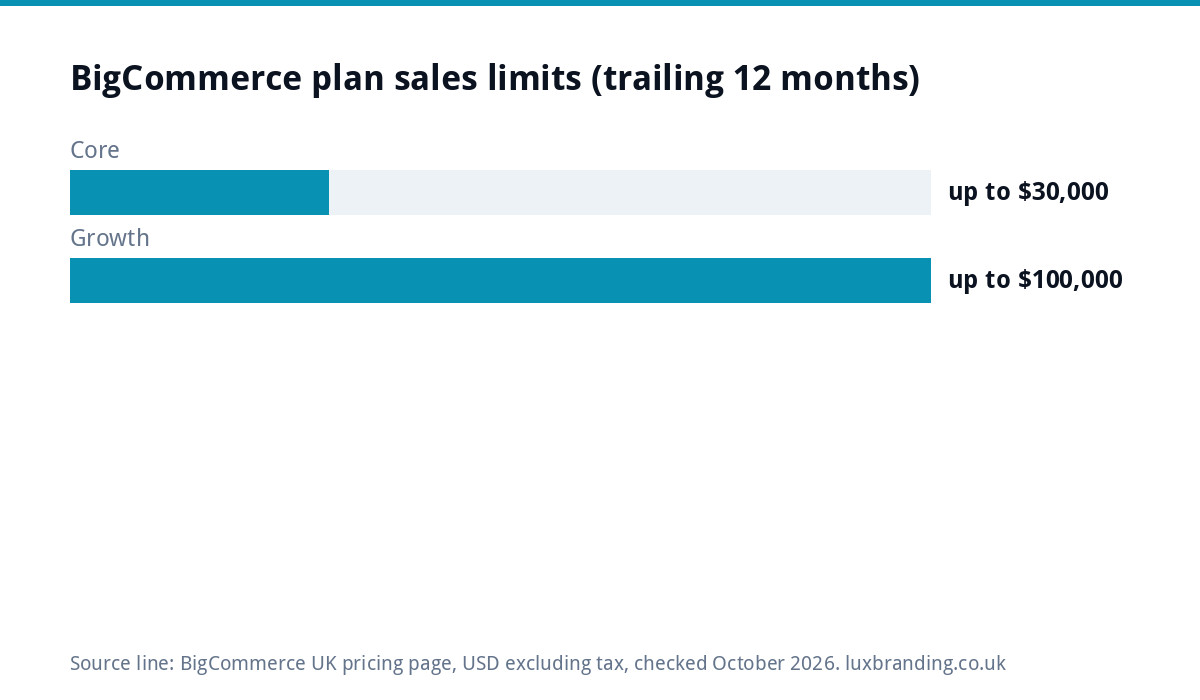
BigCommerce plans and the sales thresholds
The BigCommerce pricing page lists its plans in US dollars, excluding tax. At the time of writing:
- Core: $39 a month, or $29 a month billed annually, for up to $30,000 of online sales over the trailing 12 months.
- Growth: $105 a month, or $79 billed annually, for up to $100,000.
- Scale: $399 a month, or $299 billed annually, with a 0.9% overage above about $33,333 of sales a month.
- Performance: from $1,499 a month for shops above $1 million a year.
The thresholds are the part UK owners often miss. As your sales grow, you move up a plan, so the platform cost rises with your success. They are also measured in dollars, so a busy year can push you over a limit sooner than you expect once your sterling sales are converted.
Payment fees, line by line
For a UK shop on WooCommerce, the WooPayments fee schedule lists 1.5% + £0.25 per card transaction, plus 2% for international cards and another 2% where currency conversion is needed, with no monthly fee for online payments. A dispute costs £15, refunded if you win. You can also use Stripe or PayPal instead.
BigCommerce lists card processing starting at 2.89% + $0.29 per transaction on its own payments. If you use an outside payment provider that is not one of its embedded providers, it adds a platform fee: 2.0% on Core, 1.0% on Growth and 0.6% on Scale, at the time of writing.
Worked example: a month of £1,000 in card sales
Say a small UK shop takes 25 orders of £40 in a month, all on UK cards. On WooPayments, the fees are 1.5% of £1,000 (£15) plus 25 lots of 25p (£6.25): £21.25 for the month, before hosting. On BigCommerce, the card fees start at 2.89% + $0.29 per order, and the monthly plan sits on top, both in dollars. At this size, the fixed platform fee is a noticeable share of the total, which is why small shops should price both options with their own figures.
Running costs over a year
| Cost line | WooCommerce shop | BigCommerce shop |
|---|---|---|
| Build | £499 with us, up to 20 products | Your time, a theme, or a BigCommerce partner |
| Platform | £0 for the core plugin | Core from $29 a month billed annually |
| Hosting, backups and updates | £20 a month on our plan | Included in the plan |
| Card fees | 1.5% + 25p (WooPayments, UK cards) | From 2.89% + $0.29 |
| Paid extensions or apps | Only what you choose | Only what you choose |
| Cost as sales grow | Fees grow with sales; platform stays free | Plan steps up at each sales threshold |
Our full cost breakdown for different shop sizes is in the e-commerce website cost guide.
Where BigCommerce wins
- No servers to think about. Security patches, uptime and updates are handled for you.
- Built-in features. A lot comes in the box, so fewer add-ons to choose and keep updated.
- Predictable for growing brands that are happy to pay more as sales rise and want a single supplier.
Where WooCommerce wins
- Ownership. Your shop, your data, your code. If you fall out with your web company or host, you take the whole thing with you.
- No sales ceiling. Selling more does not move you onto a bigger plan.
- Sterling costs. Your hosting and UK card fees are in pounds.
- One site for everything. Your shop sits on the same WordPress site as your services, blog and contact pages.
The trade-off is upkeep. A WooCommerce shop needs updates, backups and security monitoring, by you or by your host. Our guide to WordPress security for small businesses covers what that involves.
UK points that tip the decision
A few details matter more for a UK business than the headline comparisons suggest.
- Tax on the plan. BigCommerce states that its prices exclude all forms of tax, including VAT. Check with your accountant how that applies to you, and budget for it rather than comparing the bare dollar figure with a sterling price.
- Exchange rates. A dollar-billed plan costs a different amount in pounds each month. That is a small thing on Core and a bigger one on Scale.
- Foreign customers. On WooPayments, international cards add 2% and currency conversion adds another 2%. If most of your buyers are in the UK paying in pounds, those rarely apply.
- American Express. BigCommerce lists a standard online rate of 3.5% for Amex. If your trade customers pay by Amex company cards, check the rate on whichever provider you use.
- Your other pages. Many UK trades and makers sell a few products alongside services. A WooCommerce shop sits on the same site as your service pages, reviews and contact form, so there is one website to manage, not two.
None of these decides it alone, but together they explain why UK small shops that mainly sell at home in pounds tend to find the WooCommerce maths simpler.
Which suits your shop
- Choose WooCommerce if you want to own the shop, already have or want a WordPress site, sell mainly in the UK, and have someone to keep it updated.
- Choose BigCommerce if you want no technical upkeep at all, expect to sell internationally at volume, and accept a monthly dollar bill that rises with sales.
- Price it both ways if you are unsure: estimate a year of sales, then add up plan, hosting and fees on each.
Five questions before you choose
- What will your sales be in year one and year three, and which BigCommerce plan does that put you on?
- Which payment providers do you want, and do they add a platform fee?
- Who will apply updates and take backups if you choose WooCommerce?
- Do you need your shop on the same site as your service pages?
- If you had to leave the platform in three years, what would that involve?
What we build
We build shops on WooCommerce or Shopify rather than BigCommerce. Our E-commerce Website is £499 one-off for up to 20 products, with Stripe and PayPal set up, hand-coded with no page builders, and you own the code. Bigger catalogues are quoted in writing before any work starts. See the e-commerce website page.
For the upkeep side, our Website Management and Hosting plan is £20 a month with UK hosting, SSL, daily backups, security monitoring and automatic updates. All prices are on our pricing page, and our website cost calculator gives a quick estimate for your shop.
Get the UK Website Project Brief Template (free)
A two-page template for briefing any UK web designer: sitemap, integrations, audience and deliverables. Cuts revision rounds in half.
No spam. UK GDPR compliant. We only use your email to send this resource, unless you tick the box to hear from us.
Frequently asked questions
Is WooCommerce free? +
The core WooCommerce plugin is free and open source. You still pay for hosting, any paid extensions you choose and payment fees. In the UK, WooPayments lists 1.5% + 25p per card transaction with no monthly fee for online payments, and you can use Stripe or PayPal instead if you prefer.
Does BigCommerce charge in pounds? +
BigCommerce's pricing page lists its plans in US dollars, excluding VAT, at the time of writing. Core was $39 a month or $29 a month billed annually. Because plans are tied to your trailing 12-month sales in dollars, a strong year in pounds can move you onto a higher plan sooner than you expect.
What happens when my BigCommerce sales go over the plan limit? +
BigCommerce ties each plan to your online sales over the last 12 months. Core covers up to $30,000 and Growth up to $100,000 at the time of writing, and above those you move to the next plan. Scale adds a 0.9% overage above its monthly level. Check the current thresholds before you commit.
Which is easier to look after, WooCommerce or BigCommerce? +
BigCommerce, because it is hosted: the company handles servers, security and updates. A WooCommerce shop needs updates, backups and security monitoring, either by you or a host who does it for you. Our Website Management and Hosting plan covers those for £20 a month.
Can I move my shop away from BigCommerce or WooCommerce later? +
WooCommerce says you keep full ownership of your store's content and data and can export it to another platform. Moving off a hosted platform such as BigCommerce generally means rebuilding the shop elsewhere and importing products and customers. Plan the domain and redirects either way so search rankings are kept.