Quick answer
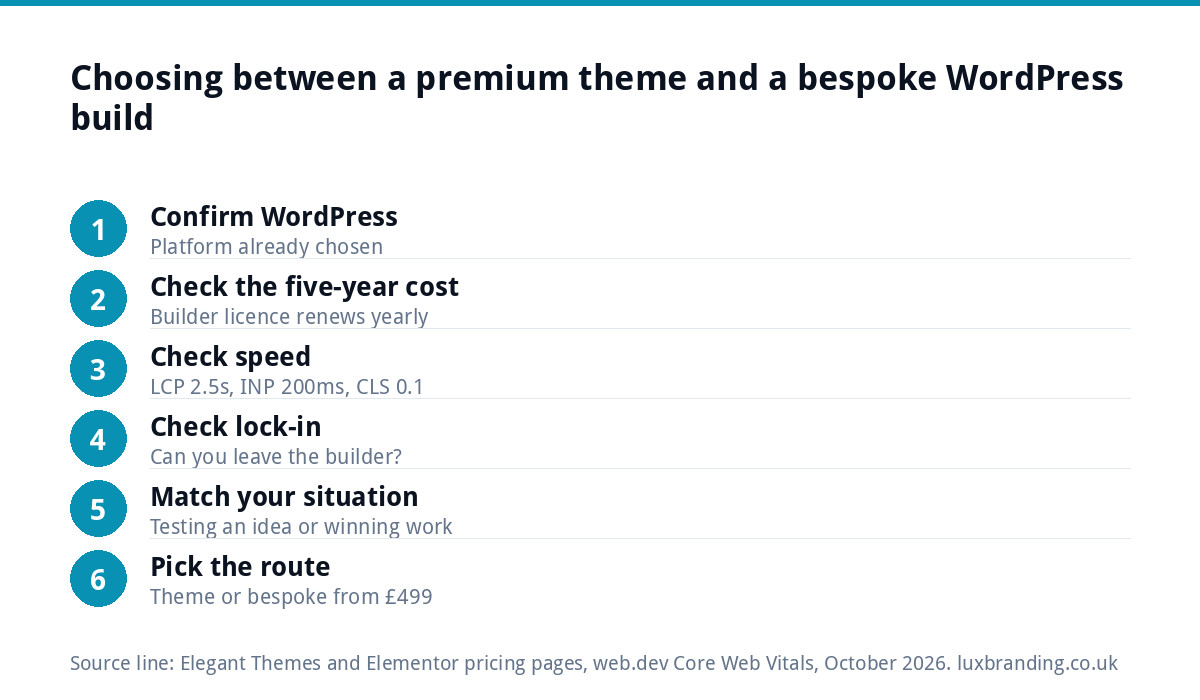
A bespoke WordPress website from us starts at £499 for up to 8 pages, paid once. A premium theme with a page builder costs less on day one, but its licence renews yearly: Divi lists $89 a year and Elementor Pro starts from $60 (October 2026). Bespoke code loads less and cannot lock you into a builder.
This guide assumes you have already picked WordPress (if not, start with our platform comparison). The choice here is narrower: a premium theme and page builder set up cheaply, or a theme written by hand for your business alone.
What each option really is
A premium theme is a design sold to thousands of buyers. Most now ship with, or rely on, a page builder: a plugin such as Elementor or the Divi Builder that lets you drag sections, columns and widgets onto a page. You (or a freelancer) pick a demo layout, swap in your text and photos, and adjust colours. It is quick because the design decisions were made for everyone.
A bespoke theme is written for one site. The designer plans your pages around what your customers need to see, and a developer codes those templates directly. There is no builder plugin in the middle. You still edit your text, images and posts in the normal WordPress editor; what changes is that the layout is designed for your business rather than chosen from a demo.
Both are real WordPress and both can rank and take enquiries. The differences are running cost, speed, editing and how hard it is to leave.
Up-front cost: what you pay on day one
The theme route looks cheap because the licence is cheap. At the time of writing (October 2026), the official pricing pages list:
- Divi (Elegant Themes): $89 billed yearly, or $249 as a one-off lifetime payment, according to the Elegant Themes pricing page.
- Elementor Pro: plans “starting from $60/year”, with each plan marked “renews at regular rate”, according to the Elementor pricing page.
Both are listed in US dollars, so your card statement will show a sterling figure that moves with the exchange rate. Prices change; check the vendor page before you buy.
The licence is not the build. Someone still has to turn a demo into your site: pages, images, forms, analytics. If that is you, the cost is your evenings; if it is a freelancer, ask exactly what the quote includes.
Our bespoke route is priced in the open on our pricing page: Custom WordPress Website at £499 one-off for up to 8 pages, usually 2 to 4 weeks, or Premium Custom WordPress at £1,499 for up to 14 pages. Both include custom design, a mobile-first build, an SEO foundation (schema, meta, sitemap), contact forms connected to your inbox, Google Analytics, a written CMS walkthrough and 30 days of support.
Three-to-five-year cost: the licences nobody mentions
The real comparison is over the life of the site. Sites usually run for years, so yearly items add up. Hosting is a cost on both routes, so it cancels out; what differs is the builder licence and the time spent keeping it all working.
| Cost item | Premium theme + builder | Bespoke theme |
|---|---|---|
| Design and build | Your time, or a freelancer’s quote | £499 (up to 8 pages) or £1,499 (up to 14), one-off |
| Builder licence, year 1 | Divi $89 or Elementor Pro from $60 | None |
| Builder licence, years 2 to 5 | Divi $89 a year at list price ($445 over five years), or $249 once for lifetime | None |
| Add-on packs and extra plugins | Common; each may carry its own renewal | Only what the site needs |
| Hosting and updates | Needed | Needed |
| Code ownership | You own your content; the builder is licensed | You own the code and can host anywhere |
Two things to check on the theme route. First, whose account holds the licence. If a freelancer installed it under their own account and later lets it lapse, Elegant Themes states that a cancelled yearly plan loses theme updates and support at the end of the term, though you can keep using what you downloaded. Second, whether the first-year price is an introductory rate: Elementor marks its plans as renewing “at regular rate”.
Speed and Core Web Vitals
Google measures real-world page experience with three Core Web Vitals. According to web.dev, a good page has Largest Contentful Paint within 2.5 seconds, Interaction to Next Paint of 200 milliseconds or less, and Cumulative Layout Shift of 0.1 or less, measured at the 75th percentile of page loads.
Page builders have to be able to build any layout anywhere, so they usually load their own styling and scripts and wrap content in extra layers of containers. A carefully set up builder site can still pass all three, but you start with more code than the page needs.
A bespoke theme starts from the opposite end: it ships only the code its own templates use. It is not an automatic pass, but there is less to fight. If your current site is already slow, our guide to website speed for small businesses explains what to fix first.
Editing day to day
This is where the theme route genuinely shines. A builder lets you drag in a section, change a column or add a button anywhere. If you like tinkering, that is enjoyable.
The same freedom has a cost. Pages drift away from each other over time, fonts and spacing creep, and one mis-dragged block on a phone layout can go unnoticed for months. Many owners also find the builder screen busy, and that is a common reason people feel they cannot update their own website.
On a bespoke theme, the editable parts are decided when it is built: your text, images, services, posts and contact details, edited in the standard WordPress editor. The layout stays consistent because it is not up for grabs on every page. A brand new layout means asking a developer, which is the trade-off.
Builder lock-in: what happens when you want to leave
A page builder stores your layouts in its own format. Switch the builder off and the pages it built lose their structure. Depending on the builder, you are left with plain unstyled text or with leftover builder code scattered through your content. Either way, moving away usually means rebuilding every page that used it.
A hand-coded theme has no builder in the middle: the layout lives in the theme files, your content lives in WordPress, and our build comes with no platform lock-in. You own the code and can move it to any host.
Security and updates
Every theme and plugin is code that needs updating. A builder route often stacks up a theme, the builder, an add-on pack or two and their extensions, each with its own update cycle. More moving parts means more updates and more chances of a conflict.
A bespoke theme does not make WordPress maintenance-free. Core and plugin updates still matter, and our WordPress maintenance guide covers what a sensible routine looks like. The difference is a shorter list. If you would rather not do it yourself, Website Management & Hosting is £20 a month and covers UK hosting, SSL, daily backups, security monitoring and automatic updates.
When a premium theme is genuinely fine
We build bespoke sites, but a theme is the right call more often than agencies admit:
- You are testing an idea. If the business might not exist in six months, do not spend on a build. Get something live and learn.
- You already know the builder. If you are fluent in Elementor or Divi and enjoy the work, your time is cheap and your control is high.
- You are happy with a demo look. If looking like a well-made template is acceptable in your market, a template is honest value.
Where it stops being fine is when the site has to win work against competitors who look the same, when speed starts costing you, or when you have outgrown the DIY site and keep paying someone to fight the builder.
Which route fits your situation
| Your situation | Better fit | Why |
|---|---|---|
| Testing a new idea on a tiny budget | Premium theme, set up yourself | Lowest cash outlay; easy to throw away |
| Already fluent in Elementor or Divi | Premium theme | Your skills make the builder cheap |
| Trades or service business, 5 to 8 pages, needs enquiries | Bespoke, £499 | Fast, consistent pages built around the enquiry; no yearly builder licence |
| Established firm, up to 14 pages, brand matters | Bespoke premium, £1,499 | Room for more services and case-study pages without template sameness |
| Only need one page | One-Page Website, £299 | Built for you, but sized to the job |
| Needs logins, bookings or a portal | Bespoke site plus a written quote | Member areas and custom tools are quoted before work starts |
A worked example over five years
Take a small electrical contractor who needs six pages: home, four services and contact. Both routes need hosting and updates, so leave those aside and compare what is different.
- Theme route, set up by the owner. Divi on the yearly plan at $89 list price is $445 over five years, or $249 once on the lifetime plan. Add the owner’s evenings to build it.
- Theme route, set up by a freelancer. The same licence, plus the freelancer’s fee, plus a check that the licence is in the owner’s name.
- Bespoke route. £499 one-off for up to 8 pages, with custom design, forms, analytics, the SEO foundation and a written CMS walkthrough. No builder licence in years 2 to 5, and no builder to leave.
On cash alone, a confident DIY builder can come out ahead. Bespoke wins when the owner’s time is worth more than a few evenings, or when the site must stand apart from competitors on the same demo. Our website cost calculator gives a figure for your own page count. If you are comparing against hosted builders instead, our Wix versus custom and AI website builders versus custom guides do that maths.
Questions to ask before you commit
- Whose account holds the theme and builder licences, and what happens to updates if it lapses?
- Is the first-year price introductory? What does it renew at?
- How many plugins will the finished site run, and who updates them?
- Can I see the site’s Core Web Vitals on a phone before I pay the final invoice?
- If I leave the builder or the designer, what do I keep: the code, the content, or only the content?
- What exactly can I edit myself, and what needs a developer?
If bespoke is the right fit, you can order a Custom WordPress Website online, or email us at support@luxbranding.co.uk with your page list and we will tell you which package fits before any work starts.
Get the UK Website Project Brief Template (free)
A two-page template for briefing any UK web designer: sitemap, integrations, audience and deliverables. Cuts revision rounds in half.
No spam. UK GDPR compliant. We only use your email to send this resource, unless you tick the box to hear from us.
Frequently asked questions
Is a bespoke WordPress website worth it for a small business? +
It is worth it when the site has to win enquiries against competitors, when speed matters, or when you plan to keep it for several years. A bespoke theme avoids a yearly builder licence and builder lock-in. If you are testing an idea or already fluent in a page builder, a premium theme can be the better value.
How much does a custom WordPress website cost with Luxbranding? +
Our Custom WordPress Website is £499 one-off for up to 8 pages, usually built in 2 to 4 weeks. Premium Custom WordPress is £1,499 for up to 14 pages. Both include custom design, a mobile-first build, an SEO foundation, contact forms, Google Analytics, a written CMS walkthrough and 30 days of support.
Do Divi and Elementor charge every year? +
At the time of writing, October 2026, Divi lists $89 billed yearly or $249 for a lifetime licence, and Elementor Pro lists plans starting from $60 a year that renew at the regular rate. Prices are in US dollars and change, so check the official pricing pages before you buy.
Can I still edit a hand-coded WordPress theme myself? +
Yes. You edit your text, images, services and blog posts in the normal WordPress editor. The layout is designed for your business and stays consistent, so a brand new page layout is a developer job. We include a written CMS walkthrough so you know exactly what you can change yourself.
What happens if I stop using a page builder? +
A page builder stores layouts in its own format, so switching it off strips the structure from every page it built. Depending on the builder you are left with plain unstyled content or leftover builder code. Moving away usually means rebuilding those pages, which is the lock-in to weigh up before you start.