Quick answer
Amazon’s Professional plan costs £25 a month excluding VAT, plus a referral fee on each sale that is mostly between 8% and 15%. Your own store swaps those fees for card charges of around 1.5% to 2% plus a few pence, a one-off build and running costs. Amazon buys reach; your own store builds a customer base.
Most UK product businesses do not have to choose one forever. The real question is which comes first, and how much of your margin you are happy to rent out for reach. Below are both sets of fees from the official pricing pages, a worked £40 sale, a table by situation and a plan for running both.
What Amazon charges UK sellers
At the time of writing (October 2026), Amazon’s UK seller pricing page lists two selling plans:
- Individual: £0.75 per item sold, excluding VAT, plus other selling fees.
- Professional: £25 a month, excluding VAT, plus other selling fees.
On top of the plan comes a referral fee on every sale. Amazon says most referral fees are between 8% and 15%, depending on category, and most categories have a 25p minimum per item. Some categories sit outside that band.
If Amazon stores and ships for you (Fulfilment by Amazon), there is a flat fulfilment fee per unit based on product type, size and weight, plus monthly storage charged per cubic foot, which Amazon prices higher from October to December. Amazon also lists a 1.5% fuel and logistics surcharge on UK fulfilment fees from 17 April 2026. Fees change, so check the page before you set prices.
What your own store charges
Your own online store has no referral fee. Instead you pay card processing on each sale and fixed costs to run the site.
- Card fees: Stripe’s UK pricing lists 1.5% + 20p for standard UK cards and 2.8% + 20p for premium UK cards. On Shopify, Shopify’s UK pricing page lists an online standard card rate of 2% + 25p on the Basic plan.
- Platform: Shopify Basic is £25 a month billed monthly (£19 billed yearly). A WooCommerce store has no platform subscription but needs hosting.
- Build: a one-off cost to design and set up the store.
- Marketing: the cost Amazon quietly covers for you, because nobody finds a new store by accident.
Our guide to e-commerce website costs in the UK covers build prices in more depth, and Shopify vs WooCommerce compares the two main platforms.
A £40 sale, side by side
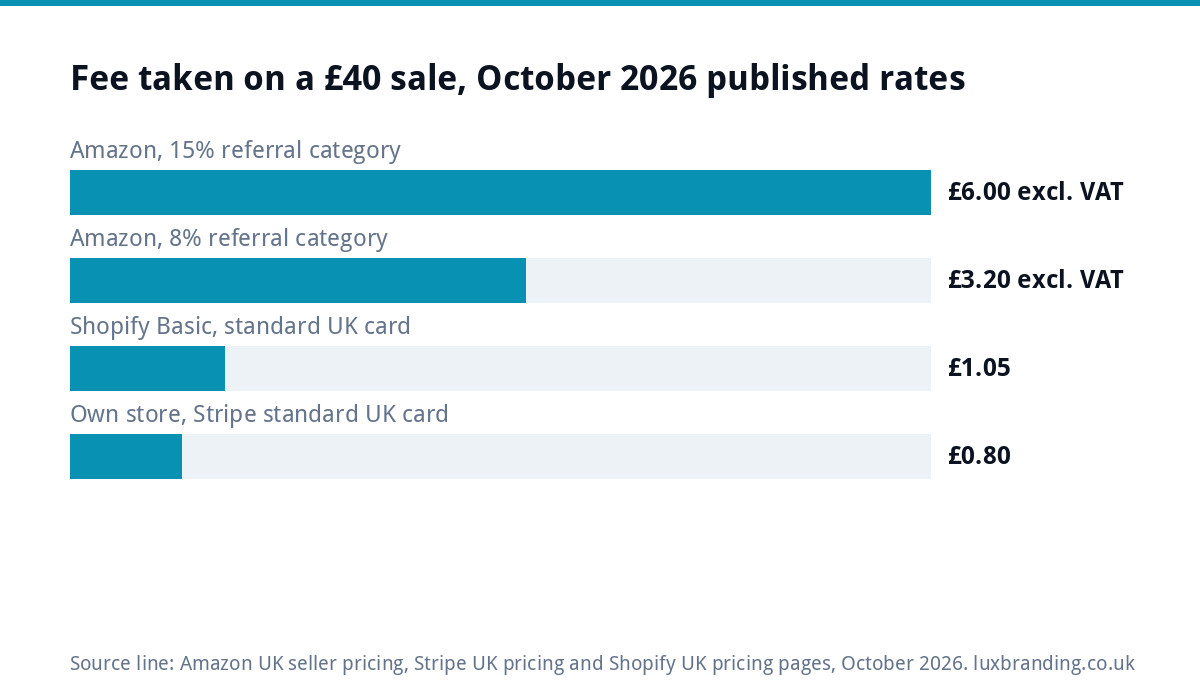
Here is what leaves the till on a single £40 order, using the published rates above. The Amazon figures use the top and bottom of the usual referral band and leave out fulfilment, which varies by product.
| Channel | Per-sale fee on £40 | Fixed monthly cost | Who owns the customer |
|---|---|---|---|
| Amazon, 15% referral category | £6.00 (excl. VAT) | £25 Professional plan (excl. VAT) | Amazon |
| Amazon, 8% referral category | £3.20 (excl. VAT) | £25 Professional plan (excl. VAT) | Amazon |
| Shopify Basic, standard UK card | £1.05 | £25 billed monthly | You |
| Own WooCommerce store, Stripe standard UK card | £0.80 | Hosting, £20 a month with us | You |
On fees alone the own store wins easily. But the table leaves out the cost of getting that £40 customer to your site in the first place. On Amazon the shopper is already there. On your own store, every visitor is one you paid for in ads, content, social posts or time.
The number that decides it: cost to win a customer
The fair comparison is not fee against fee. It is Amazon’s fee against what it costs you to bring a buyer to your own store. Work it through with your own numbers:
- Take the Amazon fee on your typical order. In a 15% category, that is £6.00 on a £40 sale, before fulfilment.
- Estimate your own cost to win that order. Add up a month of ad spend, content time and social effort, then divide by the orders it brought in.
- Compare the first order. If winning a buyer on your own store costs more than the Amazon fee, Amazon is cheaper for first sales.
- Then compare the second order. A returning customer who comes straight to your store costs card fees only, about 80p on £40 through Stripe. On Amazon, the same buyer still costs the full referral fee.
This is why so many sellers use Amazon to find customers and their own store to keep them. The first sale is often cheaper on the marketplace; every sale after that is usually cheaper at home, as long as the buyer knows your store exists.
The numbers also show where to spend effort. If your own-store cost per order is high, the fix is rarely a cheaper platform. It is better product pages, clearer delivery terms and a reason to buy direct, such as bundles or a loyalty offer Amazon cannot show.
What Amazon gives you that your own store cannot
- Buyers already searching. People go to Amazon to buy, with a card already saved.
- Trust by default. A first-time buyer does not need to have heard of you.
- Logistics. With fulfilment, storage, packing, delivery and returns are handled for a fee.
- Fast testing. You can see whether a product sells within weeks, not months.
What your own store gives you that Amazon never will
- The customer relationship. You get the name, email and order history, and with consent you can market to them again.
- Your brand in front. No competitor listings beside your product, and your packaging, photos and story set the tone.
- Pricing control. Bundles, subscriptions, trade accounts and offers work the way you want.
- Repeat sales without a fee. The second order from a customer you already know costs only card fees.
That last point is the whole argument. Amazon charges a referral fee on the tenth order from the same buyer just as on the first. Your own store makes repeat customers cheaper every time.
The rules apply on both
Selling online to UK consumers brings the same legal duties wherever the checkout sits. GOV.UK’s guide to online and distance selling says customers can cancel up to 14 days after the order is delivered without giving a reason, and that you must give clear information before the order: your business details, prices including taxes, delivery costs and cancellation terms. On Amazon, much of that is handled by the platform. On your own store, your checkout, terms page and order emails have to do it.
Which first, by situation
| Your situation | Start with | Why |
|---|---|---|
| Testing a new product with no audience | Amazon | Demand is already there; you learn fast |
| Handmade or premium goods with a story | Own store | Brand and photography sell better than a listing |
| Consumables people reorder | Both, then push repeat buyers to your store | First sale on Amazon, reorders without a referral fee |
| Trade or bulk buyers | Own store | Trade accounts and custom pricing are easier |
| Thin margins under the referral fee | Own store, or rethink price | A 15% fee can wipe out the profit |
| Already selling well on Amazon | Add an own store | Protects you if a listing or account has problems |
Running both without chaos
Many brands end up on both channels. A few habits stop it becoming two jobs:
- One source of stock. Sync inventory, or hold separate stock for each channel, so you never sell what you do not have.
- Price with the fee in mind. Your own store can match or undercut Amazon because it does not carry the referral fee.
- Brand the parcel. For orders you ship yourself, a branded insert and good packaging tell the buyer your shop exists. Our guide to packaging design for small brands covers what is worth spending on.
- Same look everywhere. Product photos, colours and name should match across both, so a buyer recognises you when they search for you directly.
Check the marketplace’s own rules before adding any inserts or offers to Amazon orders, as platform policies apply to what goes in the box.
What your own store costs with us
Our e-commerce website is £499 one-off for up to 20 products, built on WooCommerce or Shopify with Stripe and PayPal. It is hand-coded with no page builders, you own the code, and it includes custom design, a mobile-first build, an SEO foundation, Google Analytics, a written CMS walkthrough and 30 days of support. Bigger catalogues and custom features are quoted in writing before any work starts.
If your store needs a brand that holds up next to Amazon listings, brand identity design is £299 for a logo, colours, typography, imagery and guidelines. All prices are on our pricing page, and the website cost calculator gives a quick figure for your own setup.
If your store gets visitors but no sales
A store that gets traffic but few orders usually has a fixable leak: product pages, delivery costs, trust signals or checkout friction. Our guide to an online store with no sales walks through the usual five, and is worth reading before you decide your own store “does not work” and go back to paying referral fees on every order.
Get the UK Website Project Brief Template (free)
A two-page template for briefing any UK web designer: sitemap, integrations, audience and deliverables. Cuts revision rounds in half.
No spam. UK GDPR compliant. We only use your email to send this resource, unless you tick the box to hear from us.
Frequently asked questions
Is it cheaper to sell on Amazon or on my own website? +
Per sale, your own website is cheaper. On a £40 order, an 8% to 15% Amazon referral fee is £3.20 to £6.00 excluding VAT, while a standard UK card through Stripe costs 80p. But Amazon brings buyers who are already shopping, and your own store has to pay to attract every visitor through ads, content or social media.
What does Amazon charge UK sellers? +
At the time of writing, Amazon's UK pricing page lists an Individual plan at £0.75 per item sold and a Professional plan at £25 a month, both excluding VAT. A referral fee applies to each sale, mostly between 8% and 15% by category. Fulfilment by Amazon adds per-unit fulfilment and monthly storage fees. Check the page, as fees change.
Should a new product business start on Amazon? +
If you have a product to test and no audience yet, Amazon can show you quickly whether it sells, because buyers are already searching there. If you sell handmade, premium or story-led goods, your own store usually does more for the brand. Many businesses start on Amazon and move repeat buyers to their own store once demand is proven.
Can I sell on Amazon and my own store at the same time? +
Yes, and many UK brands do. Keep one source of stock, or separate stock per channel, so you never oversell. Price your own store with the missing referral fee in mind, keep photos and branding consistent across both, and check Amazon's own policies before adding inserts or offers to orders it handles.
How much does an online store cost to build with Luxbranding? +
Our e-commerce website is £499 one-off for up to 20 products, built on WooCommerce or Shopify with Stripe and PayPal. It includes custom design, a mobile-first build, an SEO foundation, Google Analytics, a written CMS walkthrough and 30 days of support. Larger catalogues and custom features are quoted in writing before any work starts.