Quick answer
A coming soon page is a single holding page on your domain while your full website is being built. Make it a normal, indexable page rather than an error or a hidden page, and include your business name, what you do, where, a rough launch date, how to contact you and an email signup with clear consent wording.
A good coming soon page does more than say “back soon”. It claims your domain, gives Google something to index, gives your Google Business Profile and social accounts a working link and starts collecting enquiries before launch day. A bad one sits there for a year with an “under construction” message and does nothing at all. This guide covers what to include, how to set it up so it does not harm your search visibility and how to switch to the full site cleanly.
Coming soon, splash, holding or landing page?
These terms overlap, but they describe slightly different pages:
| Page type | What it is | Lifespan | Main job |
|---|---|---|---|
| Coming soon page | A placeholder before a new site launches | Weeks to a few months | Claim the domain, collect interest |
| Holding page | A temporary page while a site is rebuilt or paused | Short term | Keep visitors informed |
| Splash page | An intro screen shown before the main site | Permanent, if used at all | Usually an age check or language choice |
| Landing page | A focused page built for a campaign | As long as the campaign runs | Convert visitors from ads or mailings |
| One-page website | A complete small site on a single scrolling page | Permanent | Everything a new business needs |
Splash pages that sit in front of a real website mostly add an extra click and are best avoided. And if your full site is months away, a One-Page Website at £299 often does a better job than a coming soon page, because it is a real website from day one.
Why a coming soon page is worth doing
- Your domain works. People who see your van, card or social profile and type the address find something real.
- Google can start finding you. An indexable page with your business name gives search engines something to work with before launch.
- Your profiles have a link. Google Business Profile, Instagram and Facebook all look better with a working website address.
- You can collect leads early. A simple form or email signup means launch day starts with a list, not from zero.
- It sets expectations. Customers know you exist and when to come back.
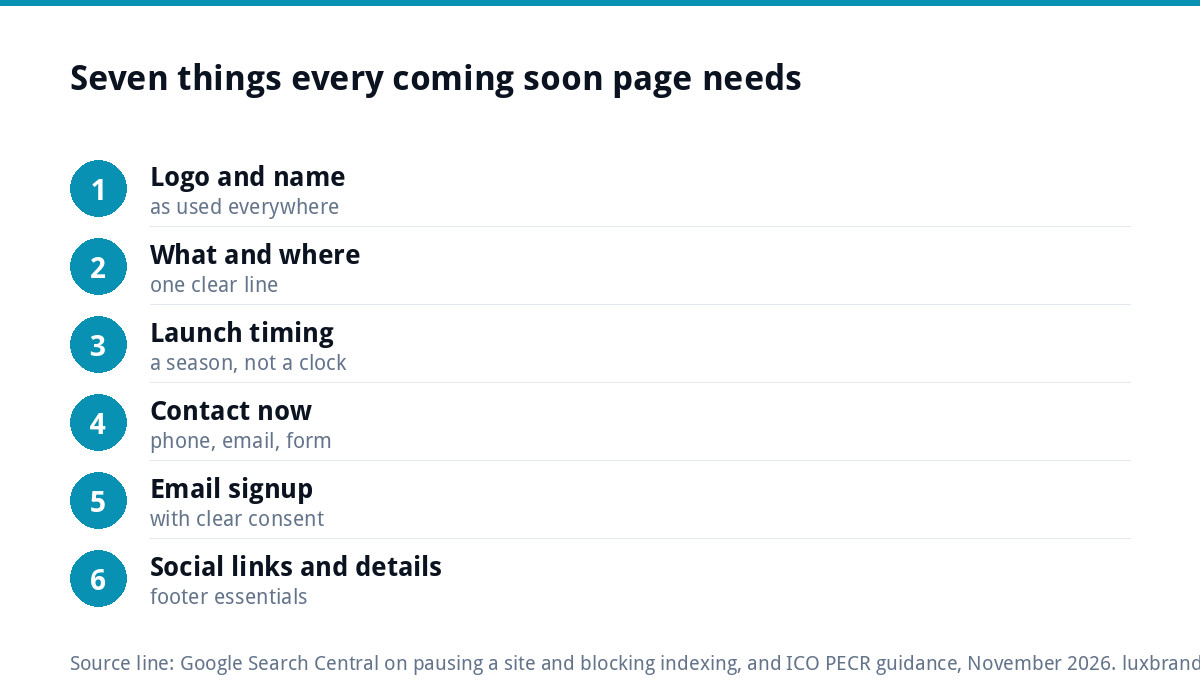
Seven things every coming soon page needs
- Your logo and business name, exactly as they will appear everywhere else.
- One line on what you do and where, such as “Kitchen and bathroom fitting across Hampshire”.
- A rough launch date or season, rather than a countdown clock you will forget to update.
- How to reach you now: phone, email and a short enquiry form, because some visitors want a quote today.
- An email signup with clear wording about what people will receive.
- Links to your social profiles where you are already active.
- Your business details in the footer, including your full business name and contact information.
Setting it up without hurting your search visibility
How the page is served matters. Google’s guidance on pausing a business online is written for existing sites, but its technical advice applies directly. For longer periods it suggests an indexable placeholder home page returned with a normal 200 status code. It warns against 403, 404 or 410 status codes and noindex, because these remove the site’s URLs from Google Search, and says a 503 status should only be used for a very short period of a few days at most.
Google’s page on blocking indexing explains that a noindex rule makes Google drop the page entirely from its results. That is the opposite of what a new business wants from its domain.
| Setup | What Google does | Use it when |
|---|---|---|
| Normal page, 200 status | Can crawl and index it | Coming soon pages lasting weeks or months |
| 503 status with retry-after | Treats the site as temporarily unavailable | Short maintenance of a day or two |
| Noindex tag | Drops the page from results | Never, for your main coming soon page |
| 404 or 410 | Treats the page as gone | Never, for a live domain |
Many website builders and maintenance tools offer a “coming soon mode”. Check what it actually sends to search engines before you switch it on; some hide the site with noindex or a 503 for as long as the mode is active.
Collecting email signups the right way
An email list built before launch is valuable, but UK rules apply from the first signup. The ICO’s guidance on electronic mail marketing says you must not send marketing emails to individuals unless they have specifically consented, giving ticking an opt-in box as an example of valid consent. The soft opt-in for existing customers does not apply to new contacts, so on a coming soon page you need clear consent.
In practice: say exactly what people are signing up for (“one email when we launch, plus occasional offers”), do not pre-tick boxes and make unsubscribing easy from the first email. When you are ready to send, our Email Marketing Automation setup from £149 can turn that list into a welcome sequence.
Design tips for a page that works
- Design for phones first. Many visitors will arrive from social media on a mobile.
- Use your real branding. The page is the first impression of your brand online; it should look like the business, not a template.
- One main action. Choose between “get a quote” and “sign up for launch news” as the primary button.
- Real photos if you have them, such as your workshop, products or team.
- Keep it fast. No video backgrounds or heavy animations on a page whose job is a first impression.
- Avoid “under construction” graphics, which make a business look unfinished rather than about to launch.
Examples by business type
| Business | Headline idea | Main action |
|---|---|---|
| New trade business | Electrical work across Bristol, taking bookings now | Call or request a quote |
| Online shop pre-launch | Handmade candles, launching in spring | Join the launch list |
| Restaurant or café opening | Opening on the High Street this summer | Sign up for opening night news |
| Consultant or freelancer | Bookkeeping for small businesses in Kent | Book a call |
How long should it stay up?
A coming soon page is a bridge, not a destination. As a rough guide, a few weeks is ideal, a couple of months is acceptable, and anything longer starts to look like a business that never got off the ground. If your launch slips, update the page so the timing is still honest, and add something useful each time: a photo of the fit-out, an early review, the services you are already taking bookings for.
If the full website is stuck, upgrade the coming soon page into something more complete rather than leaving it as it is. Adding a short services section, a few photos of real work and a proper contact form turns a holding page into a working one-page site, which is often all a new trade or local business needs for its first year.
Switching to the full site cleanly
Launch day should not undo the work the coming soon page has done. Keep the same domain and, where possible, the same homepage address, so anything Google has indexed carries over. Move signups into your email system before you remove the form. Then work through our website launch checklist to catch the usual problems, such as forms that send nowhere or a search-hiding setting left switched on.
If you have not secured your domain yet, do that first; our UK domain names guide explains the options.
Common coming soon page mistakes
- Leaving it up for a year, which tells visitors the business never got going
- A noindex or 503 setting left on for months
- No contact details, so ready customers go elsewhere
- A countdown clock that reached zero weeks ago
- Collecting emails without clear consent
- Generic template branding that does not match the van, cards or social profiles
Your options with us
For a short wait, a branded landing page at £199 makes a strong coming soon page with an enquiry form and signup. If launch is more than a few weeks away, a One-Page Website at £299 gives you a real site straight away. When you are ready for the full build, our Custom WordPress Website at £499 covers up to 8 pages, hand-coded with an SEO foundation and contact forms connected to your inbox. All prices are on our pricing page.
Get the UK Website Project Brief Template (free)
A two-page template for briefing any UK web designer: sitemap, integrations, audience and deliverables. Cuts revision rounds in half.
No spam. UK GDPR compliant. We only use your email to send this resource, unless you tick the box to hear from us.
Frequently asked questions
Should a coming soon page be indexed by Google? +
Usually yes. Google's guidance for longer pauses suggests an indexable placeholder home page returned with a normal 200 status code, and warns that noindex or 404 and 410 status codes remove URLs from search. An indexable coming soon page with your business name lets Google start finding you before launch day.
What should I put on a coming soon page? +
Your logo and business name, one line on what you do and where, a rough launch date, phone and email, a short enquiry form, an email signup with clear consent wording, links to active social profiles and your business details in the footer. Skip countdown clocks and under construction graphics.
Is a coming soon mode the same as a 503 maintenance page? +
Not always. Some tools serve a normal page, others use a 503 status or noindex. Google says 503 should only be used for a very short period of a few days at most, so check what your coming soon mode actually sends before leaving it on for weeks or months.
Can I collect email addresses on a coming soon page? +
Yes, with clear consent. The ICO says you must not send marketing emails to individuals unless they have specifically consented, and the soft opt-in for existing customers does not cover new contacts. Explain what people will receive, do not pre-tick boxes and make unsubscribing easy from the first email.
Is a coming soon page or a one-page website better? +
If launch is a few weeks away, a coming soon page is fine. If it is months away, a one-page website is usually better because it is a complete site from day one. Our Landing Page Design is £199 and our One-Page Website is £299. All our prices are listed on our pricing page.