Quick answer
Direct mail is marketing post addressed to named people or businesses. In the UK, postal marketing is not covered by the PECR consent rules; the ICO says the likely lawful basis is legitimate interests or consent. Screen your list against the Mailing Preference Service, offer an easy opt-out, and send people to a dedicated page so you can measure replies.
In a world of crowded inboxes, a well-designed card through the letterbox stands out. For trades with a list of past customers, or businesses selling to other local businesses, direct mail can be one of the most reliable ways to win repeat work. This guide covers the UK rules, how direct mail differs from leaflet drops, which formats work, how to design for response and how to tell whether it paid off.
Direct mail, door drops and email compared
Direct mail is often confused with leaflet distribution. The difference is the address: direct mail goes to a named person or business; door drops go to every letterbox in an area. That one difference changes the rules, the targeting and the results.
| Channel | Addressed to | Targeting | Main rules | Best for |
|---|---|---|---|---|
| Direct mail | A named person or business | Your own list, very precise | Data protection, MPS screening | Past customers, B2B, high-value services |
| Leaflet door drop | Every address in an area | By postcode or street | Lighter, unaddressed | New areas, broad local services |
| Email marketing | A named email address | Your own list | PECR consent or soft opt-in | Regular, low-cost contact |
Many small businesses use all three: door drops to reach new streets, email for regular contact and direct mail for the moments that matter, such as annual service reminders or a new offer for past clients.
The UK rules for direct mail
Postal marketing sits under data protection law rather than the electronic marketing rules. The ICO’s guide to choosing a lawful basis for direct marketing lists post as not covered by PECR, with the likely lawful basis being legitimate interests or consent. If you rely on legitimate interests, the ICO says you must satisfy its requirements, which are set out in its legitimate interests guidance. Whatever basis you use, respecting anyone who asks you to stop is the foundation of every rule that follows.
GOV.UK’s guide to direct marketing law adds the practical steps. Check that your mailing lists do not include anyone who has asked not to receive direct mailing, using the Mail Preference Service. More broadly, you must check whether customers want to be contacted by post, phone or email, and be able to prove you have done this.
The Mailing Preference Service is a free service for the public to reduce unsolicited direct mail. It does not cover unaddressed mail or post addressed to “The Occupier”, and a registration can take up to three months to take full effect.
Seven rules for a compliant mailing
- Know where every address came from and why it is reasonable to write to that person.
- Screen against the Mailing Preference Service before each mailing to consumers.
- Remove anyone who has objected to marketing from you, and keep that suppression list.
- Say who you are clearly, with your business name and contact details on the mailer.
- Give an easy way to opt out, such as a phone number, email address or web form.
- Keep the list accurate. Remove returned mail and people who have moved.
- Be careful with bought lists. Check exactly how the data was collected and screened.
This is a practical summary, not legal advice. For anything unusual, read the ICO’s guidance in full.
Who direct mail works best for
Direct mail costs more per recipient than email, so it pays when each reply is valuable. It tends to work well for:
- Trades with past customers: boiler service reminders, gutter clearing before winter, garden maintenance in spring
- Business-to-business services: commercial cleaners, electrical contractors and caterers writing to local offices, schools and landlords
- Higher-value home services: kitchens, windows, extensions and solar, where one job covers the cost of a mailing
- Independent shops and restaurants: inviting loyal customers to launches and seasonal events
It works poorly as a cold mailing of a generic offer to people who have never heard of you.
Formats that work
| Format | Strengths | Best for |
|---|---|---|
| Postcard (A6 or A5) | No envelope to open; message seen instantly | Reminders, simple offers, event invites |
| Letter in an envelope | Personal, room to explain | B2B introductions, high-value services |
| Folded leaflet | Space for services, photos and prices | Service menus, seasonal offers |
| Small brochure or catalogue | Shows a full range | Retailers and product businesses |
For most small businesses, a well-designed postcard or folded A5 leaflet gives the best balance of impact and cost. Our Leaflet and Flyer Design is £89 and covers A5, DL and A4, with folded options and a print-ready CMYK PDF.
What every mailer needs
- Your logo and business name, large enough to recognise at a glance
- One clear headline that says what is in it for the reader
- A single main offer or message, not a list of everything you do
- A reason to act now, such as a date, a season or limited slots
- A phone number in large type and a short web address or QR code
- Proof: a review, an accreditation or a photo of real work
- Your full business name and contact details, plus how to opt out
Designing for response
A mailer has about as long as it takes to walk from the doormat to the recycling bin. Design for that moment. Lead with a strong image and the headline, keep text short, and make the next step obvious. Personal touches lift response: the customer’s name, the date of their last service, or a note that you are working in their street next month.
Send readers to a page built for the mailing rather than your homepage. A short web address or QR code that goes to a dedicated landing page, at £199 with us, lets you repeat the offer, take bookings and count exactly how many people responded. Your mailer should also match the rest of your branding so it is instantly recognisable as yours; our guide to branding for trades businesses covers how, and if your logo, colours and fonts are not yet defined, our Brand Identity Design at £299 sets them once for every mailer, van and web page.
Timing your mailing
When a mailer lands matters as much as what it says. Tie each mailing to a moment when the reader is already thinking about the problem you solve:
- Seasonal triggers: heating checks in early autumn, roofs and gutters before winter storms, gardens and driveways in early spring
- Anniversaries: a year since you serviced the boiler, fitted the alarm or cleaned the carpets
- Local events: a new development nearby, a road you are already working on
- Business calendars: school holidays for contractors working in schools, financial year planning for B2B services
Allow time for design, printing and posting, and avoid landing on the doormat in the same week as a bank holiday, when post piles up unread.
Getting print files right
Mailings are often printed in large quantities, so mistakes are expensive. Supply files in CMYK with bleed and crop marks, check the printer’s requirements for postal formats and address areas, and approve a proof. Our guide to print-ready artwork covers the basics, and if a printer has bounced your files, see printer rejected your artwork. Royal Mail and mailing houses publish their own size and weight requirements for each service, so check these before you design.
Measuring whether it worked
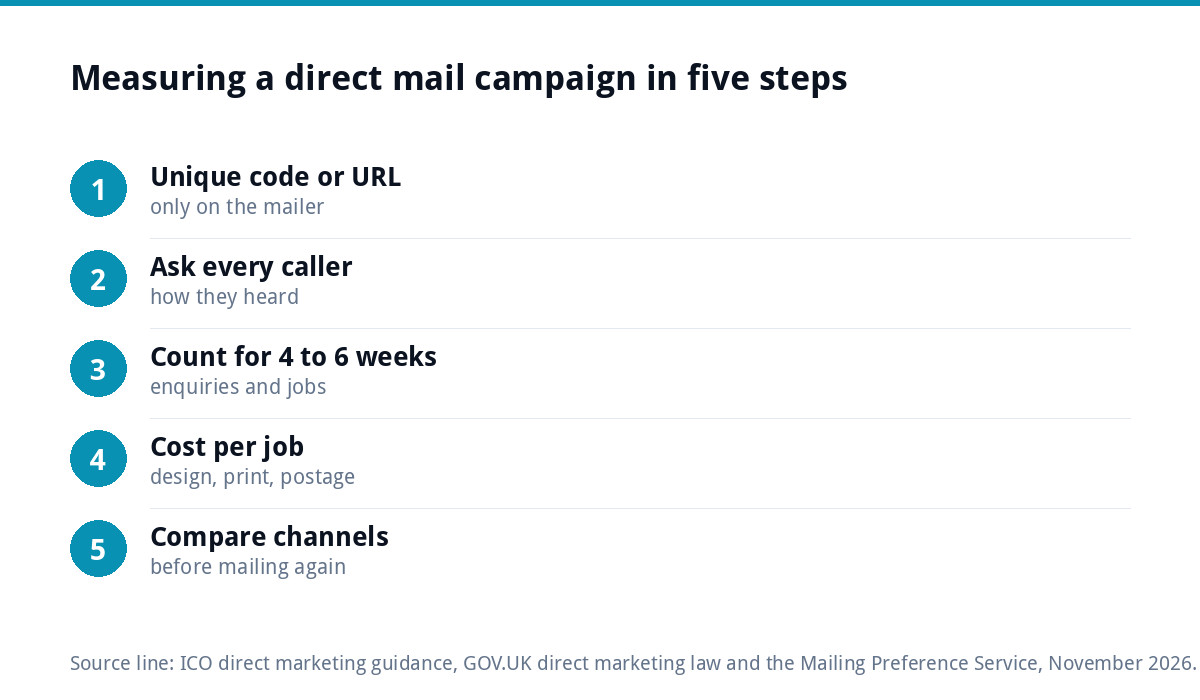
Direct mail is easy to measure if you plan it from the start:
- Use a unique web address, QR code or offer code that only appears on the mailer.
- Ask every caller how they heard about you, and note it.
- Count enquiries and booked jobs in the four to six weeks after the drop.
- Divide the total cost of design, print and postage by the jobs won.
- Compare that cost per job with your other marketing before mailing again.
Common direct mail mistakes
- Mailing everyone everything, instead of a targeted message to the right segment
- No reason to act now, so the card goes on the fridge and is forgotten
- Tiny phone numbers and web addresses nobody can type
- Skipping MPS screening for consumer mailings
- No tracking, so you cannot tell whether it paid off
- Sending to the homepage instead of a page about the offer
Plan the mailing around one message, one audience and one action, and it will usually outperform a bigger, broader drop. All our design prices are on the pricing page.
Get the UK Print-Ready Artwork Checklist (free)
A one-page checklist for any UK designer or printer covering CMYK, bleed, fonts and resolution. Saves you the pre-press fix-up fees.
No spam. UK GDPR compliant. We only use your email to send this resource, unless you tick the box to hear from us.
Frequently asked questions
Do I need consent to send direct mail in the UK? +
Not under PECR, which covers electronic marketing. The ICO lists post as not covered by PECR, with legitimate interests or consent as the likely lawful basis under data protection law. If you rely on legitimate interests, the ICO says you must satisfy its requirements. Screen consumer lists against the Mailing Preference Service and respect anyone who objects.
What is the Mailing Preference Service? +
It is a free service that lets the public reduce unsolicited addressed advertising mail. GOV.UK says businesses should check their lists do not include anyone who has asked not to receive direct mail, using the service. It does not cover unaddressed mail or post addressed to The Occupier.
Is direct mail the same as leaflet distribution? +
No. Direct mail is addressed to a named person or business from your own list, so it is precise and personal. Leaflet door drops go to every letterbox in an area without a name. Door drops suit reaching new streets, while direct mail suits past customers, business clients and high-value services.
What is the best format for direct mail? +
For most small businesses, a postcard or a folded A5 leaflet. Postcards need no opening, so the message is seen instantly, which suits reminders and simple offers. Folded leaflets give room for services, photos and prices. Letters in envelopes suit business introductions and high-value services where you need to explain more.
How much does it cost to design a direct mail piece? +
Our Leaflet and Flyer Design is £89 and covers A5, DL and A4 formats, including folded options, with a print-ready CMYK PDF and source files. Printing and postage are separate and depend on quantity and service. A dedicated landing page to track replies is £199. All prices are on our pricing page.