
Quick answer
If you sell to the public, show prices including VAT: an item you price at £20 plus VAT is shown as £24. Show delivery charges up front too. If you are not VAT-registered, below the £90,000 threshold, you charge no VAT, so do not mention it. Trade-only shops can show ex-VAT prices if clearly labelled.
Price display looks like a small detail until a customer complains, a competitor reports you, or your margins quietly vanish because VAT came out of the price you meant to keep. This guide covers what UK rules expect on an online shop, what changes when you register for VAT, how to handle trade customers and delivery charges, and a checklist to run before launch. It is practical guidance rather than legal or tax advice; your accountant should confirm anything specific to your business.
The rule for consumer prices
When you sell to consumers, the price you show must be the price they pay, with taxes included. GOV.UK’s guidance on online and distance selling says you must give customers the price including all taxes, along with delivery arrangements and costs, before they buy.
The Competition and Markets Authority’s guidance on providing clear and accurate information about prices, which summarises the Digital Markets, Competition and Consumers Act 2024, goes further. It says the total price should normally include any unavoidable charges, including tax such as VAT, and that listing those charges separately will not normally be enough. It also says hiding fees, taxes or charges until later in the purchase is illegal, with penalties of up to 10% of turnover or £300,000, whichever is greater.
The Price Marking Order 2004 is the long-standing law on how selling prices are shown to consumers, and it sits alongside the newer guidance.
What the headline price must include
| Price element | In the headline price for consumers? | Notes |
|---|---|---|
| VAT, if you are registered | Yes | Show one price that already includes it |
| Compulsory fees, such as a service or booking fee | Yes | If every customer must pay it, it belongs in the price |
| Standard delivery that can be calculated | Yes, in the total | Show it clearly before checkout |
| Delivery that varies and cannot be calculated in advance | Enough information to work it out | As prominent as the headline price |
| Optional extras, such as next-day delivery or gift wrap | No | Show them, but they can be priced separately |
Delivery charges and the total price
Delivery is where most small shops slip. The CMA’s summary says mandatory delivery charges must appear in the invitation to purchase and, if they can be calculated, be included in the total price. If the charge varies and cannot be calculated in advance, you must give enough information for the customer to work out the total, as prominently as the headline price. Optional delivery, such as next-day, must still be shown but can be presented separately.
In practice: put your delivery charges on every product page, in the basket and on a delivery page linked from the footer. Avoid adding a handling fee at the last step. Surprise costs at checkout are one of the most common reasons shoppers leave, as our guide to a store with traffic but no sales explains.
If you are not VAT-registered
GOV.UK’s page on registering for VAT says you must register if your taxable turnover for the last 12 months goes over £90,000, or you expect it to go over £90,000 in the next 30 days. Many small shops are below that line.
If you are not registered, you do not charge VAT. Your price is simply your price. Avoid wording such as “inc. VAT” or “VAT included”, which suggests you are charging tax you are not. A neutral line on your delivery or terms page, such as “We are not VAT-registered, so no VAT is charged”, answers the question for business buyers who need to know whether they can reclaim it.
When you register: changing your prices
Registration changes the maths, and the shelf price shoppers see does not have to change. You have two choices.
| Keep the shelf price | Add VAT on top | |
|---|---|---|
| Price before registering | £24.00 | £24.00 |
| Price shown after registering | £24.00 | £28.80 |
| VAT inside the price (20%) | £4.00 | £4.80 |
| What you keep | £20.00 | £24.00 |
| Risk | Lower margin on every sale | Customers notice the rise |
The VAT inside a VAT-inclusive price at the 20% standard rate is one sixth of the price, not 20% of it. That is the most common mistake: a £24 price contains £4 of VAT, not £4.80. Many shops do something in between, keeping prices on their best-sellers and rounding others up.
Telling customers about a price change
If registration means raising prices, say so plainly rather than hoping nobody notices. A short note in your next email and on social media, explaining that the business has grown past the VAT threshold and prices now include VAT, is usually received well, especially from a small business people already like. Change every price on the same day, including bundles, delivery charges and gift vouchers, so no page shows an old figure.
Prices in adverts, emails and social posts
The headline price rules apply wherever you invite people to buy, which can include product adverts, emails and social posts that show a product and a price, not just the shop itself. Make sure the price in an advert is the same VAT-inclusive figure the shopper will see on the product page.
Different VAT rates in one shop
Not everything is taxed at the same rate. GOV.UK’s page on VAT rates sets out the standard rate of 20%, a reduced rate of 5% for some goods and services, and a zero rate for others. A shop selling a mix, such as food and gifts, or children’s items and adult items, needs each product assigned to the right rate in the shop settings. Check the rate for each product type with HMRC guidance or your accountant before launch, not after.
Selling to trade customers
The consumer price rules exist to protect consumers. Shops that sell only to businesses, such as trade suppliers, commonly show prices excluding VAT, because their buyers reclaim it. If you do this, label prices clearly as “ex. VAT” everywhere, and make sure the site is genuinely aimed at trade buyers.
If you sell to both, the safest set-up is to show VAT-inclusive prices by default and offer trade accounts that display ex-VAT prices after login. Both WooCommerce and Shopify can be set up to handle tax-inclusive or tax-exclusive pricing; the important thing is that a member of the public never sees a lower price than they will pay. Our Shopify vs WooCommerce comparison covers trade and wholesale pricing on each platform.
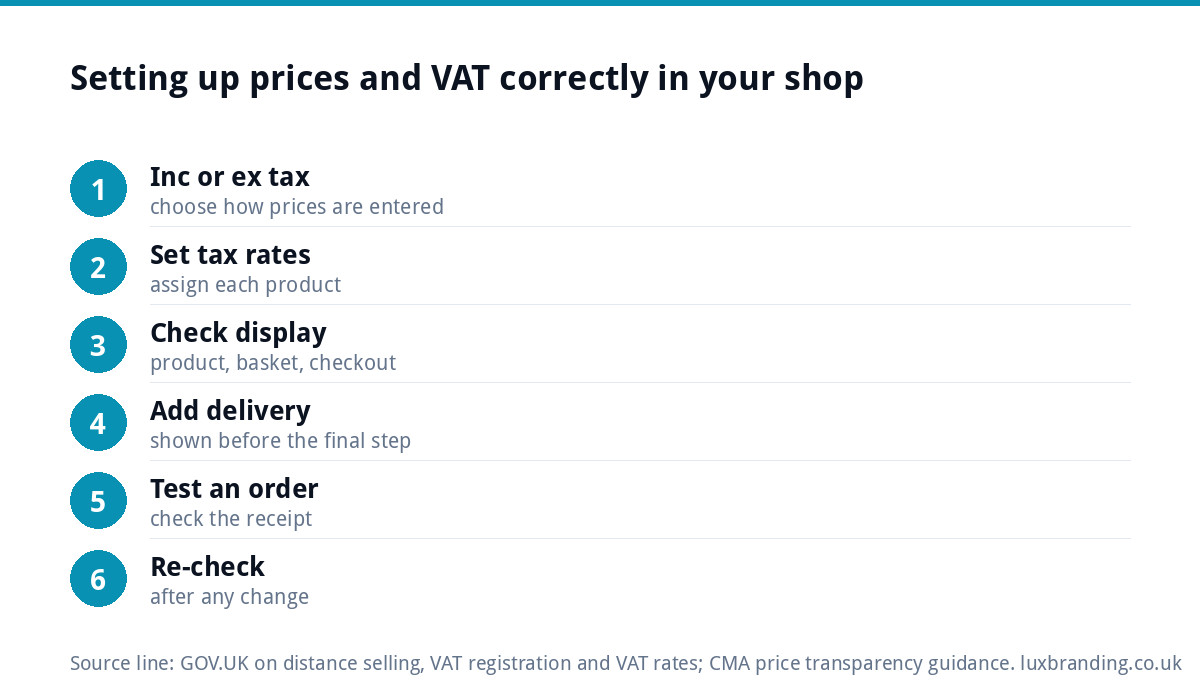
Setting up your shop correctly
- Decide whether you enter prices including or excluding tax in the shop settings, and stick to it.
- Set your tax rates and assign each product to the right one.
- Check how prices display on product pages, the basket and the checkout.
- Add delivery charges so they show before the final step.
- Test a full order and check the receipt shows the VAT correctly if you are registered.
- Re-check after any change to your registration, prices or delivery rates.
A pre-launch price display checklist
| Check | Done? |
|---|---|
| Consumer prices include VAT, if registered | ☐ |
| No “inc. VAT” wording if not registered | ☐ |
| Compulsory fees included in the price | ☐ |
| Delivery charges shown on product pages and in the basket | ☐ |
| Optional extras clearly priced as extras | ☐ |
| Trade prices labelled “ex. VAT” and shown only to trade buyers | ☐ |
| Each product on the right VAT rate | ☐ |
| Receipts and order emails show VAT correctly | ☐ |
Our website launch checklist covers the wider checks every new site needs.
Mistakes that cost money or trust
- Working out VAT as 20% of an inclusive price, and under-pricing every product.
- Showing ex-VAT prices to the public to look cheaper.
- Forgetting to update prices on the day registration takes effect.
- Adding fees at the final checkout step.
- Putting every product on the standard rate without checking.
- Leaving old prices in product feeds, adverts or marketplace listings after a price change.
Getting your shop built with pricing set up properly
Our E-commerce Website is £499 one-off for up to 20 products on WooCommerce or Shopify, with Stripe and PayPal payments, product setup and delivery rules. Our e-commerce website cost guide covers the running costs of a small shop, and every fixed price is on our pricing page.
Get the UK Website Project Brief Template (free)
A two-page template for briefing any UK web designer: sitemap, integrations, audience and deliverables. Cuts revision rounds in half.
No spam. UK GDPR compliant. We only use your email to send this resource, unless you tick the box to hear from us.
Frequently asked questions
Do I have to show prices including VAT on my website? +
If you sell to consumers and are VAT-registered, yes. GOV.UK says customers must be given the price including all taxes, and CMA guidance says the total price should normally include unavoidable charges such as VAT. Showing VAT separately will not normally be enough. Trade-only shops commonly show ex-VAT prices, clearly labelled.
What should I show if I am not VAT-registered? +
Just your price. If you are not registered you do not charge VAT, so avoid wording such as 'inc. VAT', which suggests you are charging tax you are not. A short line on your terms or delivery page saying you are not VAT-registered helps business buyers. GOV.UK says you must register once taxable turnover passes £90,000.
How do I work out the VAT in a VAT-inclusive price? +
At the 20% standard rate, the VAT inside an inclusive price is one sixth of it, not 20% of it. A £24 price contains £4 of VAT and £20 for you. Working it out as 20% of the inclusive price, £4.80 in this example, is a common mistake that leads to under-pricing.
Do delivery charges have to be included in the price? +
CMA guidance says mandatory delivery charges must appear in the invitation to purchase and, if they can be calculated, be included in the total price. If they cannot be calculated in advance, you must give enough information to work out the total. Optional delivery, such as next-day, can be shown separately.
Can you set up VAT and delivery pricing when building my shop? +
Yes. Our E-commerce Website is £499 one-off for up to 20 products on WooCommerce or Shopify, with Stripe and PayPal payments, product setup and delivery rules. Your accountant should confirm which VAT rates apply to your products; we set the shop up to display them. Every fixed price is on our pricing page.