Quick answer
Facebook ads usually stop working after a few weeks because the same people have seen them too often: frequency rises, clicks fall and each result costs more. Check frequency and cost per result in Ads Manager. If both are climbing, replace the creative with a genuinely new image, video or angle, rather than tweaking the settings.
It is one of the most common complaints from small businesses running their own Facebook and Instagram ads: an ad that brought in enquiries at a good price for the first fortnight slowly goes quiet, even at £10 a day. This guide explains why it happens, how to tell ad fatigue apart from other problems, what a real creative refresh involves, and a simple rhythm that keeps ads fresh without constant firefighting.
What ad fatigue actually is
Ad fatigue is what happens when your audience has seen the same ad so many times that they stop noticing it. The first time someone sees a good ad, it might catch their eye. The fifth time, they scroll past without thinking. By the tenth, some may actively hide it.
The platform notices too. When fewer people engage, the ad becomes less efficient to deliver, so you pay more for each click or enquiry. The ad has not changed; the audience’s reaction to it has.
It is not a sign that the ad was bad. Often the best-performing ads fatigue fastest, because they are shown the most. It is simply a cost of running ads to the same people over time, and the fix is a planned supply of new creative.
The signs, in numbers
Ads Manager shows everything you need to spot fatigue. Add these columns to your view and compare this week with the first fortnight of the ad.
| Metric | Early on | Sign of fatigue |
|---|---|---|
| Frequency | Low; most people have seen it once or twice | Climbing week on week |
| Click-through rate | Steady | Falling while frequency rises |
| Cost per result | At or near your target | Rising steadily |
| Reach | Growing | Flattening; few new people being reached |
| Comments | Questions and interest | Fewer, or “I keep seeing this” |
One number alone can mislead. A rising cost per result could be a seasonal dip; a rising frequency could be harmless if results hold. The pattern that points to fatigue is frequency up, click-through rate down and cost per result up, all at the same time.
Why small local audiences tire faster
A national brand advertising to millions of people can run one ad for months, because there are always new people to show it to. A local business targeting a town and its surroundings may be reaching a much smaller pool of relevant people. Even a modest daily budget can reach most of them within a few weeks, and after that the same faces see the ad again and again.
That is why small businesses often feel fatigue sooner than the guides written for big advertisers suggest. The answer is not necessarily a wider audience, which may bring in people who are too far away to become customers. More often, it is new creative for the same audience, shown in rotation.
Running two or three different ads in the same ad set at once helps too. The platform spreads delivery between them, so each one is seen less often by the same person, and you learn which angle your local audience responds to. When one tires, the others carry on while you prepare its replacement. It is also worth checking the audience size estimate in Ads Manager now and then: if the pool of people you are targeting is small, expect to refresh more often, and plan your creative bank accordingly.
Is it fatigue or something else?
Before replacing the creative, rule out the other common causes of a sudden drop. Fixing the wrong thing wastes time and money.
| Symptom | Likely cause | What to do |
|---|---|---|
| Frequency rising, clicks falling, costs rising | Ad fatigue | Refresh the creative |
| Results fell straight after you edited the ad set | The learning phase restarted | Wait it out; avoid further edits for now |
| Clicks steady but enquiries dropped | Landing page, form or tracking problem | Test the page and the form yourself |
| Everything dropped across all ads at once | Seasonality, budget change or account issue | Check dates, budget and account notifications |
| Lots of clicks, poor-quality enquiries | The ad attracts the wrong people | Make the ad clearer about price, area or who it is for |
Meta’s help page About the learning phase explains that delivery needs a certain number of optimisation events to stabilise, and that editing an ad set can send it back into learning. Constant small edits in response to a bad day are one of the most common reasons small accounts never settle.
What a real refresh looks like
Changing the headline colour or swapping one word is not a refresh. To people who have already seen the ad, it still looks like the same ad. A real refresh changes what they see first: the image or the opening seconds of the video, and ideally the angle of the message.
Useful angles for a small business to rotate between:
- The result: a finished job, a happy customer’s space, the product in use.
- The process: how the work is done, behind the scenes.
- The people: the team, the owner, the van arriving.
- The problem: what the customer is struggling with before they call you.
- Proof: a review shared with permission, an accreditation, years of experience.
- The offer: a seasonal service, a clear starting price, a booking slot.
Rotate across these rather than leaning on the offer every time. An account that only ever shows price-led ads tires its audience fastest of all, and attracts people who only care about price.
Build a creative bank before you need it
The businesses that handle fatigue best are not the ones who react fastest; they are the ones with new creative ready before the old ad tires. A simple habit makes this possible:
- Every time you are on a good job, take a few extra photos and short vertical clips.
- Once a month, pick the best into a folder, labelled by angle: result, process, people, problem, proof, offer.
- Write two or three short opening lines for each.
- When an ad shows signs of fatigue, the replacement is already waiting.
Format matters too. Meta’s Ads Guide sets out the specifications and recommendations for image, video and carousel ads in each placement. Shooting vertical video and square or vertical images covers most placements on Facebook and Instagram.
Using customer and creator content
Customer videos and content from local creators can be powerful fresh creative, because they look less like an advert. Two rules apply. Get written permission before using anyone’s photos, video or words in an ad. And if you pay or reward a creator to make content, it has to be clearly identifiable as advertising. The ASA’s guidance on recognising ads on social media recommends a prominent label such as “Ad” and warns that vague labels are usually not enough.
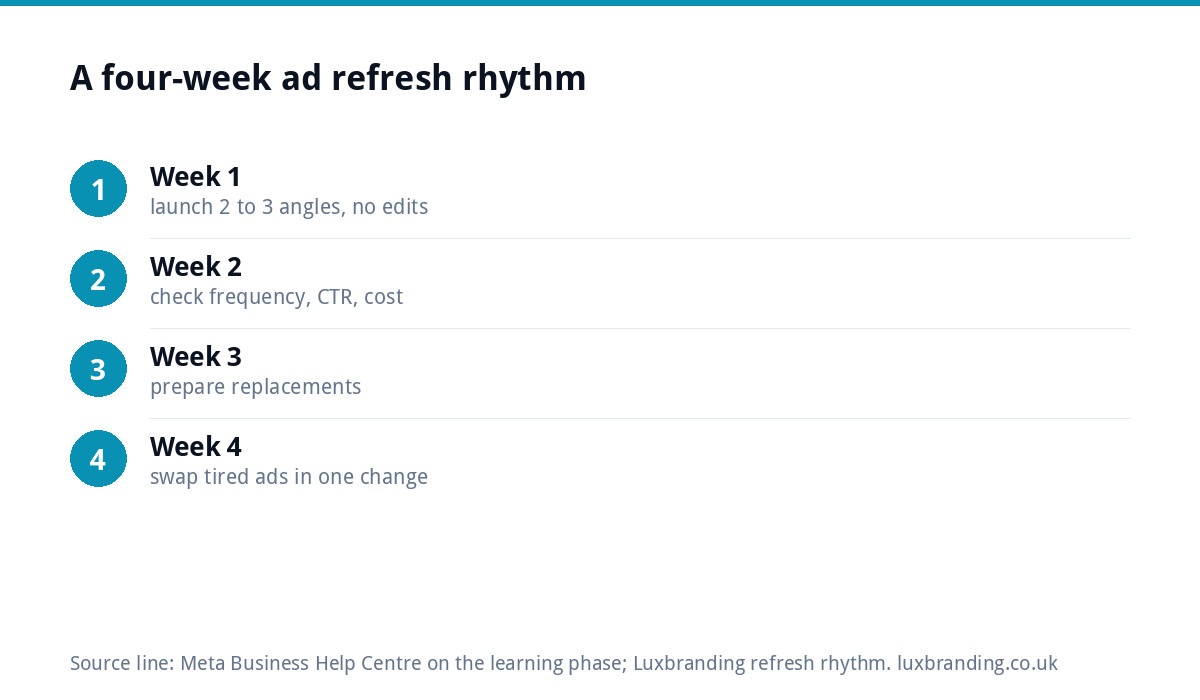
A four-week refresh rhythm
For a small local account, this rhythm keeps fatigue under control without constant tinkering:
- Week 1: launch two or three ads with different angles in the same ad set. Do not edit for the first week.
- Week 2: check frequency, click-through rate and cost per result. Leave the winners alone.
- Week 3: prepare replacements from your creative bank for any ad showing the fatigue pattern.
- Week 4: swap tired ads for new ones in a single change rather than many small ones, then start the cycle again.
Some ads will last much longer than four weeks. Keep them running for as long as the numbers hold; the rhythm is a check, not a rule to replace good ads for the sake of it.
When the creative is not the problem
Fresh creative will not rescue an ad that sends people somewhere unconvincing. If clicks hold up but enquiries fall, look at the page people land on: does it load quickly, match the ad’s promise and make the next step obvious? A focused landing page is £199. And if your branding looks different on every ad, people do not build familiarity with the business; our brand identity design at £299 gives every ad a consistent look, and our social media design templates help keep it that way.
Getting help
If you would rather someone else watched the numbers and kept the creative fresh, our Facebook and Instagram ads service can run your campaigns for you, and our social media management service keeps your organic posting running alongside. Every price we charge is on our pricing page.
Get the UK SEO DIY Audit Checklist (free)
A 32-point checklist UK SMEs can run against their own website in an afternoon. Surfaces the quick wins before paying for a paid audit.
No spam. UK GDPR compliant. We only use your email to send this resource, unless you tick the box to hear from us.
Frequently asked questions
Why did my Facebook ads stop working after a few weeks? +
The most common reason is ad fatigue: the same people have seen the ad several times and stopped responding, so frequency rises, clicks fall and each result costs more. Other causes include the learning phase restarting after edits, a landing page or tracking problem, seasonality and budget changes.
What frequency is too high for Facebook ads? +
There is no single number that suits every account. Watch the trend instead: if frequency keeps climbing while click-through rate falls and cost per result rises, the audience is tiring of the ad. Small local audiences usually reach that point sooner than large national ones.
How often should I refresh Facebook ad creative? +
Check every week or two and replace ads when they show the fatigue pattern, rather than on a fixed schedule. For a small local account, a four-week rhythm of launch, check, prepare and swap works well. Keep any ad running for as long as its numbers hold up.
Does changing an ad reset the learning phase? +
Editing an ad set can send it back into the learning phase, which is why constant small edits make results unstable. Make changes in one planned batch rather than many tweaks, and give a new ad set about a week before judging it.
Can Luxbranding manage our Facebook and Instagram ads? +
Yes. Our Facebook and Instagram ads service can run your campaigns for you. For the page ads send people to, a landing page is £199, and brand identity design at £299 gives every ad a consistent look. All prices are on our pricing page.