Quick answer
A good strapline is three to eight words that tell a customer what you do, who or where you do it for, or why you are different, without repeating your business name. Write twenty options from hard facts about your business, cut anything vague, then test the survivors on a van, a phone and a stranger.
This guide gives you a method you can finish in an evening, the formulas that work for small businesses, the tests that separate a strapline that sticks from one that sounds nice in a meeting, and the legal checks to run before it goes on a van.
Strapline, slogan or tagline?
The words get used interchangeably and the difference matters less than people think. In practice:
- A strapline sits with your name or logo and stays for years. “Domestic and commercial electricians across Bristol.”
- A slogan is often tied to a campaign or season and changes more often. “Book your boiler service before the first frost.”
- A tagline is the American term for the same job as a strapline.
This guide is about the long-lasting kind: the line on your van, website header, business cards and Google Business Profile.
What a strapline has to do
For a small business, a strapline earns its place by doing at least one of three jobs:
- Explain what you do when the name does not. “Harrow & Co” could be anything; “Harrow & Co: loft conversions in North London” cannot.
- Say who or where you serve, so the right customers recognise themselves and the wrong ones move on.
- Give a reason to choose you that a competitor cannot simply copy.
If your name already explains the trade, the strapline can focus on the second or third job. If the name is abstract, the strapline almost always needs to do the first. Choosing the name and the strapline together saves a lot of work; our guide to choosing a UK business name covers the name side.
Step 1: collect the facts, not the adjectives
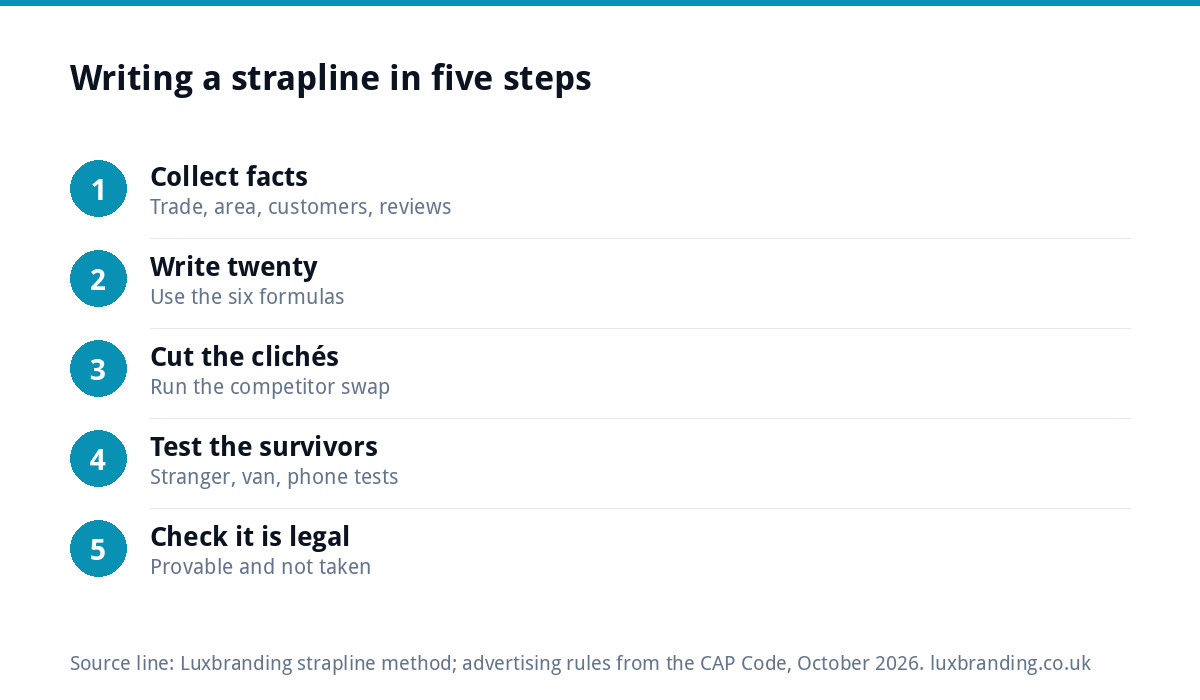
Strong straplines are built from facts. Weak ones are built from adjectives. Before writing a single line, spend fifteen minutes listing:
- What you do, in the words customers use on the phone.
- Where you work: towns, counties, postcode areas.
- Who you mostly work for: homeowners, landlords, builders, councils, restaurants.
- Anything specific and true: years trading, accreditations, guarantees you actually offer, response times you actually keep, a speciality others do not cover.
- What customers say in reviews, in their exact words.
Reviews are the richest source. If three customers mention that you “turned up when you said you would”, that is a strapline candidate, because it is a real difference in the words real people use.
Step 2: write twenty, fast
Do not try to write the perfect line. Write twenty quickly, using these formulas as starting points:
| Formula | Example (fictional business) | Best when |
|---|---|---|
| What + where | Roofing and guttering across Kent | The name does not explain the trade |
| What + who | Bookkeeping for builders and trades | You specialise in one type of customer |
| Promise you can keep | On time, tidy, and fixed first visit | Reviews repeatedly praise one behaviour |
| Speciality | Period sash windows, restored not replaced | You do something competitors avoid |
| Outcome | Warm homes, lower bills | The result matters more than the method |
| Plain fact | Family plumbers since 1998 | Longevity or family ownership is a real asset |
Mix and match. Say each one out loud. The ones you can say without stumbling go through to the next step.
Step 3: cut the clichés
Some phrases appear on so many vans that they have stopped meaning anything. Cross out any candidate that relies on them:
- “Quality you can trust” and “No job too small”.
- “Your local experts” without saying where local is.
- “Excellence in every detail” and other lines that could belong to a bank, a bakery or a builder.
- “Solutions” of any kind.
- Puns that need explaining.
A simple test: swap in a competitor’s name. If the line still works perfectly for them, it is not doing the third job, and probably not the first two either.
Step 4: test the survivors
You should now have three to five candidates. Put each one through these tests:
| Test | How to run it | Pass |
|---|---|---|
| Stranger test | Show it to someone who does not know you; ask what you do | They describe your trade correctly |
| Van test | Imagine it on the side of a van at a junction | Readable in a few seconds |
| Phone test | Put it under your name on a phone screen | Fits on one or two lines at a readable size |
| Competitor swap | Replace your name with a rival’s | It no longer fits them |
| Phone call test | Say it when answering the phone | Sounds natural, not like an advert |
| Five-year test | Ask whether it will still be true in five years | It survives new services or a new town |
Most lines fail at least one test. That is the point: you are looking for the one that fails least, not one that is perfect.
Step 5: check it is legal and yours
Two checks before the line goes anywhere expensive.
Can you prove it? Straplines count as advertising. The UK Advertising Codes’ section on misleading advertising says marketers must hold documentary evidence for claims consumers are likely to regard as objective, while obvious exaggerations that nobody takes literally are allowed. “Cheapest roofer in Leeds” or “fastest response in Essex” are factual claims you would need to prove. “Roofing done properly” is not.
Is someone else using it? Search the UK register using GOV.UK’s trade mark search and do a plain web search for the exact phrase. If you hope to register your strapline as a trade mark one day, note that GOV.UK’s guidance on what you can register says a mark cannot be too common and non-distinctive, giving a generic slogan as the example, and cannot simply describe the goods or services. Our guide to logo copyright and trade marks explains how registration works.
A worked example: an electrical firm in Bristol
Here is the method applied to a fictional two-person electrical firm called Avonmere. The name says nothing about the trade, so the strapline must do the first job.
Facts collected: domestic and small commercial work, Bristol and Bath, mostly landlords and homeowners, NICEIC registered, reviews keep mentioning clear quotes and tidy work.
A few of the twenty drafts: “Powering Bristol’s future” (vague, cut), “Your local electricians” (fails the competitor swap, cut), “Electricians for Bristol and Bath” (clear, safe), “Electrical work for landlords and homes across Bristol” (clear, a little long), “Clear quotes, tidy work, Bristol electricians” (uses the reviews).
After testing: the stranger test ruled out anything without the word electrician. The van test favoured the shorter lines. The firm chose “Electricians for Bristol and Bath” for the van and logo lockup, and used the review-led line as the headline on its website, where there is room to back it up with the reviews themselves.
Where the strapline goes
Once chosen, use it consistently. The usual places are the website header or home page headline, your Google Business Profile description, the van, business cards and quote templates, and the email signature. Use the same wording everywhere; three variations of one strapline confuse rather than reinforce.
On a vehicle, it usually sits beneath the name with the phone number and web address. Our guide to vehicle signage costs covers what that work costs, and our guide to branding for trades businesses shows how vans, workwear and quotes work together.
Adding it to your logo
Some businesses want the strapline locked into the logo itself as one piece of artwork. That works for short lines that will not change, but it can make the logo hard to use small, because the strapline becomes unreadable on a favicon or embroidered polo. The usual answer is two versions: one with the strapline for large uses, one without for small ones.
If you already own your logo and want the strapline added as a layout, our logo edit is £50 and covers layout changes while keeping the mark recognisable.
When to get help
A strapline is a short piece of writing that touches everything else: the name, the logo, the colours and the tone of the website. If you are setting all of that up at once, our brand identity design at £299 covers the logo, colours, typography, imagery and brand guidelines, so the strapline has a consistent system to sit in. See all our prices on the pricing page, then order online or email us at support@luxbranding.co.uk.
Get the UK Branding Budget Worksheet (free)
A printable worksheet: decide what your brand needs now and price it against fixed published prices and the IPO trademark fee.
No spam. UK GDPR compliant. We only use your email to send this resource, unless you tick the box to hear from us.
Frequently asked questions
How long should a strapline be? +
Three to eight words suits most small businesses. It needs to be readable on a passing van in a few seconds and fit under your name on a phone screen. If the line needs a comma and a second clause to make sense, it is usually trying to do too many jobs and should be cut back.
What is the difference between a slogan and a strapline? +
In everyday use the terms overlap. A strapline usually sits with your name or logo and stays for years, while a slogan is often tied to a campaign or season and changes more often. Tagline is the American word for a strapline. What matters is that the long-lasting line is clear and true.
Can I say we are the best or cheapest in a strapline? +
Only if you can prove it. The UK advertising code says businesses must hold evidence for claims customers are likely to take as factual, such as cheapest or fastest. Obvious exaggeration that nobody takes literally is allowed. A specific, provable line is usually more persuasive anyway than a superlative.
Can I trademark my strapline? +
Sometimes. GOV.UK guidance says a trade mark cannot be too common and non-distinctive, giving a generic slogan as an example, and cannot simply describe the goods or services. Distinctive straplines can be registered. Search the UK register with the GOV.UK trade mark search before you print anything expensive.
Can Luxbranding add a strapline to my logo? +
Yes. If you already own your logo, our logo edit is £50 and covers layout changes such as adding a strapline while keeping the mark recognisable. If you are setting up the name, logo and visual style together, our brand identity design is £299 and includes the logo, colours, typography, imagery and brand guidelines.