Quick answer
One 2026 benchmark puts the average UK freelance graphic designer at £348 a day, roughly £46 an hour over a seven-and-a-half-hour day. Agencies usually charge more to cover account management and overheads. For a small business, the hourly figure matters less than the total: always ask for a fixed project price.
Hourly and day rates are how many designers and agencies price their time, but they are hard to compare and harder to budget for. This guide explains what the rates mean, what pushes them up or down, how VAT changes the maths, how a rate turns into a project price, and how to compare quotes fairly so you are paying for results rather than hours.
What the benchmark says
Reliable rate data is scarce, because most designers do not publish their rates. One useful benchmark comes from YunoJuno, a freelance hiring platform, which publishes average contractor rates by role. Its page on graphic designer contractor rates for 2026 gives an average UK day rate of £348. For comparison, its motion graphics designer rates show an average UK day rate of £385, at the time of writing, November 2026.
Two cautions. These are averages for freelancers on one platform, so individual rates sit well above and below them. And they are freelance rates, not agency rates. Treat them as a sense check, not a price list.
To turn a day rate into an hourly one, divide by the hours in a working day. At seven and a half hours, £348 a day is about £46 an hour. Some designers count an eight-hour day, which brings it slightly lower; others bill hourly at a higher figure because short jobs carry more admin per hour.
Hourly, day rate, project fee or retainer
Designers price in four main ways. Each shifts risk differently between you and them.
| Pricing model | How it works | Good for | Risk to you |
|---|---|---|---|
| Hourly rate | You pay for each hour worked | Small, unpredictable tasks and amendments | Total cost is unknown until the end |
| Day rate | You pay per day booked | Workshops, on-site days, blocks of work | Days can stretch if the brief is loose |
| Fixed project fee | One price for a defined result | Logos, brand identities, websites | Low, if the scope is written down |
| Monthly retainer | A set fee for a set amount of work each month | Ongoing social, marketing or design support | Paying for unused time in quiet months |
For most small business projects, a fixed project fee is the safest. The designer carries the risk of the job taking longer than expected, and you know the cost before you start.
What pushes a rate up or down
- Experience: a senior designer with a strong portfolio charges more than a recent graduate, and often works faster.
- Specialism: brand strategy, packaging, motion and UX tend to command higher rates than general graphic design.
- Location: rates in London are often higher than elsewhere in the UK, though online working has narrowed the gap.
- Overheads: an agency with an office, account managers and project managers has to cover those costs in its rate.
- Demand: a designer who is fully booked can charge more than one looking for work.
- Rush jobs: tight deadlines often carry a premium.
Agency vs freelancer rates: where the difference goes
An agency’s rate is usually higher than a freelancer’s, and it is fair to ask what the extra pays for. Typically it covers people you may not see: someone managing the project and your communications, a second designer for review, cover when someone is off sick, and the business running costs of an office and software. For a large project with many moving parts, that can be good value. For a logo or a simple set of business cards, it is often more structure than the job needs.
The useful question is not “agency or freelancer?” but “how much of what I am paying for will this project actually use?”
VAT: the 20% that changes comparisons
When comparing rates, check whether VAT is included. The standard rate of VAT is 20%, as GOV.UK’s page on VAT rates confirms. A business only has to register for VAT once its taxable turnover goes over the threshold, which GOV.UK’s guidance on when to register for VAT sets at £90,000 over the last 12 months.
So a VAT-registered agency quoting £50 an hour plus VAT actually costs £60 an hour to a business that cannot reclaim VAT, while a smaller freelancer below the threshold quoting £50 means £50. If you are VAT-registered yourself and can reclaim it, the gap disappears. Always compare like with like.
From rate to project price: worked examples
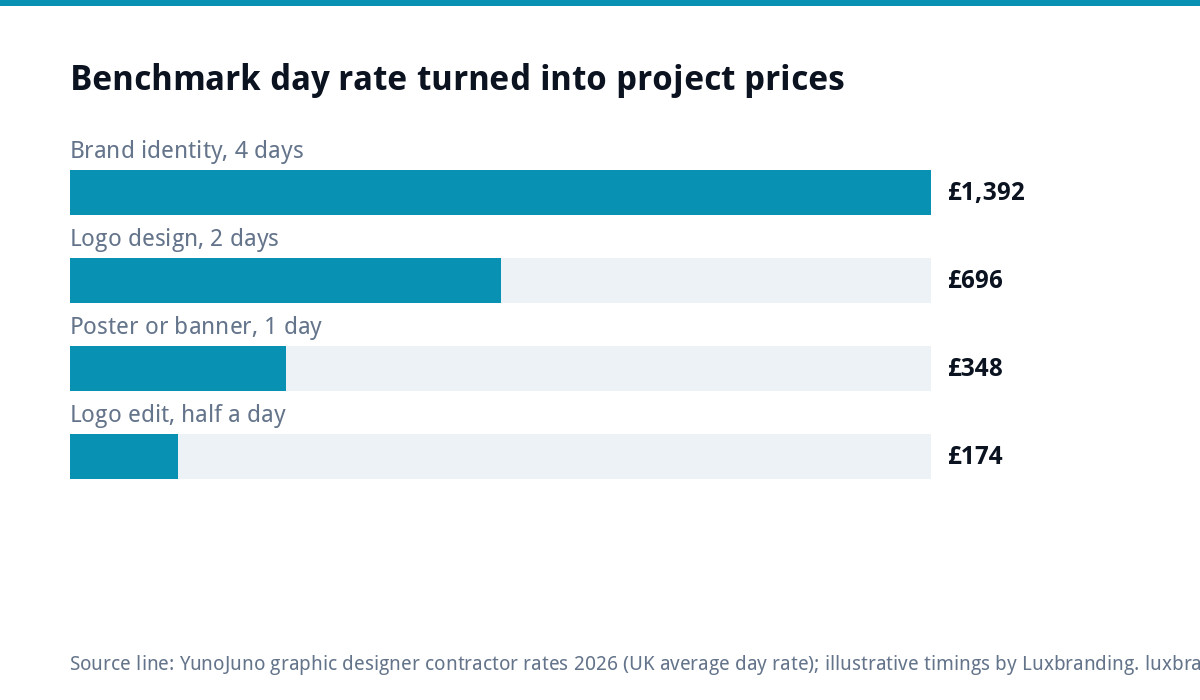
The rate is only half the sum; the other half is how long the job takes. Here is how the £348 benchmark day rate turns into project prices, using illustrative timings. Real timings vary with the designer and the brief.
| Project | Illustrative time | At £348 a day | Our flat price |
|---|---|---|---|
| Logo design | 2 days | £696 | £129 |
| Brand identity (logo, colours, type, guidelines) | 4 days | £1,392 | £299 |
| Small edit to an existing logo | Half a day | £174 | £50 |
| Poster or banner design | 1 day | £348 | £89 |
The comparison is not to say every day-rate designer is overpriced. A senior designer spending four days on bespoke brand strategy is doing different work. The point is that flat fees work when the process is defined: we know what a logo or brand identity involves, so we can price the result rather than the hours.
How to compare quotes fairly
- Ask for a total, not just a rate. “£45 an hour” is meaningless without an estimate of hours.
- Check what is included: number of concepts, rounds of revisions, file formats, and who owns the final artwork.
- Check what triggers extra charges: extra revisions, rush delivery, new formats.
- Check VAT, as above.
- Check timescales: when you will see a first draft and when the job will be finished.
- Look at relevant work: a portfolio of businesses like yours matters more than a high rate.
If you suspect you are being overcharged on an existing project, our guide to a web designer overcharging covers the warning signs and what to do.
Red flags in hourly billing
- No estimate given at the start, or an estimate that keeps growing without explanation.
- Time billed in large blocks for small tasks, such as an hour for a two-line email.
- Charges for revisions that were caused by the designer’s own mistakes.
- No itemised breakdown of hours on the invoice.
- Final files withheld until disputed hours are paid, with no clear agreement about ownership.
When an hourly rate makes sense
Hourly billing is not wrong. It suits small, unpredictable work where a fixed price would be guesswork: ad hoc changes to a website, ongoing tweaks to marketing material, or a job where you genuinely do not know the scope. In those cases, agree a rate, a cap (“stop and check with me after five hours”) and a simple log of time spent.
Retainers: the monthly version of an hourly rate
Some agencies suggest a monthly retainer instead of project fees: a set amount each month for a set number of hours or deliverables. It can work well when there is a steady flow of design work, such as weekly social posts, regular print materials or a busy website. It works less well when the work comes in bursts, because quiet months are still paid for.
Before agreeing to one, ask four questions:
- How many hours or deliverables does the monthly fee cover, exactly?
- What happens to unused hours: do they roll over, or are they lost?
- What rate applies to work beyond the allowance?
- What is the notice period if you want to stop?
A useful sense check is to divide the monthly fee by the hours included. If the result is far above the rates you have seen quoted elsewhere, the retainer is buying availability as much as design time. That can still be worth paying for, as long as you know it.
Our flat prices
We price by the result, not the hour. Logo design is £129 with unlimited concepts, unlimited revisions within your brief and every layout included. Brand identity design is £299 and covers the logo, colours, typography, imagery and brand guidelines. A logo edit to an existing logo is £50. To see how these compare with typical quotes, our guide to how much branding costs and the logo cost calculator set out the ranges, and every price is on our pricing page.
Get the UK Branding Budget Worksheet (free)
A printable worksheet: decide what your brand needs now and price it against fixed published prices and the IPO trademark fee.
No spam. UK GDPR compliant. We only use your email to send this resource, unless you tick the box to hear from us.
Frequently asked questions
What is the average hourly rate for a graphic designer in the UK? +
One 2026 benchmark from YunoJuno gives an average UK day rate of £348 for freelance graphic designers, which is roughly £46 an hour over a seven-and-a-half-hour day. Individual rates vary widely with experience, specialism and location, and agencies usually charge more to cover overheads.
Why do design agencies charge more than freelancers? +
An agency rate usually covers people and costs you may not see: project management, a second designer for review, cover for absence, offices and software. For large projects with many moving parts that can be good value. For a logo or business cards it is often more structure than the job needs.
Is it better to pay a designer hourly or a fixed price? +
For most small business projects, a fixed price is safer, because the designer carries the risk of the job taking longer and you know the cost up front. Hourly billing suits small, unpredictable tasks. If you do pay hourly, agree a cap and ask for an itemised log of time.
Do designer rates include VAT? +
Not always. VAT-registered designers and agencies add VAT at the standard rate of 20%, while those below the £90,000 registration threshold do not charge it. If your business cannot reclaim VAT, compare quotes including VAT so you are comparing like with like.
How much does Luxbranding charge for design? +
We use flat prices rather than hourly rates. Logo design is £129 with unlimited concepts and every layout included, brand identity design is £299, a logo edit is £50, and poster and banner design is £89. Every price is listed on our pricing page.