Quick answer
A font licensing letter usually claims you are using a typeface beyond the licence you hold, most often as a web font on your site. Check which font, where it appears and what licence you or your designer bought. If the licence is missing, buy the right one or switch fonts, and negotiate any back-charge in writing.
Font letters confuse people because the font looks like part of the design, not a piece of software. But a font file is software, and the licence decides where you can use it. Below we explain the licence types in plain English, the order of work for replying, an audit table for your brand and how to stop it happening again. This is general guidance, not legal advice.
Why font letters happen
A font file is protected like any other software. GOV.UK’s copyright page lists software among the works protected automatically, with no registration needed. When you buy a font, you are buying a licence to use that software in certain ways, not the font itself.
The trouble is that licences are split by use. A licence that lets a designer install a font on their computer does not usually let you load that font on your website. Websites are easy to check, because the font files load in every visitor’s browser, so foundries and their agents can see which sites use which fonts, then compare that against their list of web licences.
The licence types, in plain English
| Licence type | What it usually covers | Common gap |
|---|---|---|
| Desktop | Installing the font on a set number of computers to make documents and artwork | Does not cover loading the font on a website |
| Web font | Embedding the font on a website, often priced by traffic or domains | Traffic grows past the tier, or a second site uses it |
| App or e-book | Embedding the font in software or digital publications | Rarely bought by small businesses, but needed for apps |
| Open licence (such as the OFL) | Free use in print, websites and logos, within the licence terms | Few gaps, but read the licence file |
| Subscription | Use while the subscription is active, under the service’s terms | Check what happens to existing work when you cancel |
Every foundry writes its own end user licence agreement, so treat the table as a map, not the rules. The licence that came with your font is what counts.
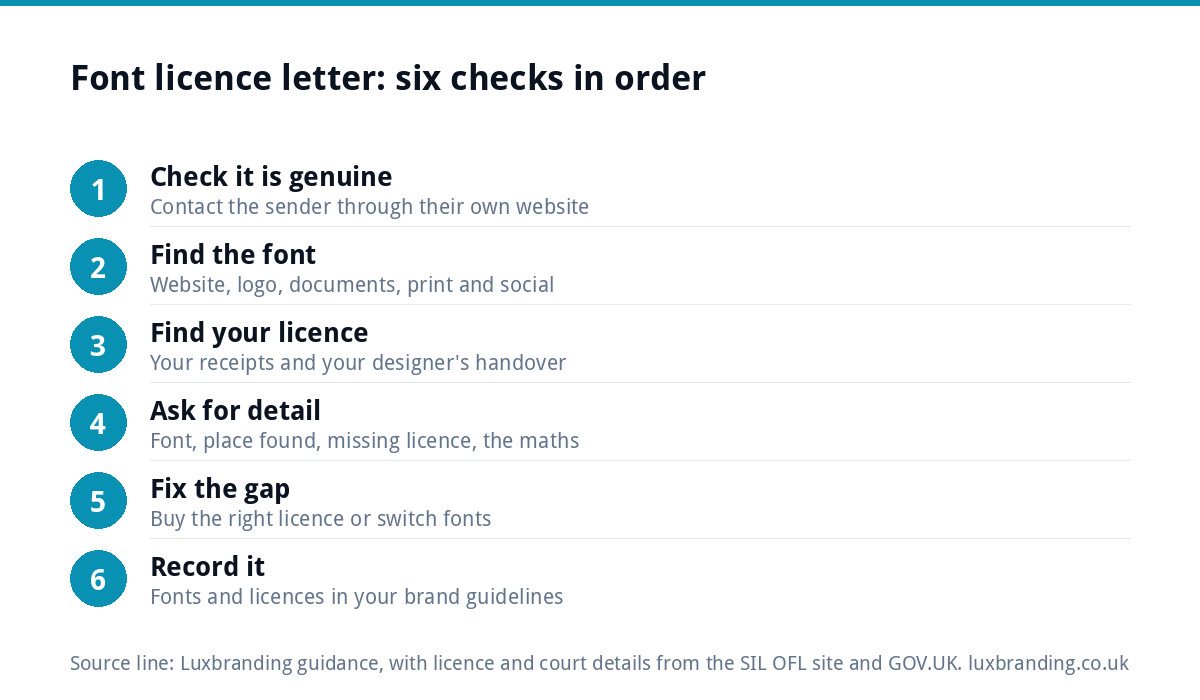
Step 1: check the letter and the claim
Contact the sender through their own website, not a link in the email, to confirm it is genuine. Then check the letter names a specific font, a specific place it was found (usually a web address) and a date. A vague claim that you are “using our fonts” without naming one is not something to pay against.
Step 2: find where the font is used
Most businesses use a typeface in more places than they realise. Work through:
- The website: the font files your site loads, which a web developer can list in minutes.
- The logo: whether the logo artwork uses the font, and whether it was converted to outlines.
- Documents and templates: quote templates, invoices and presentations on staff computers.
- Print, signage and vehicles: anything a printer or sign maker produced.
- Social graphics: templates in design tools.
The letter is usually about one use, often the website. Answer that one, but fix every other gap while you are looking. Mixed fonts across these places are also a sign the brand has drifted, which our guide to a brand that looks different everywhere deals with.
Step 3: find the licence you already hold
Search your emails and your designer’s handover for font receipts. Three things to know:
- A designer’s licence is usually theirs. Many designers hold desktop licences to create your artwork. That does not automatically give your business a web licence or a licence for staff computers.
- Logos are often fine. Many desktop licences allow a font to be used to make static artwork such as a logo, and a logo supplied as vector outlines no longer needs the font installed. Some licences restrict logo or trademark use, so check yours.
- Free does not always mean free for business. Some fonts on download sites are free for personal use only.
Step 4: reply and ask for detail
A short, neutral reply works best. Say you are looking into it, and ask for: the font and style concerned, where and when it was found, the licence they say is missing and how their figure was calculated. Do not admit liability in the first reply, and keep everything in writing.
If the claim is about a font your designer chose and loaded, ask your designer in writing which licence they bought and for which use. Your contract with them may matter if they supplied a font without the right licence.
A first reply you can adapt
“Thank you for your letter of [date] about the font [name]. We take licensing seriously and are looking into it now. So that we can respond properly, please confirm the font family and styles concerned, the web address or item where you found it and the date, the licence you say is missing, and how you calculated the amount requested. We will reply within 14 days of receiving that information.”
That reply admits nothing, shows good faith and puts the burden of detail back on the sender. While you wait, check whether the font is still loading on your site; if you plan to switch, a web developer can swap it in an afternoon.
Your options if the licence is missing
- Buy the right licence. Often the simplest fix: a web licence for the tier your site actually needs.
- Switch to an openly licensed font. The SIL Open Font License site says fonts under the OFL can be used in books, posters, artwork, logos and on websites, with no acknowledgement needed. Many fonts in free libraries are published under it; check each font’s licence file before you rely on it.
- Negotiate the back-charge. The figure for past use is a negotiation. Point out how long the font was used, the size of your site and what a correct licence would have cost, and make one reasoned offer in writing marked “without prejudice”.
If it escalates, smaller intellectual property disputes in England and Wales can go to the IPEC small claims track, which the HM Courts & Tribunals Service guide describes as the route for disputes worth under £10,000. A formal claim form has short deadlines, so take legal advice at that point.
Your brand font audit
Use this table to record every font your business uses and the licence behind it. It takes an hour and ends the uncertainty.
| Where it is used | Licence you need | Proof to keep |
|---|---|---|
| Website | Web font licence, or an open licence | Receipt, tier and domain |
| Logo artwork | Desktop licence that allows logo use, or an open licence | The licence terms on the date of design |
| Staff documents and templates | Desktop licence for each computer, or a system font | Number of seats bought |
| Print, signage and vehicles | Usually covered by the designer’s desktop licence | Designer’s confirmation |
| App or digital publication | App or e-book licence | Receipt and the product it covers |
If your logo font has to change
Sometimes the cleanest answer is to move the brand off a font you cannot license properly. If your logo needs a different typeface but the mark itself stays, our Logo Edit is £50 one-off: changes to a logo you already own, including the font, spacing and proportions, returned as an edited vector in SVG, AI, EPS, PDF, PNG and JPG with colour codes. If you only have a JPG or PNG of the logo, it needs rebuilding as vector first through Recreate & Vectorise, at £79 for one layout.
Our guide to logo copyright and trademarks covers who owns the artwork once it is paid for, which is a separate question from the font licence.
Record fonts in your brand guidelines
Font letters are a symptom of nobody writing down which typefaces the brand uses and where they came from. Brand guidelines are the right home for it: the typefaces, the weights, where each is used and the licence behind it. Our guide to brand guidelines costs explains what a good set contains.
If the brand needs setting up properly from the start, our brand identity design is £299 and covers the logo, colours, typography, imagery and brand guidelines in one go. When you brief any designer, ask them to list each font and the licence it needs for your uses. Full prices are on our pricing page.
Get the UK Branding Budget Worksheet (free)
A printable worksheet: decide what your brand needs now and price it against fixed published prices and the IPO trademark fee.
No spam. UK GDPR compliant. We only use your email to send this resource, unless you tick the box to hear from us.
Frequently asked questions
Why have I received a letter about a font on my website? +
Font files are software, and licences are split by use. A desktop licence used to design your artwork usually does not cover loading the font on a website. Web fonts load in every visitor's browser, so foundries and their agents can see which sites use a font and compare that with their list of web licences.
Does my designer's font licence cover my business? +
Not automatically. Many designers hold desktop licences so they can create your artwork, and those licences are theirs. Your business may still need its own web licence for the website or desktop licences for staff computers. Ask your designer in writing which licence they bought and which uses it covers.
Do I need a font licence for my logo? +
Often the logo itself is fine. Many desktop licences allow a font to be used to make static artwork such as a logo, and a logo supplied as vector outlines no longer needs the font installed. Some licences restrict logo or trademark use, though, so check the licence that applied when the logo was designed.
Can I just switch to a free font? +
Yes, if the free font's licence allows business use. The SIL Open Font License site says OFL fonts can be used in print, artwork, logos and on websites with no acknowledgement needed. Some fonts on download sites are free for personal use only, so read each font's licence file before you rely on it.
How much does it cost to change the font in my logo? +
Our Logo Edit is £50 one-off for changes to a logo you already own, including the font, spacing and proportions. You get the edited vector in SVG, AI, EPS, PDF, PNG and JPG with colour codes. If you only have a JPG or PNG, it is rebuilt as vector first through Recreate and Vectorise at £79 for one layout.