Quick answer
Engagement matters more than followers for sales. One local follower who books a £150 job is worth more than a thousand who scroll past. Comments, shares, saves and messages tell Instagram and Facebook to show your posts to more people, and they are where enquiries start. Follower count matters mainly as a sign of trust.
Follower numbers are the first thing anyone sees on a profile, so it is natural to chase them. But a small business does not get paid in followers. This guide explains what each number really tells you, when follower count does matter, which metrics actually lead to sales and how to review them in twenty minutes a month.
Followers vs engagement: what each tells you
| Followers | Engagement | |
|---|---|---|
| What it is | How many accounts have chosen to follow you | How many people interact with what you post: likes, comments, shares, saves, messages |
| What it tells you | How big your potential audience is | Whether that audience cares |
| Effect on reach | Indirect | Direct; platforms show engaging posts to more people |
| Link to sales | Weak on its own | Strong, especially messages and saves |
| Can be faked | Easily, by buying followers | Harder; fake engagement is obvious and against platform rules |
| Best use | Social proof on the profile | Judging what content works and who is interested |
Why engagement drives reach
Social platforms decide who sees each post by predicting who will interact with it. Instagram’s own explainer, Instagram Ranking Explained, says Feed ranking uses signals including likes, shares, saves and comments, as well as a person’s history of interacting with your account. Reels ranking looks at things like shares and whether people watch to the end.
That has a practical consequence. Followers who never interact gradually see less of your content, because the platform learns they are not interested. Followers who regularly comment, save and message see more of it. So an account with 400 engaged local followers can reach more of the right people than an account with 5,000 followers who stopped paying attention long ago.
Engagement is also self-reinforcing. A post that gets early comments and shares is shown to more people, who engage in turn. A post that gets nothing quietly disappears.
When follower count does matter
Followers are not worthless. They matter in three situations:
- First impressions. A profile with a dozen followers can make a new visitor wonder whether the business is active. A few hundred real local followers is enough to look established; beyond that, the count matters much less.
- Partnerships. If you want to collaborate with other local businesses or venues, a reasonable audience helps.
- Owned reach. Every genuine follower is someone you can reach without paying for ads. That has real value, as long as they are the right people.
The key word is genuine. A follower in your area who might one day need your service is valuable. A follower on the other side of the world who followed during a giveaway is not.
Vanity metrics vs money metrics
Some numbers feel good. Others pay the bills. It helps to know which is which.
| Metric | What it means | Link to sales |
|---|---|---|
| Followers | Size of your audience | Low on its own |
| Likes | A quick, low-effort reaction | Low |
| Comments | Someone cared enough to type | Medium |
| Saves | Someone wants to come back to it | Medium to high |
| Shares | Someone recommended you to a friend | High |
| Profile visits | Someone wants to know more about the business | High |
| Link taps and messages | Someone is taking a step towards buying | Highest |
Read the table from top to bottom and it becomes clear why follower count is a poor target. The closer a metric is to a conversation, the more it matters.
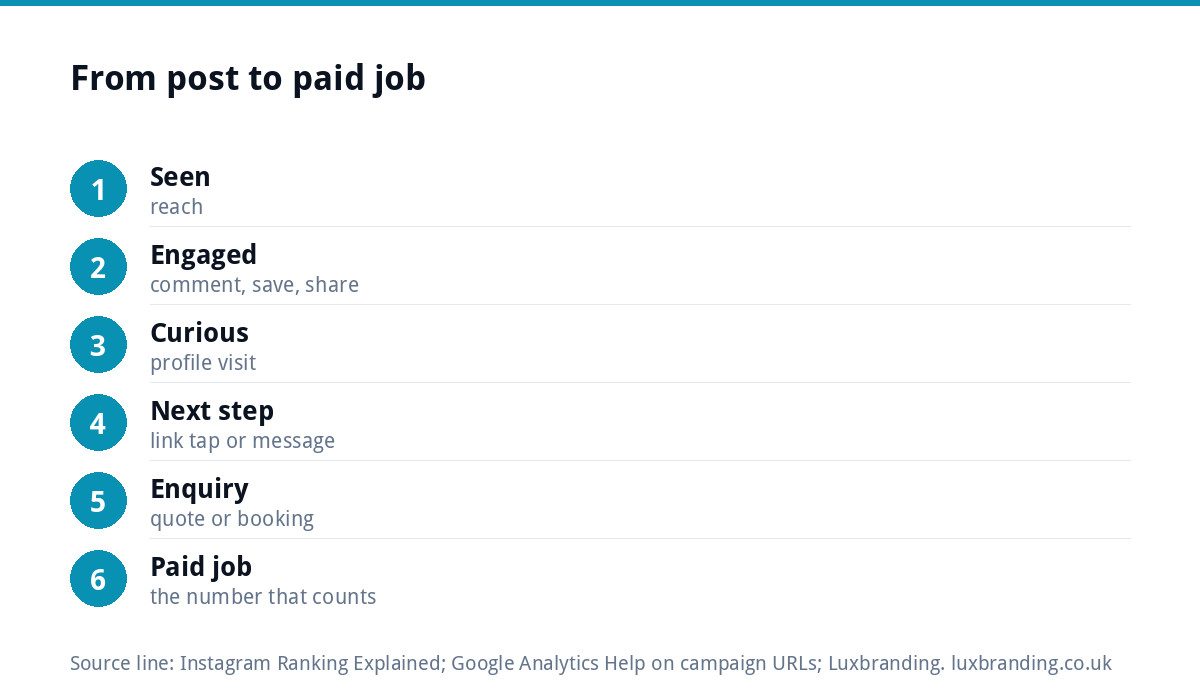
The path from post to paid job
For most small businesses, social media works as a chain. A post is seen, someone engages, they visit the profile, they tap through to the website or send a message, and some of those become enquiries and jobs. Each link in the chain can break.
- Seen but ignored: the content is not relevant or not interesting enough.
- Engaged but no profile visit: the post entertained but did not make people curious about the business.
- Profile visit but no message: the bio, link or grid does not make the next step obvious.
- Message but no booking: slow or unclear replies.
Finding the weakest link is far more useful than chasing more followers at the top.
Measuring what actually leads to sales
Instagram’s help pages on Instagram Insights explain that a professional account can see reach, engagement and follower data. Use those for the first part of the chain.
For the rest, track visits from social media to your website. Google’s guide to URL builders and campaign tags explains how to add utm_source, utm_medium and utm_campaign tags to the link in your bio and posts, so Google Analytics shows which visits and enquiries came from which platform. A link tagged with utm_source=instagram tells you in Analytics exactly how many visitors Instagram sent and what they did.
Then ask every new enquiry how they found you, and write it down. Simple, but it catches what tracking misses, such as someone who saw your posts for months and then searched for your name.
Worked example: two cleaning companies
Picture two domestic cleaning companies in the same town, both posting three times a week.
The first has 6,000 followers, most gained through a giveaway two years ago. Its posts get a handful of likes, almost no comments and the occasional message, usually from someone outside the area. The owner feels the account should be working, but it rarely produces a booking.
The second has 450 followers, nearly all local. Its posts are short before and after clips of real homes, quick tips on removing limescale, and replies to questions people ask in the comments. Each post gets a few saves and shares, several comments and, most weeks, two or three messages asking about availability. Some of those become regular weekly cleans.
On follower count, the first business looks thirteen times bigger. On the numbers that pay, the second is well ahead, and because its posts are engaging, the platforms keep showing them to more local people, so it is growing too. The lesson is not that small accounts are better. It is that the right audience, engaged, beats a large audience that has stopped listening.
Why bought followers do harm
Buying followers is cheap and tempting, and it backfires for a small business:
- Bought followers are fake or inactive accounts, so they never engage. Your engagement rate falls, and the platform shows your posts to fewer real people.
- They are usually not in your area, so they could never become customers anyway.
- A big follower count with a handful of likes per post looks odd to anyone who checks.
- Platforms remove fake accounts in sweeps, so the number can drop suddenly.
Giveaways that require following can cause a milder version of the same problem: a burst of followers interested in the prize, not the business.
How to grow meaningful engagement
- Post things people want to save: tips, checklists, before and after sets.
- Ask simple questions: “Which finish would you pick?” gets more comments than “Another job done”.
- Reply to every comment and message, quickly. Conversations are engagement too.
- Show the people: the team, the work, the local area. People engage with people.
- Be consistent: a recognisable look and regular posting build familiarity. Our guide to a brand that looks inconsistent everywhere covers the visual side.
- Join local conversations: comment helpfully on posts from local groups and businesses.
A 20-minute monthly review
- Top posts (5 minutes): which posts got the most saves, shares and messages? Make more like them.
- Profile visits and link taps (5 minutes): rising or falling?
- Website visits from social (5 minutes): check the tagged links in Google Analytics.
- Enquiries (5 minutes): how many came from social this month, by your own notes?
Follower count can sit at the bottom of the review as a background number, not the headline.
Getting help
If social media keeps slipping down the to-do list, our social media management service can run your posting for you, and our social media design templates keep every post on brand. To put your best posts in front of local people who match your customers, our Facebook and Instagram ads service targets by area. And because many local customers check Google before they message, a complete Google Business Profile (setup and optimisation £199) supports everything you post. All our prices are on the pricing page.
Get the UK SEO DIY Audit Checklist (free)
A 32-point checklist UK SMEs can run against their own website in an afternoon. Surfaces the quick wins before paying for a paid audit.
No spam. UK GDPR compliant. We only use your email to send this resource, unless you tick the box to hear from us.
Frequently asked questions
Do followers matter for a small business? +
Some, but less than most people think. A few hundred real, local followers is enough to look established. Beyond that, engagement matters far more, because comments, shares, saves and messages decide how many people see your posts and are where enquiries start.
What is a good engagement metric to track? +
Saves, shares, profile visits, link taps and messages are the most useful, because they show real interest and lead towards enquiries. Likes are quick and low-effort, so they say less. Review the posts with the most saves and messages each month and make more like them.
Is it worth buying followers? +
No. Bought followers are fake or inactive, usually not in your area and never engage. Your engagement rate falls, platforms show your posts to fewer real people, and the count can drop suddenly when fake accounts are removed. A smaller, genuine local audience is worth far more.
How do I know if social media brings in customers? +
Add campaign tags to the links in your bio and posts so Google Analytics shows visits and enquiries from each platform, check profile visits and link taps in Insights, and ask every new enquiry how they found you. Together these show which platforms actually lead to work.
Can Luxbranding run our social media? +
Yes. Our social media management service can run your posting for you, our social media design templates keep posts on brand, and our Facebook and Instagram ads service can promote your best posts locally. Google Business Profile setup and optimisation is £199. All prices are on our pricing page.