Quick answer
Both matter, and you should never pay £1 for either. Customers usually trust a 4.7 from 80 reviews over a perfect 5.0 from six, because volume makes the score believable. Google says more reviews and positive ratings can help local ranking. How recent the reviews are, and how you reply, matter almost as much.
When a customer compares three local businesses on Google Maps, they see two numbers next to each name: the star rating and the number of reviews. This guide explains how people actually read those two numbers together, what Google says about them, why the newest reviews often count for more than the total, and what a small business should focus on first.
How customers read the two numbers together
People do not read a rating on its own. They read it as a pair with the count, and they make a quick judgement about how much to trust it.
- A high rating with very few reviews looks promising but unproven. Five reviews could be friends and family.
- A slightly lower rating with many reviews looks established and believable. A business that has served lots of people and kept most of them happy feels like a safe choice.
- A perfect 5.0 with a large count can, oddly, make some people suspicious. A few honest four-star reviews make the whole set feel real.
- A low rating with many reviews is the hardest position, because it reflects a long pattern rather than a bad week.
So the honest answer to “which matters more” is that neither works alone. The count makes the rating credible, and the rating tells people whether the credibility is good news.
Rating and count compared
| Star rating | Review count | |
|---|---|---|
| What it tells a customer | How happy people were | How many people the business has served and how established it is |
| Where it matters most | Choosing between businesses with similar counts | Deciding whether the rating can be trusted at all |
| Effect of one bad review | Large when the count is small | Small when the count is large |
| How fast you can improve it | Slowly, once the count is high | Steadily, with a simple asking routine |
| Main risk | A perfect score that looks too good | A large count with nothing recent |
What Google says about reviews and ranking
Google’s help page on improving your local ranking explains that local results are based on relevance, distance and prominence. Prominence is how well known a business is, and the page says more reviews and positive ratings can help a business’s local ranking.
Notice the wording: more reviews and positive ratings, together. Google does not publish a formula, and nobody outside Google knows exactly how much each counts. What the guidance does make clear is that a steady flow of genuine, positive reviews helps on both fronts at once: it builds the count and supports the rating.
Reviews are only one part of prominence and only one part of ranking. A complete, accurate profile with the right categories, photos and opening hours matters as much for relevance. Our guide to Google Business Profile optimisation covers the rest of the picture.
Why recency can beat both
There is a third number people check without thinking about it: the date on the most recent reviews. A business whose last review was 18 months ago raises questions, however good the score. Is it still trading? Has the quality slipped? Did the owner change?
Recent reviews answer those questions. They also tend to reflect the business as it is now, which is what the customer is buying. For a small business, a handful of fresh reviews every month often does more for enquiries than a big total built up years ago.
The practical lesson is to ask for reviews as a routine, not in occasional bursts. A burst of twenty reviews in one week followed by silence looks less natural, and is less useful, than two or three a week, every week.
The small numbers problem
When you have only a few reviews, every single one moves the average a lot. With five reviews averaging 5.0, one disappointed customer leaving one star drops the rating to about 4.3. With fifty reviews averaging 4.7, the same one-star review barely moves it.
That is the strongest argument for focusing on count first when you are starting out. A larger count makes the rating stable, so one unhappy customer, or one unfair review, does not define the business. It also makes the occasional honest criticism look like what it is: an exception.
What a healthy review profile looks like
Instead of chasing one number, aim for a profile that ticks these boxes.
| Sign | Healthy | Needs work |
|---|---|---|
| Rating | Strong, with a few honest four-star reviews mixed in | Perfect 5.0 with a tiny count, or falling steadily |
| Count | Growing every month | Unchanged for a year |
| Recency | Several reviews in the last month or two | Newest review is over six months old |
| Detail | Reviews mention the job, the town, the staff | Mostly stars with no text |
| Replies | Every review answered, briefly and personally | No replies, or the same pasted thank-you |
| Spread | Reviews arrive steadily | Large bursts followed by silence |
How to grow the count the right way
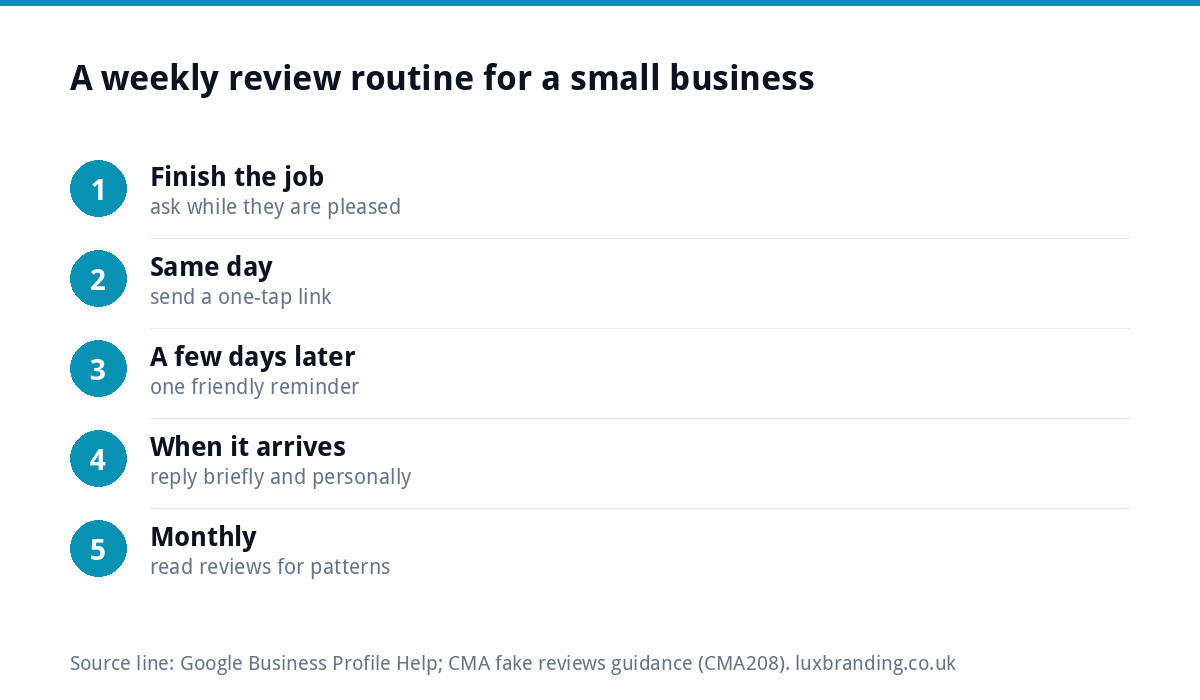
Google’s own tips to get more reviews recommend sharing a link or QR code that takes customers straight to the review form. The simplest routine for a small business:
- Ask at the right moment: when the job is finished and the customer is pleased, not three weeks later.
- Make it one tap: send the review link by text or email the same day.
- Ask everyone: do not pick only the customers you think will be happiest. Honest spread looks real and stays within the rules.
- Remind once: a single friendly reminder a few days later is fine. More than that becomes pestering.
- Reply to every review: short, specific and polite, good or bad.
Replies: the part future customers read closely
A review shows what one customer thought. Your reply shows every future customer how you behave when something is said about you in public. That makes replies a quiet third signal alongside the rating and the count.
- Thank people specifically. “Thanks, Sarah, glad the new radiators are keeping the back bedroom warm” reads as real. “Thank you for your review!” pasted fifty times does not.
- Answer criticism calmly. Acknowledge the problem, apologise where it is fair, explain briefly what you have done about it and offer to talk it through privately.
- Keep private details out. Never mention addresses, prices paid or anything the customer did not share themselves.
- Reply promptly. A reply within a day or two shows the business is active and paying attention.
A business with a slightly lower rating but thoughtful replies to every review can look more trustworthy than one with a higher rating and no replies at all. When a customer is weighing up two similar profiles, the replies are often what tips it.
What not to do
Some shortcuts can wipe out a review profile, or worse.
- Never offer anything in exchange for reviews. Google’s help page calls offering free or discounted goods or services in exchange for reviews strictly prohibited.
- Never buy reviews or post them yourself. Fake reviews break Google’s policies and are removed when found.
- Know the law. In the UK, the CMA’s fake reviews guidance sets out what is prohibited for businesses that publish or deal with consumer reviews. Fake and concealed incentivised reviews are a legal risk, not just a platform one.
- Do not argue in replies. Future customers read your response more closely than the complaint.
If reviews have vanished from your profile, our guide to Google reviews that disappeared covers the usual causes.
Where to start this week
If your count is low, focus on count and recency: set up the review link, ask every finished customer for a month and reply to everything. If your count is healthy but the rating is slipping, read the last twenty reviews for patterns. The fix is usually in the service, such as response times or tidying up, not in the profile.
Either way, make sure the rest of the profile is complete. Our free Google Business Profile checklist walks through every section.
Getting help with your profile
Our Google Business Profile setup and optimisation is £199 and covers categories, keywords, photos, a review strategy and tracking, so the asking routine is in place from day one. If you want to know what else is involved, our guide to Google Business Profile setup costs compares the options. All our prices are on the pricing page.
Get the UK SEO DIY Audit Checklist (free)
A 32-point checklist UK SMEs can run against their own website in an afternoon. Surfaces the quick wins before paying for a paid audit.
No spam. UK GDPR compliant. We only use your email to send this resource, unless you tick the box to hear from us.
Frequently asked questions
Is it better to have more reviews or a higher rating? +
You need both, but when you are starting out, count usually matters more. A higher count makes the rating believable and stable, so one unhappy customer cannot drag it down. Many people trust a strong rating from lots of reviews more than a perfect score from a handful.
Do Google reviews affect local ranking? +
Google says local results are based on relevance, distance and prominence, and that more reviews and positive ratings can help a business's local ranking. Google does not publish exactly how much they count, and a complete, accurate profile matters for relevance as well.
Does a perfect 5.0 rating look suspicious? +
It can, especially with a large number of reviews. Many people expect a real business to have the occasional four-star review. A strong rating with a few honest, slightly lower reviews mixed in often looks more trustworthy than a flawless score.
How many new Google reviews should a small business aim for? +
There is no magic number. A steady flow is better than occasional bursts: a few genuine reviews every week or two keeps the profile recent and growing. Ask every customer when the job is finished, send a one-tap review link the same day and reply to every review.
Can I offer a discount for a Google review? +
No. Google prohibits offering free or discounted goods or services in exchange for reviews, and the CMA's fake reviews guidance sets out what UK law prohibits for businesses that deal with consumer reviews. Ask every customer honestly and make leaving a review easy instead.