Quick answer
Most small UK shops do best with one flat delivery charge, such as £3.95, plus free delivery over a threshold set above your average basket. Work out your true cost per parcel first: postage, packaging and card fees. Use weight bands only if your products vary a lot in size, and always show delivery costs before checkout.
Delivery pricing is one of the few levers a small shop can pull on day one that changes both sales and margin. This guide compares the four common ways to charge, shows how to work out what a parcel really costs you, and explains how to set a free delivery threshold that pays for itself.
The four ways to charge for delivery
Almost every UK online shop uses one of four models, or a mix of two.
- Free delivery on everything. The cost is built into product prices. Simple for the shopper, but you pay for every parcel, including small, low-margin orders.
- Flat rate. One charge per order, whatever is in the basket. Easy to explain and easy to set up on any platform.
- Tiered or weight-based. The charge rises with weight, size or basket value. Fair when products range from a greetings card to a garden bench.
- Carrier-calculated. The checkout asks the carrier for a live price. Accurate, but the shopper sees a number they cannot predict.
On top of these sit two extras worth offering where they fit: free delivery over a threshold, and click and collect or local delivery for customers near you.
Comparing free, flat and tiered delivery
| Model | Best for | Risk | Shopper sees |
|---|---|---|---|
| Free on everything | Light, high-margin products of similar size | Small orders can lose money | Nothing extra at checkout |
| Flat rate | Most small shops with similar-sized items | Heavy orders cost more than you charge | One clear figure |
| Flat rate + free over a threshold | Shops wanting bigger baskets | Threshold set too low | A target to reach |
| Weight or size bands | Mixed catalogues: small and bulky items | Harder to explain on product pages | A charge that changes with the basket |
| Carrier-calculated | Heavy, bulky or international orders | Surprise totals at the last step | A live quote |
If you are unsure, start with flat rate plus a free delivery threshold. It is the easiest model to understand, and you can change it later once you have real sales data.
Work out what a parcel really costs you
Before choosing a price, add up everything that goes out of the door with a sale. Most new sellers count only postage.
- Postage or courier charge for your most common parcel size. Check your carrier’s current price list, as these change.
- Packaging: box or mailer, tissue, tape, labels and any printed insert.
- Card processing fee on the delivery part of the payment. Stripe, for example, lists 1.5% + 20p for standard UK cards on its UK pricing page at the time of writing, November 2026.
- Your time to pick, pack and drop off, even if you only count it roughly.
- Losses: the occasional damaged or missing parcel you replace.
A worked example: setting a free delivery threshold
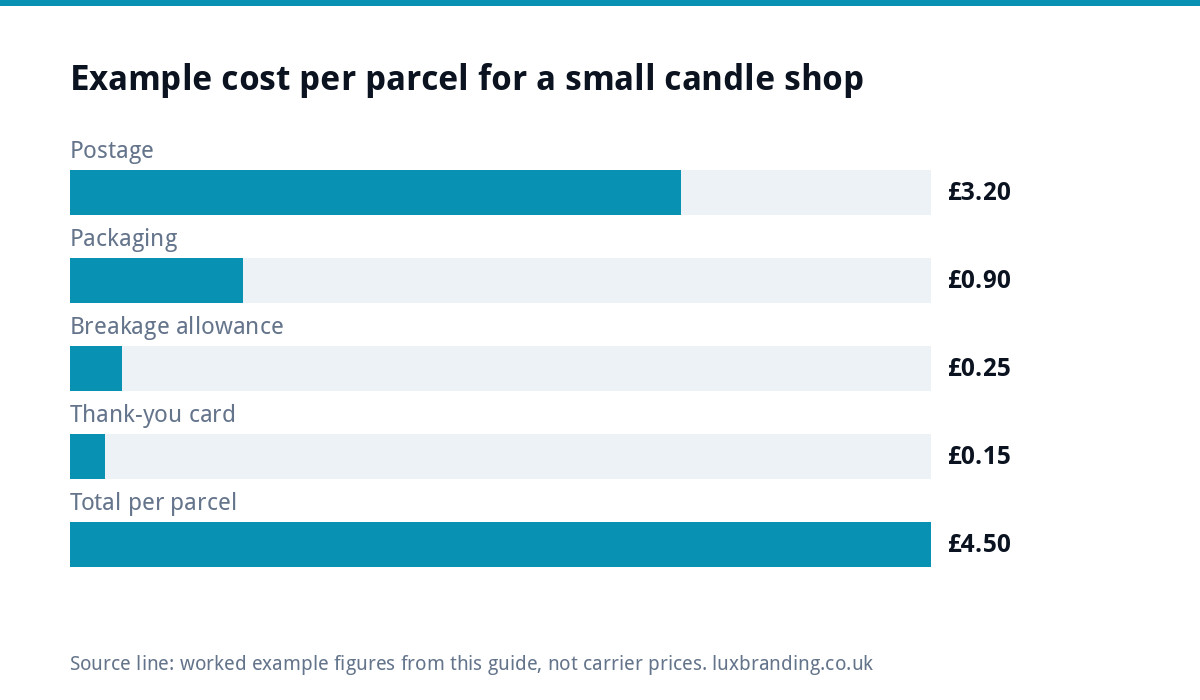
Take a small candle shop. The figures below are an example to show the method, not real carrier prices.
| Cost line | Per parcel |
|---|---|
| Postage for a small parcel | £3.20 |
| Box, filler and tape | £0.90 |
| Printed thank-you card | £0.15 |
| Allowance for breakages | £0.25 |
| Total cost per parcel | £4.50 |
The shop charges a flat £3.95, so it absorbs 55p on every parcel. Its average basket is £28. To offer free delivery, it needs the extra margin from a bigger basket to cover the full £4.50. If each candle earns about £6 profit, one extra candle per free-delivery basket pays for the parcel with change.
So the threshold goes at £40, comfortably above the £28 average. Shoppers just under it add one more item, and the shop keeps charging £3.95 on small baskets. Review it after three months: if almost nobody reaches £40, lower it; if almost everybody does, you may be giving away delivery on sales that would have happened anyway.
When weight bands make sense
Bands are worth the extra setup when your heaviest product costs several times more to post than your lightest. A shop selling both seed packets and bags of compost cannot use one flat rate without losing money or overcharging.
- Keep it to three or four bands, such as large letter, small parcel, medium parcel and large item.
- Name the band on the product page, so the shopper is not surprised.
- Round charges to simple figures, such as £2.95, £4.95 and £8.95.
- For very large items, use a “delivery quoted by postcode” note rather than a band that guesses.
Both main platforms handle this. WooCommerce uses shipping zones with flat rate, free shipping and local pickup methods in each zone, and Shopify’s shipping rates support flat rates, free shipping and carrier-calculated rates. Our Shopify vs WooCommerce comparison covers the wider differences between the two.
Zones: mainland UK, Highlands and islands, and abroad
Many couriers charge more for the Scottish Highlands, the islands and Northern Ireland. If yours does, set up a separate zone for those postcodes rather than raising prices for everyone. Say so plainly on your delivery page, with the extra charge shown.
Only open international delivery when you are ready for customs paperwork, duties and longer delivery times. A small shop can do well on UK sales alone for a long time, and every new country adds questions to answer.
Faster delivery as a paid extra
A next-day or tracked option is a useful upsell for gifts and urgent buys. Price it on what it really costs you, keep your standard option as the default, and only promise next-day if you can dispatch the same afternoon. If you miss a cut-off time often, a slower promise you always keep earns more trust than a fast one you sometimes break. Show the dispatch cut-off on the product page and in the basket, so people ordering at 4pm know whether their parcel leaves today.
Click and collect and local delivery
If you have a workshop, studio or shop, offer free collection. It costs you nothing in postage and gives local buyers a reason to choose you over a national seller. A local delivery option, limited to nearby postcodes, works well for bulky or fragile goods such as plants, furniture or cakes, and you can set your own charge for it.
Showing delivery costs: the legal side
UK rules expect shoppers to know the full price before they commit. GOV.UK’s guidance on online and distance selling says you must give customers the price including all taxes, plus delivery arrangements, costs and how long goods will take to arrive. It also says goods must be delivered within 30 days unless you have agreed otherwise with the customer.
In practice that means:
- A delivery page linked from the footer and from every product page.
- The delivery charge, or how it is worked out, shown before the final checkout step.
- Delivery times stated honestly, including which days you dispatch.
- Your returns terms in plain English, one click from the basket.
Surprise costs at the last step are one of the most common reasons people abandon a basket. If your shop gets visits but few sales, our guide to a store with traffic but no sales walks through the usual leaks in order.
Packaging affects postage
Parcel prices usually depend on size as well as weight. A box a few centimetres too big can push a parcel into a dearer size band. Choose packaging that fits your best-sellers snugly, and check it against your carrier’s size limits before you order a thousand.
Branded packaging can also earn its cost back in repeat buying and social shares. Our guide to packaging design for small brands covers what is worth printing and what is not.
Mistakes that cost small sellers money
- Free delivery with no maths behind it. Heavy, low-price items can lose money on every sale.
- A threshold below the average basket. You give away delivery on sales you would have had anyway.
- Hidden extras such as a handling fee added at the last step.
- Forgetting the remote-postcode surcharge your courier adds to some parcels.
- Never reviewing the charge after carrier prices change.
Getting your shop built with delivery set up properly
Our E-commerce Website is £499 one-off for up to 20 products, built on WooCommerce or Shopify, with Stripe and PayPal payments. Delivery settings are part of the build, so the first sale goes through with the right charge. See every fixed price on our pricing page, or read our e-commerce website cost guide for the full running costs of a small shop.
Get the UK Website Project Brief Template (free)
A two-page template for briefing any UK web designer: sitemap, integrations, audience and deliverables. Cuts revision rounds in half.
No spam. UK GDPR compliant. We only use your email to send this resource, unless you tick the box to hear from us.
Frequently asked questions
Should a small online shop offer free delivery? +
Only when the numbers support it. Free delivery on everything works for light, high-margin products of a similar size. For most small shops, a flat charge plus free delivery over a threshold is safer: small baskets still cover postage, and the threshold nudges shoppers to add an item. Work out your real cost per parcel before deciding.
How do I set a free delivery threshold? +
Start from your average basket value and set the threshold comfortably above it, so free delivery encourages one more item. Check that the extra margin from that item covers your full cost per parcel, including packaging and card fees. Review the threshold after three months of sales and adjust it if almost nobody, or almost everybody, reaches it.
What is the best delivery charge for a UK online shop? +
There is no single right figure, but one simple flat rate is easiest for shoppers to understand. Base it on your true cost per parcel: postage, packaging, card fees and an allowance for breakages. Many small shops round it to a figure such as £3.95, then add free delivery over a threshold.
Do I have to show delivery costs before checkout? +
Yes. GOV.UK guidance on online and distance selling says customers must be told the price including taxes, plus delivery arrangements, costs and how long goods will take to arrive. Show the charge, or how it is worked out, on a delivery page and before the final checkout step, so there are no surprises.
Can you set up delivery zones and rates when building my shop? +
Yes. Our E-commerce Website is £499 one-off for up to 20 products on WooCommerce or Shopify, with Stripe and PayPal payments. Delivery settings are part of the build, so your zones, rates and any free delivery threshold are in place before launch. Every fixed price is listed on our pricing page.