Quick answer
To compare web design quotes fairly, put them side by side on the same eight lines: pages and copy, design, build method, domain and hosting, SEO set-up, legal pages, support after launch, and timeline with VAT. Then add three years of running costs. A £499 quote and a £2,000 quote often turn out closer, or further apart, than they look.
Three quotes for the same website can differ by thousands of pounds and still be honest, because each designer has assumed a different job. The only way to compare them is to translate each one into the same format. This guide gives you that format, the questions to fill the gaps, and a worked example.
Why web design quotes are hard to compare
Most quotes are written to sell, not to be compared. One lists every page; another says “up to 10 pages” with no mention of who writes the words. One includes hosting for a year; another quotes hosting separately after launch. One designer is VAT-registered and another is not. None of this is necessarily dishonest, but it means the headline figure tells you very little.
If you suspect a quote is simply too high, our guide to spotting a web designer who is overcharging has the market benchmarks. This guide assumes the quotes are all plausible and you need to know which one is actually the best value for your business.
Comparison is far easier if every designer quoted from the same brief. If you sent different information to each, send them all one short written brief now: what the business does, the pages you think you need, who will write the words, any features such as booking or a shop, your budget and your deadline. Quotes written against the same brief are much easier to put side by side.
The comparison sheet
Copy this table into a spreadsheet or onto paper, one column per quote. Fill in every cell. Where a quote is silent, write “not stated” and ask.
| Line | What to write down | Quote A | Quote B | Quote C |
|---|---|---|---|---|
| 1. Pages and copy | Number of pages; who writes the words | |||
| 2. Design | Custom or template; rounds of changes | |||
| 3. Build method | Platform, page builder or hand-coded; who owns the code | |||
| 4. Domain and hosting | Whose name the domain is in; hosting cost after year one | |||
| 5. SEO set-up | Titles, meta, sitemap, schema, redirects from the old site | |||
| 6. Legal pages and cookies | Privacy policy, cookie consent, company details | |||
| 7. Support after launch | Free support period; monthly fee after that | |||
| 8. Timeline, payment and VAT | Weeks to launch; deposit; VAT added or not |
Lines 1 and 2: pages, copy and design
Count the pages each quote actually covers, and check who writes the text. Writing is often the slowest part of a website project, and “you supply the content” can add weeks of your own evenings. If one quote includes copywriting and another does not, they are not the same job. Also check whether service pages are individual pages or one long list, because separate pages for each main service usually do better in search.
On design, ask whether the design is created for you or adapted from a theme, and how many rounds of changes are included. A theme is not automatically bad, but you should know what you are paying for. Ask to see two or three sites the designer built recently, on your phone, because that is how most of your customers will see yours.
Line 3: build method and ownership
This line hides the biggest long-term differences:
- Website builders (Wix, Squarespace and similar) are quick but the site usually cannot be moved elsewhere. Our Wix versus custom website comparison covers the trade-offs.
- WordPress with a page builder is common and flexible, but can be slower and harder to maintain.
- Hand-coded WordPress is lean and fast, and you can host it anywhere if the code is yours.
Whatever the method, ask one direct question: “If we part company, do I get the files and the admin logins?” The answer should be yes, in writing.
Line 4: domain and hosting
The domain must be registered in your name or your company’s name, not the designer’s. You can check who holds a .uk domain with the Nominet lookup tool. Then compare hosting on a three-year basis, not a first-year one: an introductory price that jumps at renewal can outweigh a difference in build price. Our guide to website hosting costs gives typical figures.
Line 5: SEO set-up
“SEO included” can mean anything from a plugin switched on to a proper foundation. A real foundation includes unique page titles and descriptions, a sitemap, structured data, fast loading on phones and, if you are replacing an old site, redirects from every old address to its new one. Missing redirects are one of the most common reasons a new website loses enquiries in its first months. Ask each designer to list exactly what their SEO set-up covers.
Line 6: legal pages and cookies
A UK business website needs a privacy policy and, if it uses analytics or advertising cookies, a way for visitors to consent. The Information Commissioner’s Office explains the rules in its guide to cookies and similar technologies. Limited companies also need to show company details. Check whether each quote includes these or leaves them to you.
Lines 7 and 8: support, timeline and VAT
Write down the free support period after launch and the monthly cost after that. Some quotes are cheap to build and expensive to keep; our guide to website maintenance costs covers what ongoing care usually involves.
For the timeline, note the weeks to launch and what the designer needs from you to hit it. For payment, note the deposit and when the balance is due.
Then check VAT. A business must register for VAT once taxable turnover passes £90,000 in a 12-month period, according to HMRC’s VAT registration guidance (at the time of writing, October 2026). Many small studios and freelancers are below that and do not charge VAT; larger agencies add 20%. If you cannot reclaim VAT, compare the totals you will actually pay.
A worked example: three quotes, three years
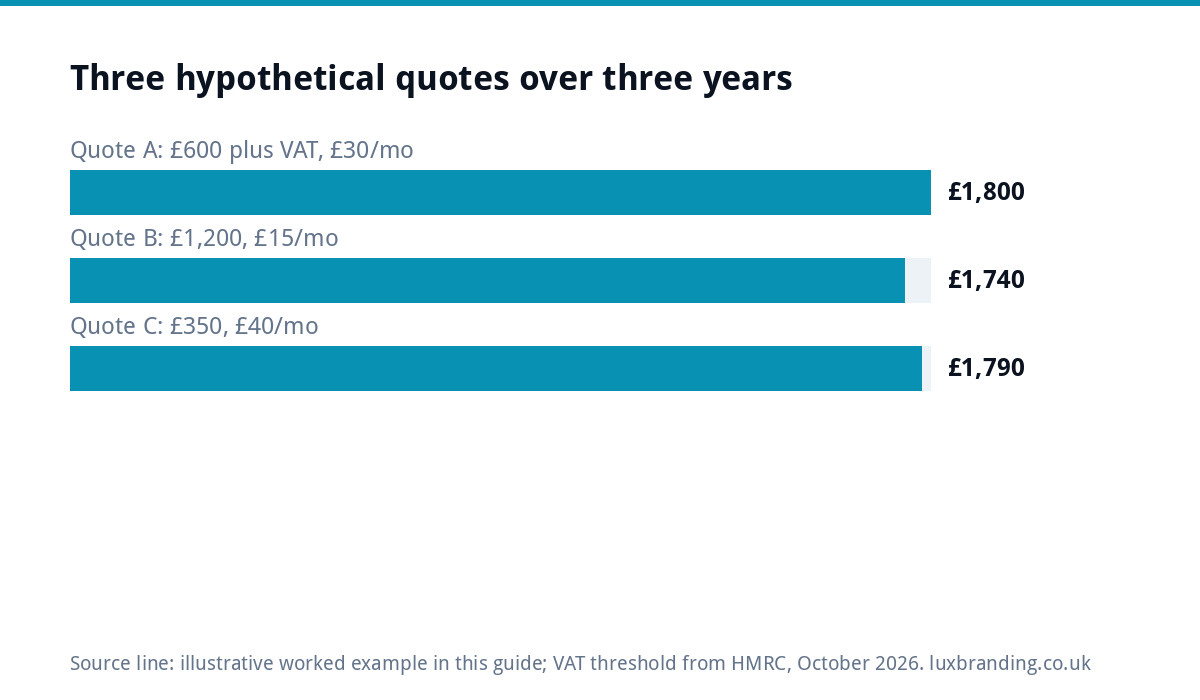
Here is how three hypothetical quotes for an eight-page trades website look once they are put on the same basis. The figures are illustrative, not market data.
| Item | Quote A | Quote B | Quote C |
|---|---|---|---|
| Build price | £600 plus VAT | £1,200, no VAT | £350, no VAT |
| Copywriting | Not included | Included | Not included |
| Hosting and care | £30 a month | £15 a month | £40 a month, 24-month contract |
| Redirects from old site | Not stated | Included | Not included |
| Domain held by | You | You | The designer |
| Three-year total | £1,800 | £1,740 | £1,790 |
Quote A’s total is £720 including VAT plus £1,080 of hosting and care; Quote B is £1,200 plus £540; Quote C is £350 plus £1,440. The cheapest headline price is the most expensive to own once hosting is counted, and it keeps your domain in someone else’s name. Quote B is the best value even though it looked the dearest, because copywriting and redirects are included. For a quick estimate of what your own project should cost, try our website cost calculator.
Questions to send every designer
- How many pages are included, and who writes the text?
- Is the design custom or based on a theme, and how many rounds of changes are included?
- Which platform and build method will you use, and will I own the code and logins?
- Will the domain be registered in my name?
- What does hosting cost after the first year?
- Exactly what does your SEO set-up include, and will you redirect my old pages?
- Are a privacy policy and cookie consent included?
- What support is free after launch, and what does it cost afterwards?
- Is VAT included in your price?
Send the same list to everyone. The way each designer answers is useful evidence too: clear, specific replies tend to predict a smoother project.
How our quote reads on the same sheet
Our Custom WordPress Website is £499 one-off for up to eight pages, built in two to four weeks. It is hand-coded with no page builder, you own the code and can host it anywhere, and it includes custom design, a mobile-first build, an SEO foundation (schema, meta, sitemap), contact forms connected to your inbox, Google Analytics, a written CMS walkthrough and 30 days of support. Hosting is optional: Website Management & Hosting is £20 a month. Bigger sites are quoted in writing before any work starts, and every price is on our pricing page.
Get the UK Website Project Brief Template (free)
A two-page template for briefing any UK web designer: sitemap, integrations, audience and deliverables. Cuts revision rounds in half.
No spam. UK GDPR compliant. We only use your email to send this resource, unless you tick the box to hear from us.
Frequently asked questions
Why do web design quotes vary so much? +
Because each designer assumes a different job. Quotes differ on the number of pages, whether copywriting is included, the build method, hosting after year one, SEO set-up, legal pages, support and VAT. Putting each quote on the same eight lines shows whether the gap is real or just a difference in what is included.
Should I always choose the cheapest website quote? +
Not on the headline figure alone. Add three years of hosting and support, check whether copywriting and redirects are included, and confirm who will own the domain. A low build price with a high monthly fee and a long contract can cost more over three years than a quote that looked dearer.
Do web designers charge VAT? +
Only if they are VAT-registered. HMRC guidance says a business must register once taxable turnover passes £90,000 in a 12-month period, so many small studios and freelancers do not charge VAT while larger agencies add 20%. If you cannot reclaim VAT, compare the totals you will actually pay.
What should a website quote include? +
At minimum: the pages and who writes them, the design approach and rounds of changes, the platform and who owns the code, domain ownership, hosting costs after year one, the SEO set-up, privacy and cookie pages, support after launch, the timeline, payment terms and whether VAT is included.
What does a Luxbranding website quote include? +
Our Custom WordPress Website is £499 for up to eight pages, built in two to four weeks, hand-coded with no page builder. It includes custom design, mobile-first build, an SEO foundation, contact forms, Google Analytics, a CMS walkthrough and 30 days of support. Hosting is optional at £20 a month.