
Quick answer
Most small-business websites get little traffic because Google has little reason to show them: too few pages matching what people actually search, a thin Google Business Profile, few reviews or links, and titles nobody clicks. Start in Google Search Console. Impressions without clicks point to titles or rankings; no impressions at all point to indexing or demand.
This guide is for a site that has been live a while and has never had much traffic. If your visits fell off a cliff recently, that is a different problem with different causes, covered in our guide to website traffic that dropped suddenly.
First, check the traffic really is low
Before fixing anything, make sure the number you are worried about is real. Two common reasons a site looks quieter than it is:
- Cookie consent. Under UK rules, analytics cookies generally need consent. The ICO’s guidance on cookies and similar technologies explains that cookies which are helpful but not essential still require consent. Visitors who decline are not counted by consent-based analytics, so the dashboard can show far fewer visits than the site really gets.
- The wrong tool or property. Analytics installed on the old site and never moved, or a tag missing from some pages.
Cross-check with sources that do not rely on cookies: Search Console clicks, calls tracked from your Google Business Profile, and the enquiries in your inbox. If those are healthy, your problem is measurement, not traffic.
Read Search Console in ten minutes
Google Search Console is free and shows how your site performs in Google Search. Its Performance report gives four numbers: clicks, impressions, click-through rate and average position. Set the date range to the last three months and read the pattern:
| What you see | What it usually means | Where to look next |
|---|---|---|
| Almost no impressions | Pages not indexed, or nothing on the site matches real searches | Causes 1 and 2 |
| Impressions only for your business name | Google knows you exist but you do not rank for the jobs you do | Causes 2, 3 and 4 |
| Plenty of impressions, few clicks | Ranking on page two or lower, or titles that do not earn the click | Causes 4 and 5 |
| Impressions for searches you do not serve | Pages written around the wrong terms | Cause 2 |
| Steady clicks but no enquiries | A conversion problem, not a traffic problem | The page itself |
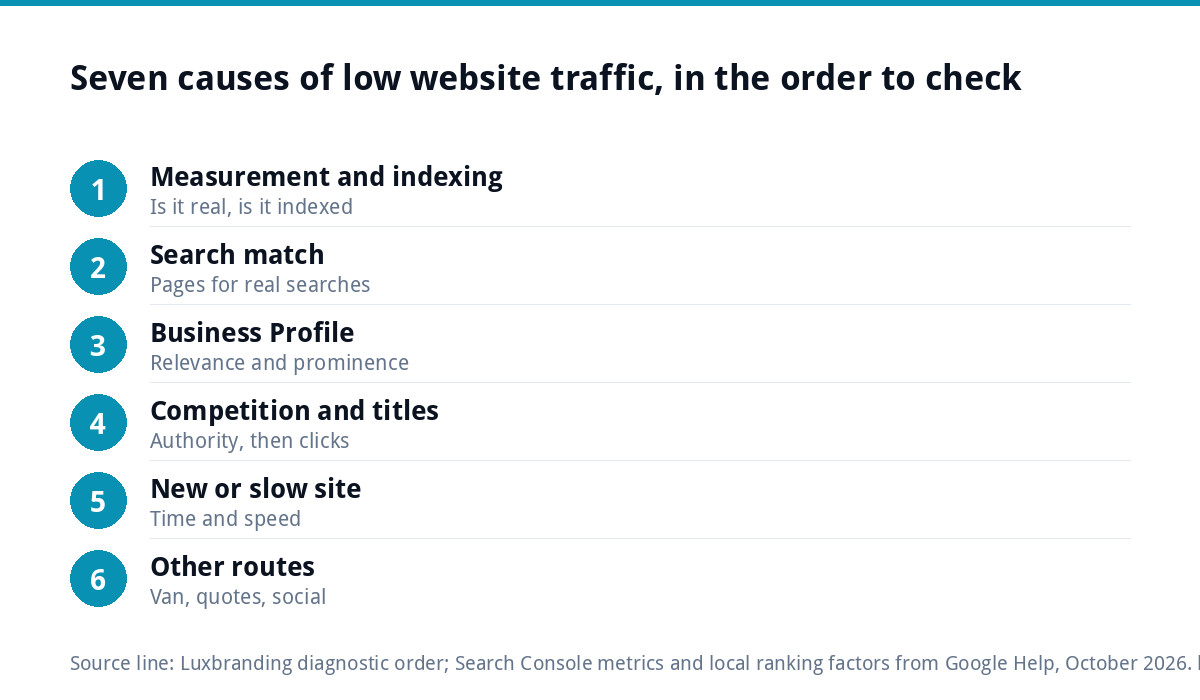
Cause 1: Google has not indexed your pages
If Google has not added your pages to its index, they cannot appear at all. Common culprits are a “discourage search engines” setting left on after launch, a noindex tag, or a brand-new site Google has not crawled yet. We cover the full diagnosis in website not showing on Google, so here is the short version: search site:yourdomain.co.uk and use the URL Inspection tool in Search Console on your key pages.
Cause 2: nothing on the site matches what people search
This is the most common cause for small businesses. The home page says “Quality workmanship you can trust” and the services page lists eight jobs in one paragraph. Nobody searches for “quality workmanship”. They search “kitchen fitter Swindon” or “consumer unit replacement cost”.
The fix is a page for each main service, written around the words customers use, with the towns you cover named in the text. Each page should explain the job, show real photos, give a rough idea of price or timescale, and answer the questions you hear on the phone. Search Console’s query list will show you which terms you already appear for, which is the best place to start.
A quick example. A landscaper in Kent had one services page listing patios, fencing, turfing and garden clearance in a single paragraph, and appeared only for its own name. Splitting that into four pages, each describing the job, the materials, typical timescales and photos from local gardens, gives Google four clear answers to four different searches instead of one vague one. Expect the effect over months rather than weeks, and keep adding real job photos as you go.
Cause 3: a weak Google Business Profile
For local searches, the map results often get the attention before any website does. Google’s own guidance on improving local ranking says local results are mainly based on relevance, distance and prominence. You cannot change distance, but you can improve the other two: correct categories, a full list of services, real photos, regular posts and a steady flow of genuine reviews.
A strong profile also sends visitors to your website, so fixing it often lifts site traffic too. Our Google Business Profile optimisation guide walks through every field, or our Google Business Profile setup and optimisation service does it for £199.
Cause 4: competitors are simply more established
Sometimes the site is fine and the competition is stronger. Firms that have traded online for years usually have more reviews, more pages, and more links from other websites such as suppliers, trade bodies, local news and directories. Google reads those as signs a business is well known.
You will not close that gap in a month. You can start: ask suppliers and associations you belong to for a listing with a link, get your accreditation profiles pointing at your site, and build reviews steadily rather than in bursts. Pick a narrower target first, such as one service in two or three towns, rather than the whole county.
Good places to earn a genuine link usually include:
- Trade bodies and accreditation schemes that list members.
- Suppliers and manufacturers with an installer or stockist finder.
- Local business groups, chambers of commerce and sponsorships you already support.
- Customers who are businesses themselves and are happy to credit your work.
Cause 5: titles and descriptions nobody clicks
If Search Console shows impressions but very few clicks, look at how your pages appear in results. A page titled “Home” or “Services” tells a searcher nothing. Compare it with “Boiler Repair in Bolton: Same-Week Visits, Gas Safe” and it is obvious which earns the click.
Rewrite the title of each important page to say what the page offers, where, and one reason to choose you. Keep the claims honest and specific. Then give it a few weeks and check the click-through rate again.
The description under the title matters too. Google may rewrite it, but a clear one that mentions the job, the area and the next step gives it something good to work with.
Cause 6: the site is new, or too slow to wait for
New sites take time. Google’s SEO starter guide notes that some changes take effect in hours and others take months, so a site launched six weeks ago with no traffic is normal rather than broken.
Speed is the other quiet cause. A page that takes a long time to load on a phone loses visitors before they arrive, and slow sites tend to perform worse in search over time. Our guide to website speed for small businesses lists the fixes that matter; our speed optimisation service is £99 if you would rather hand it over.
Cause 7: you are relying on Google alone
Search is one route. For many trades and local firms, plenty of website visits can come from elsewhere: the link on your van, your quotes and invoices, your email signature, social media posts, local Facebook groups and repeat customers. If none of those point at your website, traffic stays low even when search is working.
Put your web address everywhere you already appear. It costs nothing and makes every job a small advert for the site.
What each fix costs and how long it takes
| Fix | DIY cost | Time to see a change | Our option |
|---|---|---|---|
| Check indexing and measurement | Free | Days | Free SEO audit |
| Rewrite titles and descriptions | Free, a few hours | A few weeks | Part of SEO |
| Complete Google Business Profile | Free, a day | Weeks | £199 setup and optimisation |
| Add proper service pages | Your time | One to three months | Part of a website build |
| Speed up the site | Varies | Weeks | £99 speed optimisation |
| Build reviews and links steadily | Your time | Months | SEO from £249 a month |
Where to start this week
Do the free checks first: confirm the traffic is genuinely low, read the Search Console pattern, and fix anything blocking indexing. Then tackle the cause the data points to, one page at a time.
If you want the ongoing work done for you, our SEO service is £249 a month and covers rankings, content, technical health, link building and reports. Our guide to what SEO costs in the UK shows how that compares with the wider market. Every price is on our pricing page. Order online or email us at support@luxbranding.co.uk with your web address.
Get the UK SEO DIY Audit Checklist (free)
A 32-point checklist UK SMEs can run against their own website in an afternoon. Surfaces the quick wins before paying for a paid audit.
No spam. UK GDPR compliant. We only use your email to send this resource, unless you tick the box to hear from us.
Frequently asked questions
Why is my website getting no traffic? +
The usual reasons are that Google has not indexed the pages, nothing on the site matches what people search for, the Google Business Profile is thin, competitors are better established, or titles do not earn clicks. Check Google Search Console first: the pattern of impressions and clicks shows which of these applies to your site.
How do I check if my website traffic is really low? +
Compare your analytics with sources that do not rely on cookies, such as Search Console clicks, calls from your Google Business Profile and enquiries in your inbox. Analytics that waits for cookie consent does not count visitors who decline, so it can show far fewer visits than your site really receives.
How long does it take for a new website to get traffic? +
It varies. Google's own guidance says crawling can take days to weeks and that some changes take months to show an effect. A site launched a few weeks ago with little search traffic is normal. Promote it through your Google Business Profile, quotes, van and social media while search catches up.
Will a Google Business Profile bring traffic to my website? +
Often, yes, for local businesses. The profile appears in map results and links to your website. Google says local results are mainly based on relevance, distance and prominence, so complete categories, services, photos and genuine reviews help the profile show up, which in turn sends visitors to the site.
Can Luxbranding help get more traffic to my website? +
Yes. Our SEO service is £249 a month and covers rankings, content, technical health, link building and reports. Google Business Profile setup and optimisation is £199, and website speed optimisation is £99. You can also run our free SEO audit first to see the main issues on your site.