Quick answer
Do not ignore the letter and do not pay on the spot. Take the image down, work out where it came from, then ask the sender for proof that they own it and evidence of your use. If you hold a licence, send it. If you do not, negotiate in writing towards a fair licence fee.
A copyright claim over a photo on your website feels like an accusation, and the first instinct is either to panic-pay or to bin it. Neither is the right move. Below is the calm order of work most small UK businesses can follow, a table of responses by situation, and an image audit so it does not happen twice. This is general guidance, not legal advice; for a large or disputed claim, speak to a solicitor.
What the letter actually is
These letters usually come from a photo library, a photographer, or a licence-compliance agency acting for one of them. Image-matching software crawls the web, finds their photo on your site, and checks it against their list of paying customers. If your domain is not on the list, a letter or email goes out asking for payment for past use.
The claim rests on how copyright works in the UK. According to GOV.UK’s copyright page, protection is automatic: there is no register and the creator does not need to apply or pay a fee. So “I found it on Google” is not a defence, and neither is the absence of a watermark or a copyright symbol.
That does not mean every letter is right. Agencies sometimes chase images that were properly licensed through a website theme, a stock subscription or a designer. The steps below are about finding out which kind of letter you have.
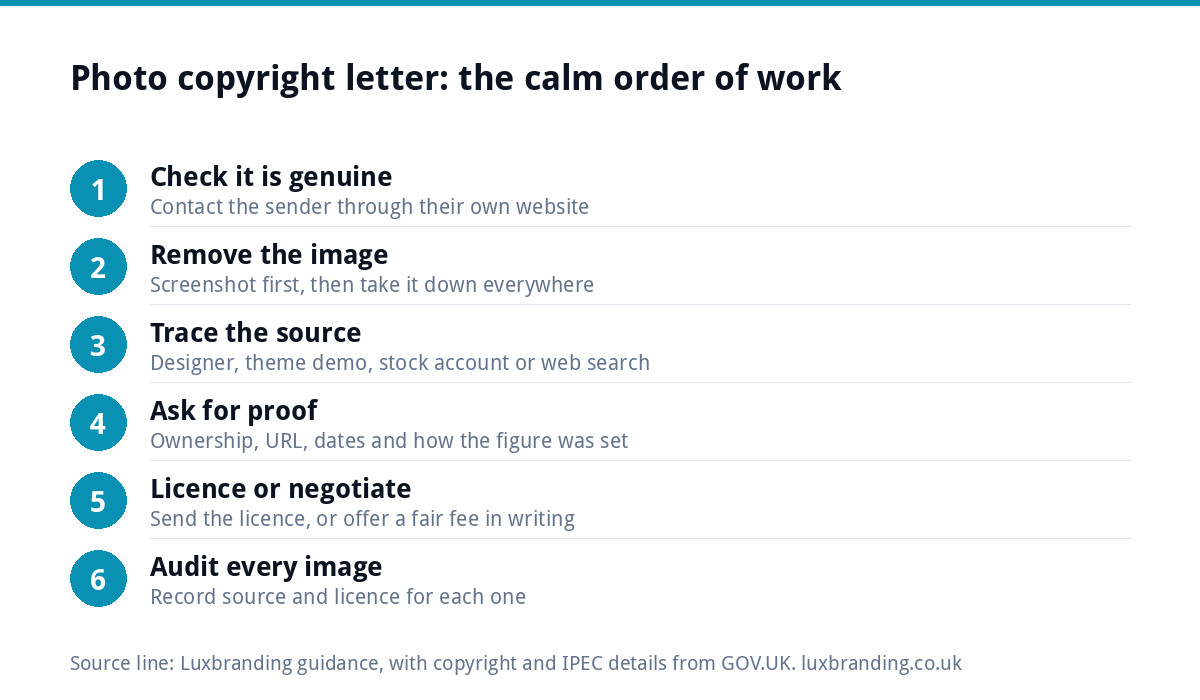
Step 1: check the letter is genuine
Scammers copy the format of these letters because they work. Before you reply:
- Look up the sender’s company yourself and contact them through their own website, never through a link or phone number in the email.
- Check the letter names a specific image, the page it was on and a date it was found. A vague “you are using our content” is a red flag.
- Never pay through a link in an unexpected email, and never hand over login details.
If it checks out, note the deadline in the letter. Short deadlines are a pressure tactic, but replying within it keeps the conversation calm.
Step 2: take the image down, everywhere
Remove the photo from the page, then from the places it tends to hide: the media library, old blog posts, social posts, email newsletters, PDFs and Google Business Profile photos. Removing it does not erase the past use, so it does not end the claim, but it stops any further use and shows good faith.
Take dated screenshots before you delete anything. You may need them to show where the image appeared and for how long.
Step 3: find out where the image came from
Most small businesses never chose the photo themselves. Work back through the likely sources:
- A web designer or agency who built the site. Ask them, in writing, where the image came from and whether a licence was bought.
- A theme or template demo. Many themes ship with sample images that are licensed for the demo only, not for your live site.
- A stock subscription you or a former staff member paid for. Search old emails for receipts and download records.
- A social post or Google image search, which is the case with no defence.
If you are struggling because nobody can get into the site to check, our guide to what to do when you cannot update your own website covers getting back control first.
Step 4: ask them to prove the claim
You are entitled to see the basis of the claim before you pay. A short, polite reply works best. Ask for:
- Evidence that they own the copyright or are authorised to act for the owner.
- The exact image, the URL where it appeared and the date or dates of the alleged use.
- How they calculated the figure they are asking for.
Do not admit liability in that first reply, and do not argue. Something like: “We have removed the image while we look into this. Please send proof of ownership and details of how your figure was calculated.” Keep every message in writing.
How to respond, by situation
Once you know where the image came from, the right response is usually clear.
| Your situation | What to send | Likely outcome |
|---|---|---|
| You bought a licence that covers this use | The licence, receipt and licence ID | Claim usually withdrawn |
| Your designer supplied the image | Ask the designer for their licence; reply with it or say you are checking | Withdrawn if licensed; if not, raise it with the designer under your contract |
| It came with a theme demo | Theme licence terms showing what the image covers | Often a demo-only licence, so expect to negotiate |
| No licence, image taken from the web | An acknowledgement and a reasoned offer | Negotiated settlement |
| Sender cannot prove ownership | A request for proof, then nothing more until it arrives | Claim often goes quiet |
The designer route matters. If a supplier put an unlicensed image on your site, you are still the one publishing it, but your contract with them may let you recover the cost. Read what you signed before you reply to anyone.
Step 5: negotiate a fair figure
If the claim is valid and you have no licence, you are negotiating, not just paying. The starting point most people argue from is what a proper licence for that image, used that way and for that long, would have cost. A photo on a small trades site for a few months is not the same as an image in a national ad campaign.
- Look up what the same library charges for a standard web licence today, and quote it.
- Point out the image has been removed, how long it was up and that the use was small and local.
- Make one reasoned offer in writing, marked “without prejudice”, and ask for written confirmation that payment settles the claim in full.
Many claims settle at this stage. If the other side refuses to move from a figure that looks far above any licence fee, that is the point to take advice.
Step 6: if it goes further
Most claims never reach court, but it helps to know what would happen. In England and Wales, smaller intellectual property disputes can go to the Intellectual Property Enterprise Court’s small claims track. The HM Courts & Tribunals Service guide to IPEC small claims describes it as the route for an intellectual property dispute worth under £10,000, and explains how a claim is started and served.
If you receive a formal claim form rather than a letter, the deadlines are real and short. Speak to a solicitor at that point. The Intellectual Property Office’s copyright notice on digital images and photographs is a useful plain-English background read, though it says itself that it is not a substitute for legal advice on a particular case.
Do this week: the image audit
One letter often means more images are at risk, because the same source supplied several. Go through every image on the site and sort it into one of these rows.
| Image source | Proof you need | Action |
|---|---|---|
| Your own photos | Nothing beyond the originals | Keep |
| Paid stock | Receipt and licence ID | Keep and record the licence |
| Free libraries with a clear licence | Screenshot of the licence terms on the download date | Keep and record the source |
| Supplied by a designer | Their written confirmation of the licence | Keep if confirmed; otherwise replace |
| Theme demo images | Theme licence covering live use | Usually replace |
| Unknown | None | Replace now |
Keep a simple spreadsheet: image file name, page, source, licence ID and date. Ten minutes per new image saves a letter later. The website launch checklist includes image licensing for exactly this reason.
Replace stock with your own work
For trades and small local firms, your own photos are both the safest and the most convincing choice: real vans, real jobs, real premises. A decent phone, good daylight and a tidy site are enough for most pages. Customers trust a photo of the kitchen you actually fitted more than a perfect stock kitchen.
Your brand matters here too. Copyright in a logo works the same way as in a photo, which our guide to logo copyright and trademarks in the UK explains, including who owns a design once it is paid for.
When the letter is a sign the site needs rebuilding
Sometimes the letter exposes a bigger problem: a site full of unknown images, built by someone you can no longer reach, that nobody in the business can edit. Patching that site image by image can cost more time than starting clean.
Our custom WordPress website is £499 one-off for up to 8 pages, hand-coded with no page builders, and you own the code. It includes custom design, a mobile-first build and a written CMS walkthrough, so you can swap images yourself afterwards. If you want ongoing care, website management and hosting is £20 a month with UK hosting, daily backups and automatic updates. Every price is on our pricing page, and the website cost calculator gives a figure for your own page count in a minute.
The short version
- Check the letter is genuine.
- Remove the image everywhere and screenshot first.
- Trace where it came from.
- Ask for proof of ownership and the basis of the figure.
- Send your licence if you have one; negotiate in writing if you do not.
- Take advice if a claim form arrives, then audit every image on the site.
Get the UK Website Project Brief Template (free)
A two-page template for briefing any UK web designer: sitemap, integrations, audience and deliverables. Cuts revision rounds in half.
No spam. UK GDPR compliant. We only use your email to send this resource, unless you tick the box to hear from us.
Frequently asked questions
Should I ignore a copyright letter about a photo on my website? +
No. Ignoring it tends to make the sender escalate, and if the claim is valid the cost rarely goes down with time. Check the letter is genuine, remove the image, then reply in writing asking for proof of ownership and how the figure was worked out. A short, polite reply keeps the matter calm and on your terms.
Does removing the image end the claim? +
Not on its own. Copyright claims cover past use, so taking the photo down stops further use but does not cancel the period it was already live. Remove it anyway, because it shows good faith and stops the problem growing. Take dated screenshots first, so you can show where it appeared and for how long.
My web designer added the photo. Am I still responsible? +
Usually the business publishing the image is the one the claim is aimed at, even if a supplier chose it. Ask your designer in writing where the image came from and whether a licence was bought. If they supplied an unlicensed image, your contract with them may let you recover the cost. Read what you signed before replying.
How much should I offer to settle? +
Most people negotiate from what a proper licence for that image and that use would have cost. Look up the library's current web licence price, note how long the image was live and that the use was small, then make one reasoned written offer marked without prejudice. Ask for written confirmation that payment settles the claim in full.
Can a photo copyright claim go to court? +
It can. In England and Wales, smaller intellectual property disputes can go to the IPEC small claims track, which HM Courts and Tribunals Service describes as the route for disputes worth under £10,000. Most claims settle long before that. If you receive a formal claim form rather than a letter, the deadlines are short, so speak to a solicitor promptly.